50 | Section 5
These latest-generation cancellers are a miracle. You can have ear-splitting volume with very
little of the caller audio making it back to the other end. They work with up to 20kHz audio
bandwidth, so are ready for the wideband VoIP codecs now coming online. And they solve a
longstanding problem: Older ‘time-domain’ AECs depended upon the acoustic path remaining
invariant and could quickly degenerate into feedback when a microphone was slightly moved
or the acoustic path changed from some other cause. The ‘frequency-domain’ technology used
by the new AECs works just fine with moving microphones and other echo path changes.
This new AEC technology is particularly useful for TV studio applications where it can be
impractical to have talk show guests using earplugs. Today’s high-performance AECs let talent
and guests listen to phone calls on foldback loudspeakers.
AECs are provided within the VX Engine, but they are not connected into its internal signal
paths. This is because they need to be placed in the signal paths between the studio loud-
speakers and microphones. With Axia mixing consoles, the insert and return points are
provided with Livewire channels and are installed by configuring the appropriate channel
numbers. The AEC can be used with Non-LW consoles via LW Nodes connected to the appro-
priate audio signal paths.
(??) AECs are possible from a single VX Engine. Additional Engines could be used to provide
more. Please contact us to discuss your options, should you want to do this.
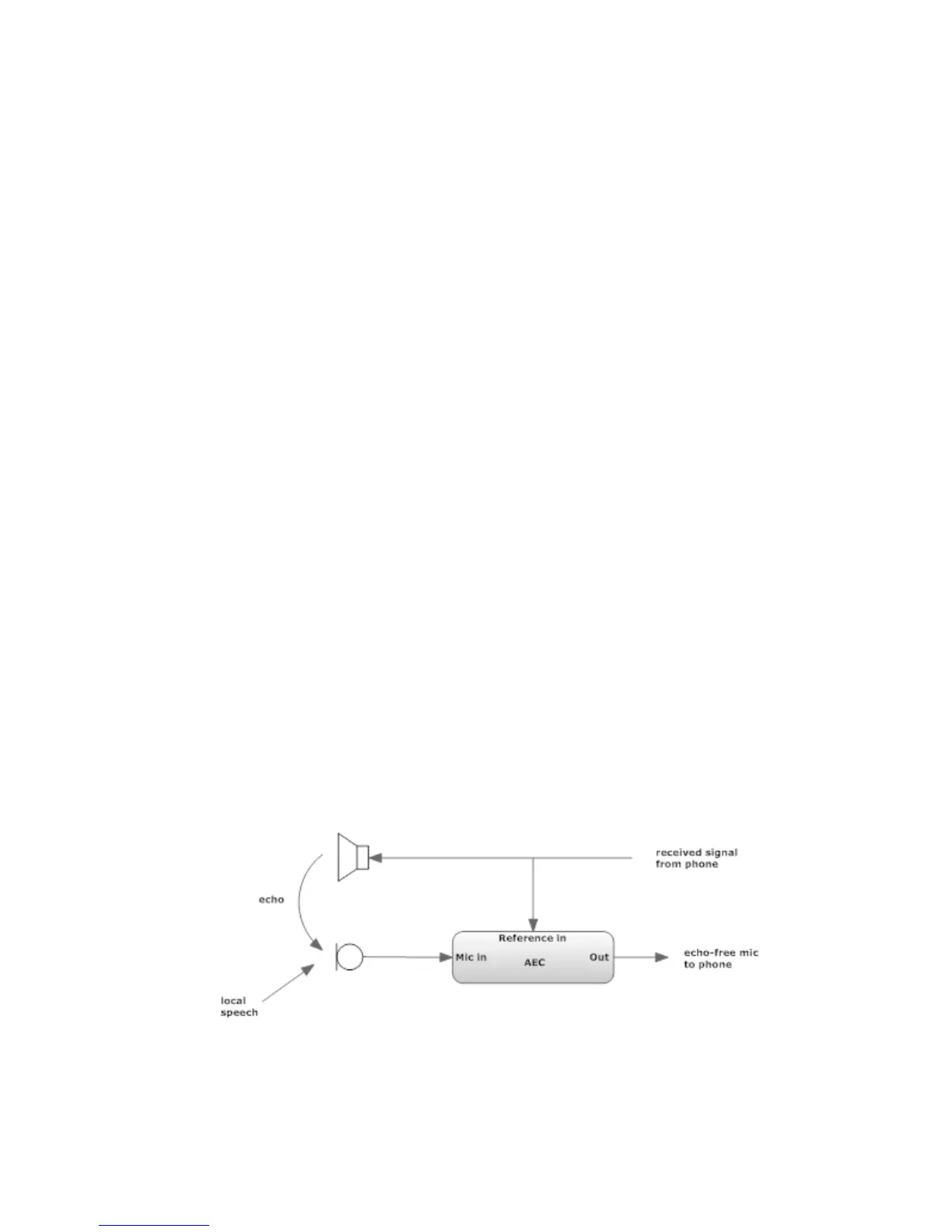
There are three connections for each AEC:
♦ Microphone input (from the studio mic)
♦ Microphone output (feeds the console mic input that goes to the phone system)
♦ Reference input (parallels the signal that feeds phone audio to the studio loudspeaker)
If multiple mics are used, there must be an AEC dedicated to each of them.
The AEC cancels audio that is put on the reference input so that it does not appear on the
output. Without canceling, the output would be a mix of the studio mic and the delayed/echoed
phone audio. After cancellation, only the mic audio will be present. That is; it creates a replica
of the acoustic path, then passes the reference audio through it and subtracts the resulting
filtered signal from the microphone feed.
The AECs are full-range and low-distortion, so they can be put in an air signal path if need be.
Nevertheless, we recommend that they be inserted only into the mic-to-phone path if possible,
avoiding causing any trouble to mic-to-air fidelity. (There could be subtle frequency response
alteration depending upon the echo path and other factors. Noise might also be added.)


 To Next Page