NOTES, RESOURCES, ADDITIONAL INFORMATION | 73
When communicating through a proxy server, the caller sends an INVITE request to the proxy
server and then the proxy server determines the path and forwards the request to the called party.
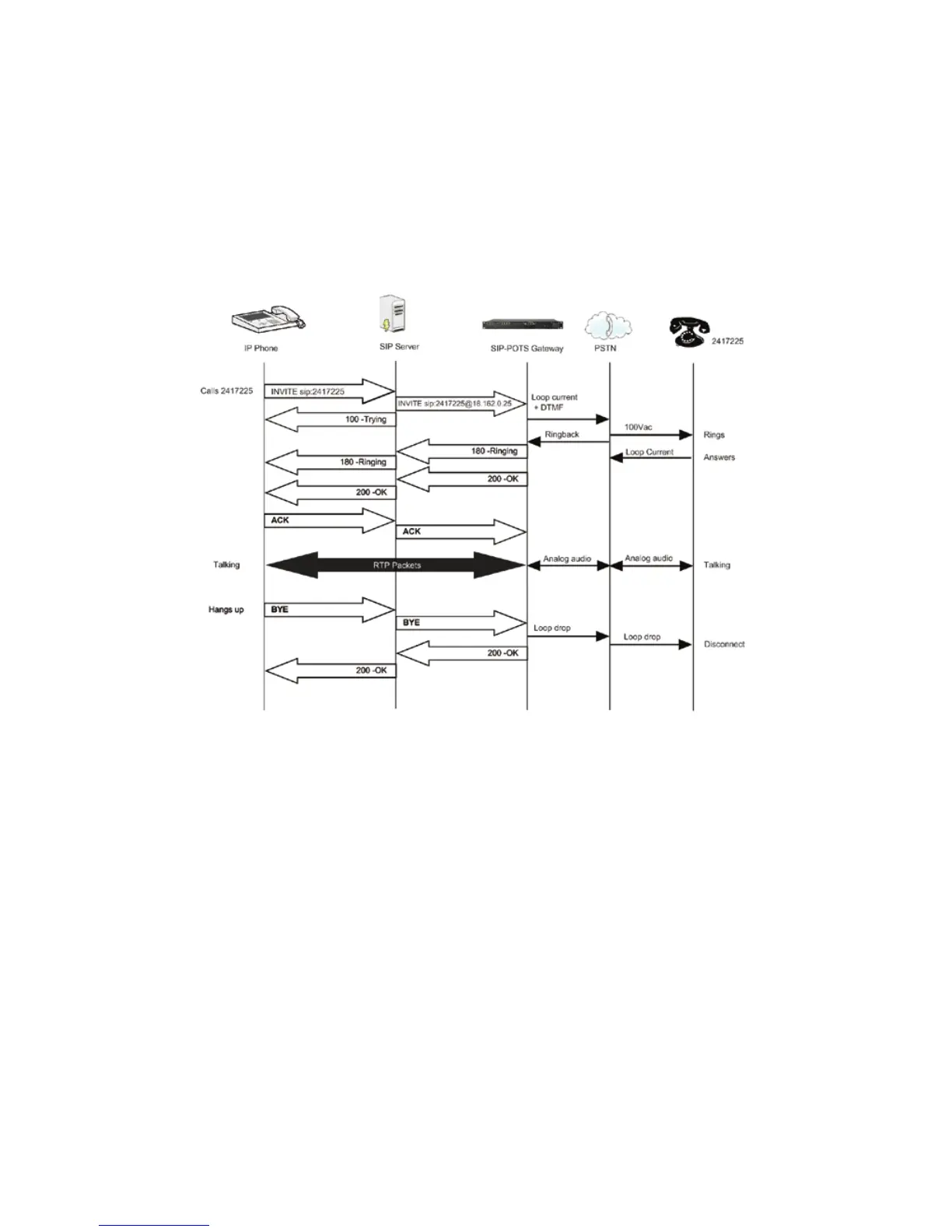
Since we usually need to reach phones that are connected to the PSTN, gateways will be
involved in real world systems. These translate SIP signaling to the PSTN’s requirements: loop
current, DTMF, and ring detect for POTS lines, set-up messages for ISDN, etc.
A SIP call set-up to the PSTN via a SIP server and a gateway to POTS lines.
SIP messages may be carried by UDP or TCP. SIP has its own built-in reliability mechanisms, so
it doesn’t need TCP’s reliability services. Most SIP devices such as phones and PC clients use
UDP for transmission of SIP messages. PBXs on LANs almost always use UDP because LANs
don’t drop packets and there is no need to incur the overhead of TCP. Transport Layer Security
(TLS) protocol is sometimes used to encrypt SIP messages. TLS runs on top of TCP. (This is the
protocol used with HTTP to make the secure HTTPS used for secure Web transactions.)
Not shown in our transaction examples is the media negotiation that is part of the INVITE/200
OK/ACK sequence. Through this process, endpoints decide which codec to use. The Session
Description Protocol (SDP) defined by RFC 2327 is the way codecs are offered and (hopefully)
accepted by the other end. Usually, the caller sends an SDP message along with its INVITE,
listing the codecs it is prepared to use. The far end chooses one of them and tells the caller
which it prefers in the 200 OK response. The caller can let the far end propose a codec by not
sending an SDP message in its INVITE. It is possible that the two endpoints have no codec in
common and the connection is unable to proceed, but systems are designed so that this does
not happen. For example, almost all phones, gateways and SIP Telco services have G.711 as a
supported codec, so this is an insurance policy that two endpoints will find common ground.
Within a PBX system, designers usually choose one codec as a standard for the system and
stick with it for all connections. For example, the Telos VX studio system uses 8kHz sampling-
rate, 16-bit uncompressed PCM internally for all calls that connect to the PSTN.


 To Next Page