It
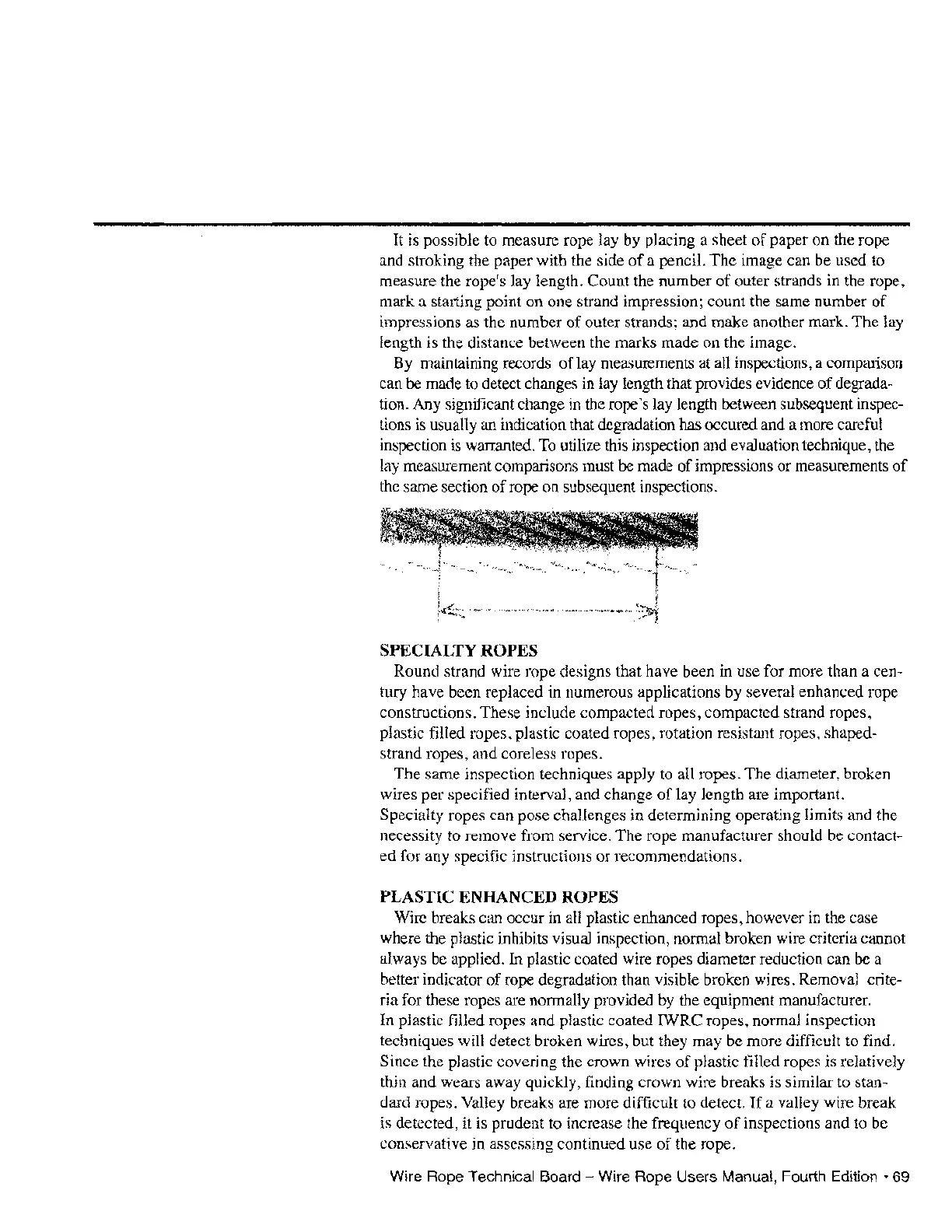
is possible to measure rope lay
by
placing a sheet
of
paper
on
the rope
and stroking the paper with the side
of
a pencil.
The
image can
be
used to
measure the rope's lay length. Count the number
of
outer strands in the rope,
mark a starting point
on
one strand impression; count the same number
of
impressions as the number
of
outer strands; and make another mark.
The
lay
length is the distance between the marks made on the image.
By maintaining records
of
lay measurements at all inspections, a comparison
can be made to detect changes in lay length that provides evidence
of
degrada-
tion. Any significant change in the rope's lay length between subsequent inspec-
tions
is
usually an indication that degradation has occured and a more careful
inspection is warranted.
To
utilize this inspection and evaluation technique, the
lay measurement comparisons must be made
of
impressions or measurements
of
the same section
of
rope on subsequent inspections.
SPECIALTY ROPES
Round strand wire rope designs that have been in use for more than a cen-
tury have been replaced
in
numerous applications by several enhanced rope
constructions. These include compacted ropes, compacted strand ropes,
plastic filled ropes, plastic coated ropes, rotation resistant ropes, shaped-
strand ropes, and coreless ropes.
The
same inspection techniques apply to all ropes. The diameter, broken
wires per specified interval, and change
of
lay length are important.
Specialty ropes can pose challenges in determining operating
limits and the
necessity to remove from service. The rope manufacturer should be contact-
ed
for any specific instructions
or
recommendations.
PLASTIC ENHANCED ROPES
Wire breaks can occur in all plastic enhanced ropes, however iu the case
where the plastic inhibits visual inspection, normal broken wire criteria cannot
always be applied.
In
plastic coated wire ropes diameter reduction can be a
better indicator
of
rope degradation than visible broken wires. Removal crite-
ria for these ropes are normally provided
by
the equipment manufacturer.
In plastic filled ropes and plastic coated IWRC ropes, normal inspection
techniques will detect broken wires, but they may be more difficult to find.
Since the plastic covering the crown wires
of
plastic filled ropes is relatively
thin and wears away quickly, finding crown wire breaks is similar to stan-
dard ropes. Valley breaks are more difficult to detect.
If
a valley wire break
is detected, it is prudent to increase the frequency
of
inspections and to be
conservative in assessing continued use
of
the rope.
Wire Rope Technical Board - Wire Rope Users Manual, Fourth
Edition'
69



 To Next Page