14 Performing the measurement
65
14.2.3 1st BImSchV
• Do not operate the product if there are signs of damage on the
housing, mains unit or connected cables.
• The product must be checked for any visible damage before
commissioning.
• Do not store any solvents (e.g. isopropanol) or items containing
solvents in the case, as the vapours can damage the sensors.
In the case of the 1st BImSchV, the Smart Probe testo 915i (0563
3915) can be connected allowing the combustion air temperature to be
measured in parallel.
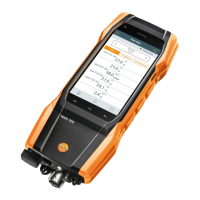
• The measuring instrument has been tested according to the requirements of
VDI 4206 part 1.
• The following fuels are approved for measurements according to the 1st
BImSchV:
• For official measurements in accordance with the first German Federal
Immission Control Ordinance (BImSchV), the measuring instrument must be
checked every six months by a technical testing body of the Guild of Master
Chimney Sweeps or another testing body recognised by the authorities.
To achieve usable measurement results, the measurement period for
flue gas should be approx. 3 minutes and the measuring instrument
should display stable measured values. Readiness for operation is
achieved after a maximum of 10 minutes.



 To Next Page