iCNC PERFORMANCE
5-8 NESTING Manual 0-5399
5.3.5 Rows and Columns
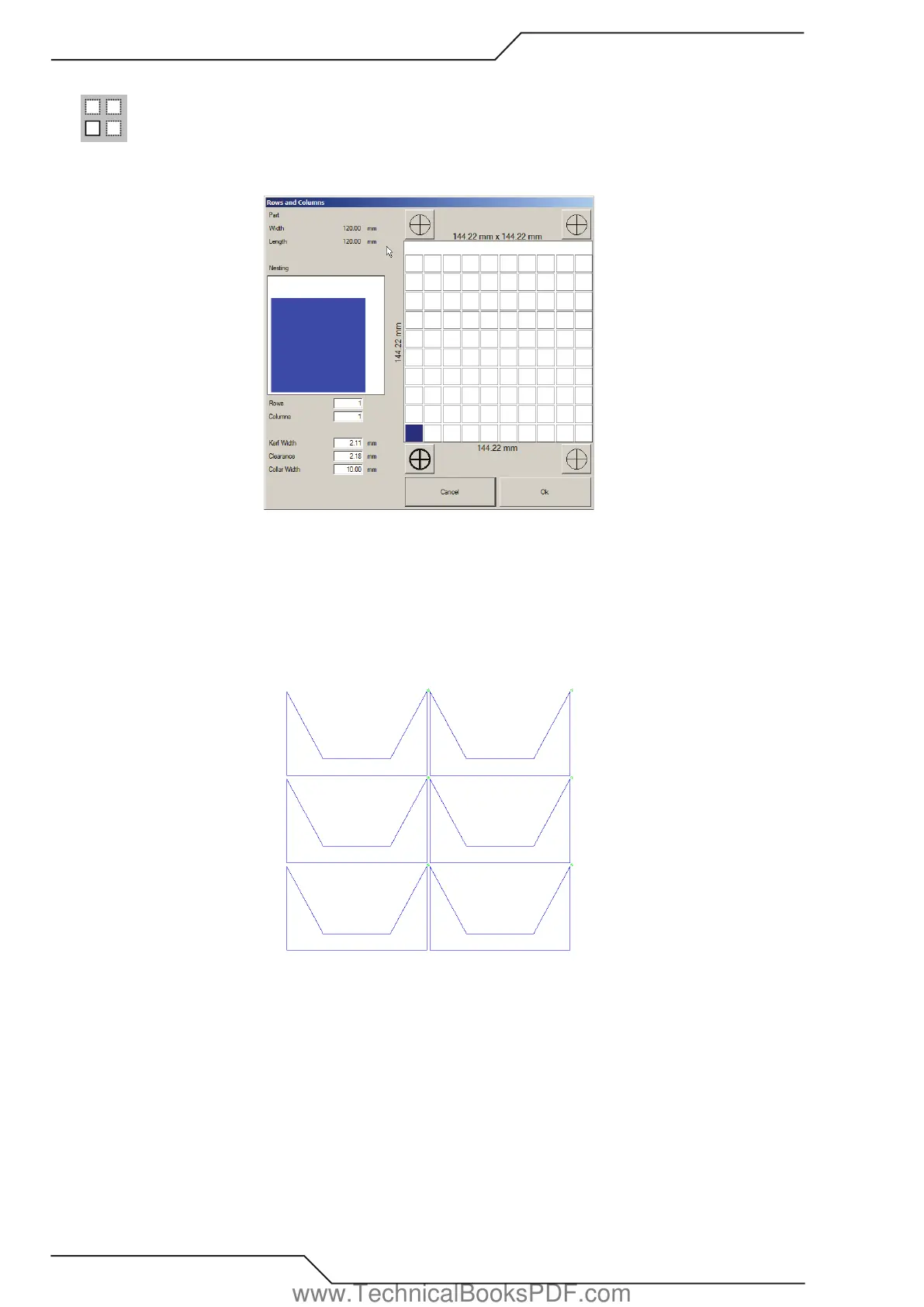
Use this tool to multiply parts. You can set the number of rows and columns. The final number of copies will be rows x columns. For
example 3 rows times 4 columns will result as 3 x 4 = 12 copies.
Rows defines how many rows of copies there will be.
Columns defines how many columns of copies there will be.
Kerf width The minimum kerf width is zero.
Clearance and kerf width define the distance between copies. The distance is clearance + 2 x kerf width. The clearance may also be
negative, if you want to copy the parts closer to each other.
Hint: If you need different clearance values in X and Y directions, then do the columns first (rows = 1, colums = n) and then the rows
(rows = m, columns = 1). This way you will get m x n copies. Please see the below picture as an example of negative Y clearance.
Collar width is an extra distance that is left on the edges of the nesting. This is used to avoid the edges of plate which may not be of
good quality. For example if you have roughly a 50” x 50” plate, but the edges are not perfectly straight, then you can set the collar as
1” and the usable area is then 48” x 48”. The minimum collar is zero, but if the clearance is greater than the collar, then the clearance
is used as the collar.
www.TechnicalBooksPDF.com



 To Next Page