EasyManua.ls Logo

veba SC25 - Blade Selection, Use and Maintenance

veba SC25
40 pages
Print Icon
To Next Page IconTo Next Page
To Previous Page IconTo Previous Page
Loading...
16.5
Scelta,
uso e
manutenzione
della
lama
La
lama
deve
essere
a
norma
EN
847-1
La
scelta
del
tipo
di
lama
dipende
dal
numero
di
taglienti della lama
e
dalla
loro
forma,
che
deve essere scelta
in
relazione
al
materiale
ed
allo
spessore
del
tipo
di
legno
da
tagliare,
secondo
le
indicazioni
fomite
dal
costruttore.
Lo
spessore
del
corpo
della lama
va
scelto
in
funzione
dello
spessore
del
coltello
divisors
e
la
iarghezza
di
taglio
della lama deve
essere
maggiore
rispetto
allo spessore
del
coltello
divisore,
secondo
lo
schema
riportato
inFig.15B
Per
avere
una
maggiore
precisions
nel
taglio,
si
consiglia
di
utilizzare
lame
di
materiale
al
widia.
Per
I'uso
e la
manutenzione della lama,
verificare:
*
il
piazzamento della
macchina,
in
modo
da
evitare
delle
vibrazioni
* se i
denti
perdono
il
filo
o si
scheggiano,
sostituire
immediatamente
la
lama
*
affilare
la
lama
con
macchine
di
precisione,
rispettando le
caratteristiche
angolari
*
pulire
spesso
la
lama,
togliendo le
incrostazioni
per
mezzo
dei
prodotti
speciali
esistenti
in
commercio
*
collocare
la/e
lama/e
nei
loro
contenitori
o
in
apposite
rastrelliere,
in
modo
da
evitare
urti
fra
di
loro
B
16.5 Blade selection,
use and
maintenance
The
blade
must
be EN
847-1
norm
The
type
of
blade
to be
used depends
on
the
number
of
sharp edges
(teeth)
and on
the
shape
it
must have, themselves
relating
to
the
type
and
thickness
of the
material
to
saw.
In
selecting
the
proper blade
it is
also
compulsory
to
strictly follow
the
indications
given
by the
Constructor.
Blade
body thickness shall
be
determined
in
relation
with
the
riving knife thickness
and
blade cutting width shall
be
major than
riving knife thickness,
as
explained
in
fig.
15B.
For
a
better cutting precision
we
recommend
the use of
Widia blades!
For
a
correct
use and
maintenance
of the
blade,
*
Make sure
machine
is
installed
duly,
as
explained
in
this
user's
book,
in
order
to
reduce
the
vibrations
to the
minimum level;
*
Regularly check
the
state
of the
teeth:
wenn
they lose
the
edge
or
become dented,
immediately substitute
the
blade with
a new
one;
* To
sharpen
the
blade
use
only precision
grinding machines
and
respect
the
original
sharpening angle;
*
Regularly clean
up the
blade with
specific products
available
on the
market
to
remove
all
resin incrustations;
*
Store
the
spare
blades
in
their
packaging
box or in
special magazines
in
order
to
avoid
abrasions
and
other contacts
between
them.
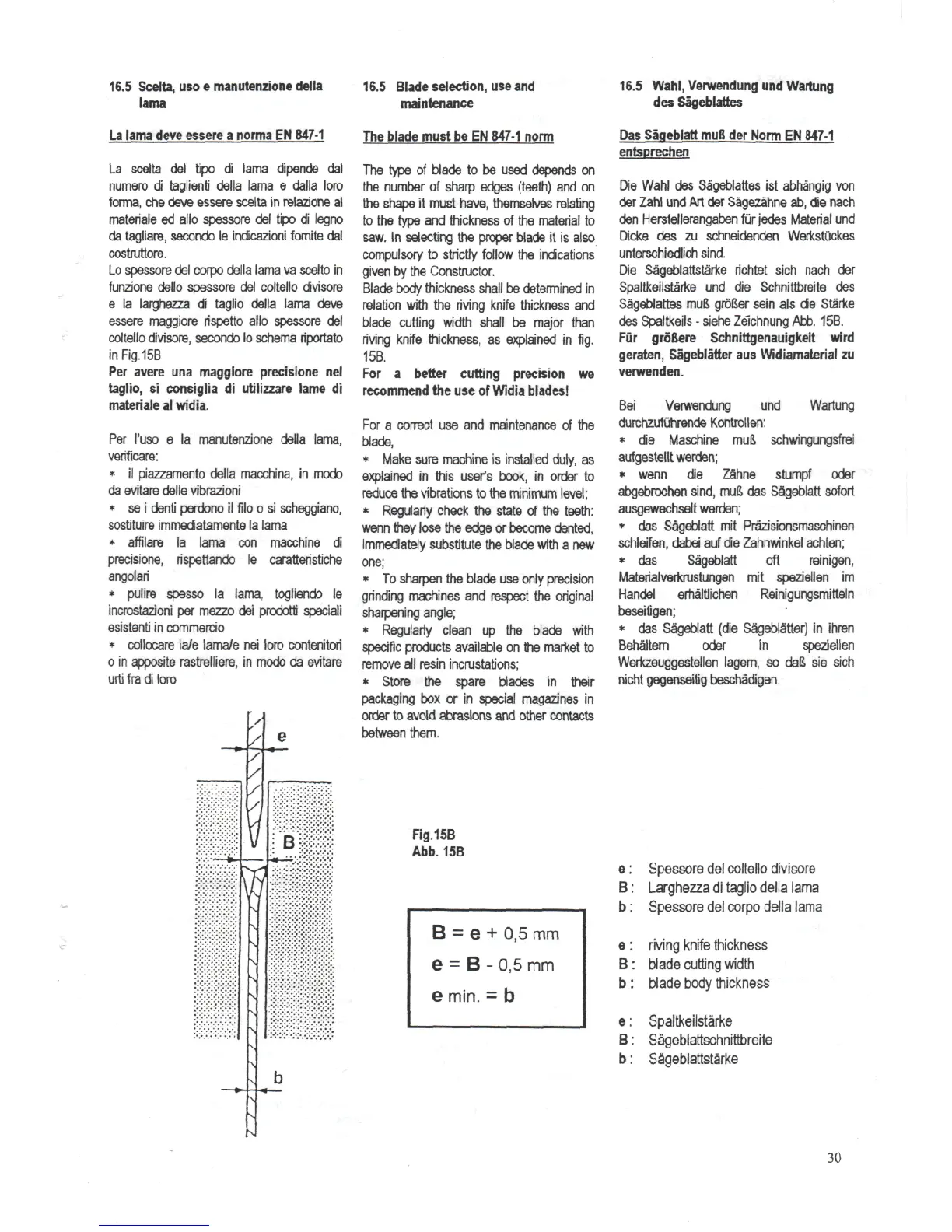
Fig.15B
Abb.
15B
B = e + 0,5
mm
e = B - 0,5 mm
e
min.
= b
16.5
Wahl,
Verwendung
und
Wartung
des
Sageblattes
Das
Saqeblatt
muB
der
Norm
EN
847-1
entsprechen
Die
Wahl
des
Sageblattes
ist
abhangig
von
der
Zahl
und Art der
Sagezahne
ab,
die
nach
den
Herstellerangaben
furjedes
Material
und
Dicke
des zu
schneidenden
Werkstiickes
unterschiedlich
sind.
Die
Sageblattstarke
richtet
sich
nach
der
Spaltkeilstarke
und die
Schnittbreite
des
Sageblattes
mu&
gro&er
sein
als
die
Sta'rke
des
Spaltkeils
-
siehe
Zeichnung
Abb.
158.
Fur
grSBere
Schnittgenauigkeit
wird
geraten,
Sageblatter
aus
Widiamaterial
zu
verwenden.
Bei
Verwendung
und
Wartung
durchzufuhrende
Kontrollen:
* die
Maschine
mu&
schwingungsfrei
aufgestellt
werden;
*
wenn
die
Za'hne
stumpf oder
abgebrochen
sind,
muS
das
Sageblatt
sofort
ausgewechselt
werden;
* das
Sageblatt
mit
Prazisionsmaschinen
schleifen,
dabei
auf
die
Zahnwinkel
achten;
* das
Sageblatt
oft
reinigen,
Materialverkrustungen
mit
speziellen
im
Handel
erhaltlichen
Reinigungsmitteln
beseitigen;
* das
Sageblatt (die
Sagebla'tter)
in
ihren
Behaltem
Oder
in
speziellen
Werkzeuggestellen
lagem,
so
da&
sie
sich
nicht
gegenseitig
beschadigen.
e:
Spessore
del
coltello divisore
B;
Larghezza
di
taglio della
lama
b:
Spessore
del
corpo della
lama
e:
riving
knife
thickness
B
:
blade
cutting width
b:
blade
body
thickness
e:
Spaltkeilstarke
B:
Sageblattschnittbreite
b:
Sageblattstarke
30