BELT
INSTALLATION, ALIGNMENT & TENSIONING
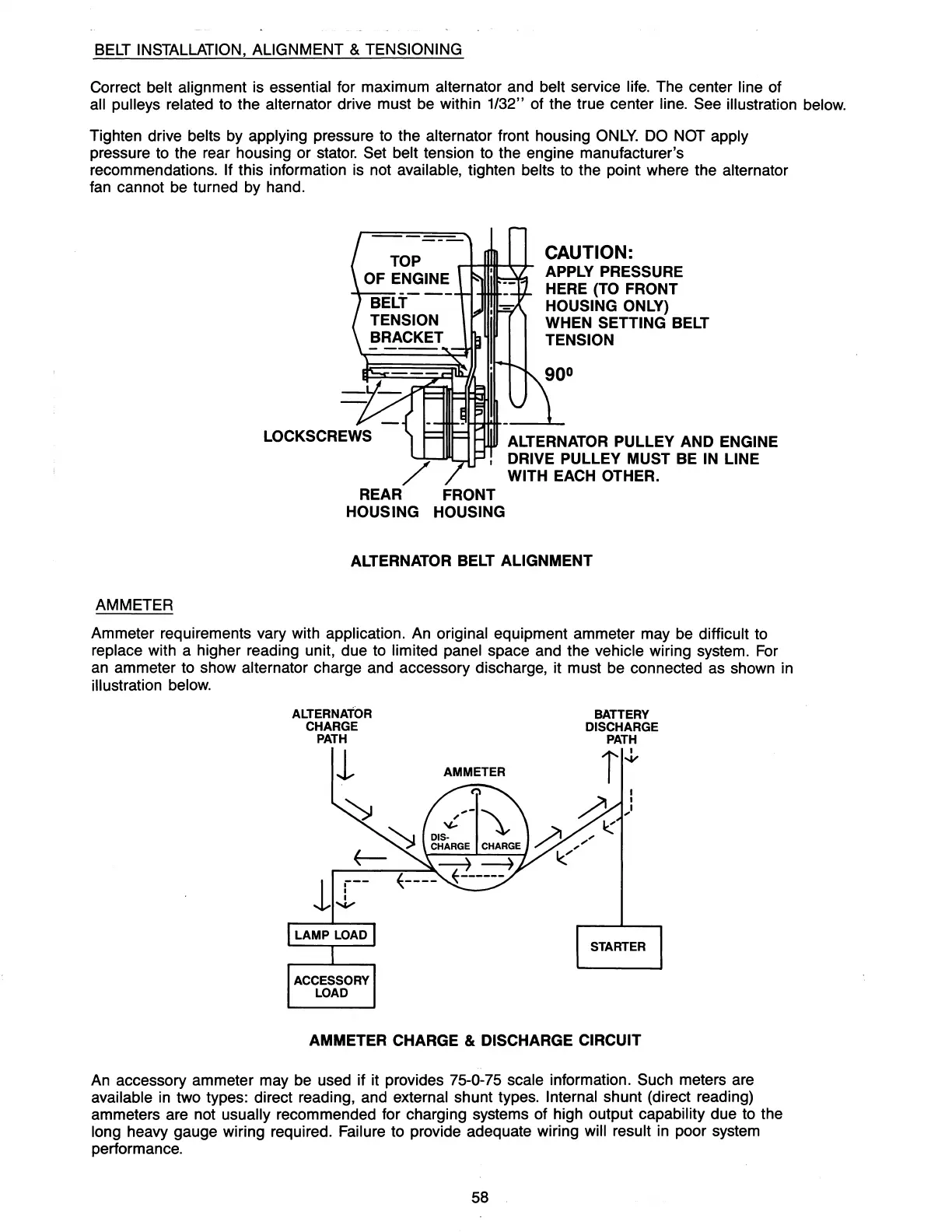
Correct belt alignment is essential for maximum alternator and belt service life. The center line of
all pulleys related to the alternator drive must be within 1/32" of the true center line. See illustration below.
Tighten drive belts by applying pressure to the alternator front housing
ONLY.
DO NOT apply
pressure to the rear housing or stator. Set belt tension to the engine manufacturer's
recommendations.
If this information is not available, tighten belts to the point where the alternator
fan cannot be turned by hand.
AMMETER
CAUTION:
APPLY PRESSURE
HERE (TO FRONT
HOUSING ONLY)
WHEN SETTING BELT
TENSION
ALTERNATOR PULLEY AND ENGINE
/
I DRIVE PULLEY MUST BE IN LINE
WITH
EACH OTHER.
REAR FRONT
HOUSING HOUSING
ALTERNATOR BELT ALIGNMENT
Ammeter requirements vary with application. An original equipment ammeter may be difficult to
replace with a higher reading unit, due to limited panel space and the vehicle wiring system. For
an ammeter to show
alternator charge and accessory discharge, it must be connected as shown in
illustration
below.
ALTERNATOR
CHARGE
PATH
1
~
AMMETER
BATTERY
DISCHARGE
PATH
T~
AMMETER CHARGE & DISCHARGE CIRCUIT
An
accessory ammeter may be used
if
it provides 75-0-75 scale information. Such meters are
available
in
two types: direct reading, and external shunt types. Internal shunt (direct reading)
ammeters are not
usually recommended for charging systems of high output capability due to the
long heavy gauge wiring required. Failure to provide adequate wiring will result in poor system
performance.
58



 To Next Page