2-8
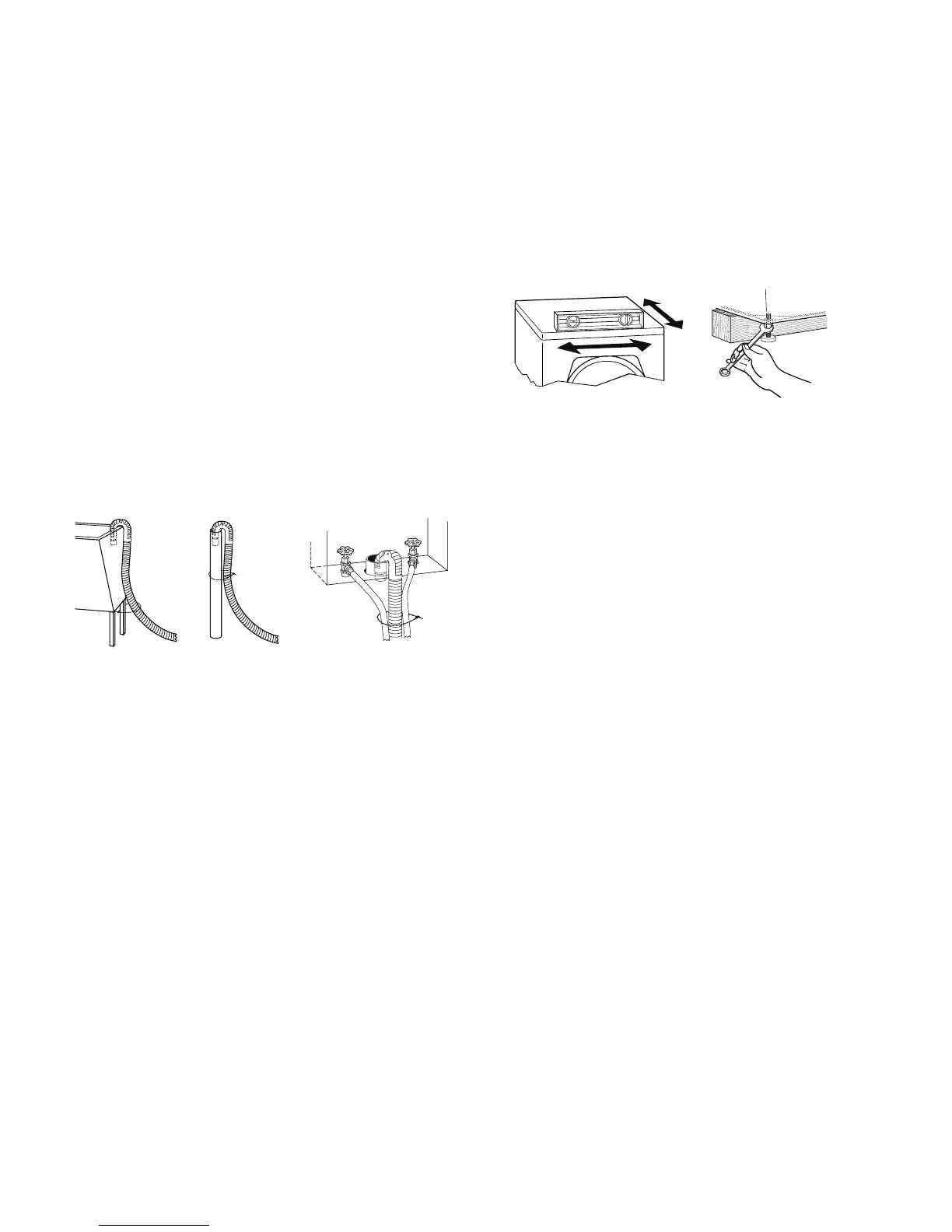
4. If the washer faucets and the drain stand-
pipe are recessed, put the hooked end of
the drain hose in the standpipe. See il-
lustration C.
NOTES:
Do not force excess drain hose back into •
the rear of the washer.
To prevent siphoning, do not seal the drain •
hose into the standpipe.
If the washer is against a wall, move the
washer out slightly before tipping back.
First prop the front with a wood block and
adjust the feet as necessary; then prop
the back and adjust feet as necessary.
Repeat this step until washer is level.
2. Make sure that all four feet are stable and
resting on the floor. Then check that the
appliance is perfectly level (use a level).
3. After the washer is level, use a 13 mm
open-end wrench to turn the nuts on the
feet tightly against the washer cabinet.
IMPORTANT: All four feet must be tight-
ened. If the nuts are not tight against the
washer cabinet, the washer may vibrate.
4. Slide the washer to its final location.
5. The washer should not move front to
back, side to side, or diagonally when
pushed on its top edges.
6. Confirm the levelness of the washer.
To keep drain water from going back into
the washer:
Do not straighten the drain hose, and do •
not force excess drain hose into standpipe.
Hose should be secure, but loose enough
to provide a gap for air.
Do not lay excess hose on the bottom of •
the laundry tub.
Floor drain
You may need additional parts. See Floor
Drain under “Tools and Parts,” page 2-1.
SECURE THE DRAIN HOSE
1. Drape the power cord over the washer
top.
2. Move the washer to its final location.
3. Place the drain hose in the laundry tub or
standpipe. See illustrations A and B.
LEVEL THE WASHER
Properly leveling your washer avoids exces-
sive noise and vibration.
1. Check the levelness of the washer by
placing a level on the top edge of the
washer, first side to side, then front to
back.













 To Next Page