POWER
TRAIN
4-1. SHEAVE
ALIGNMENT
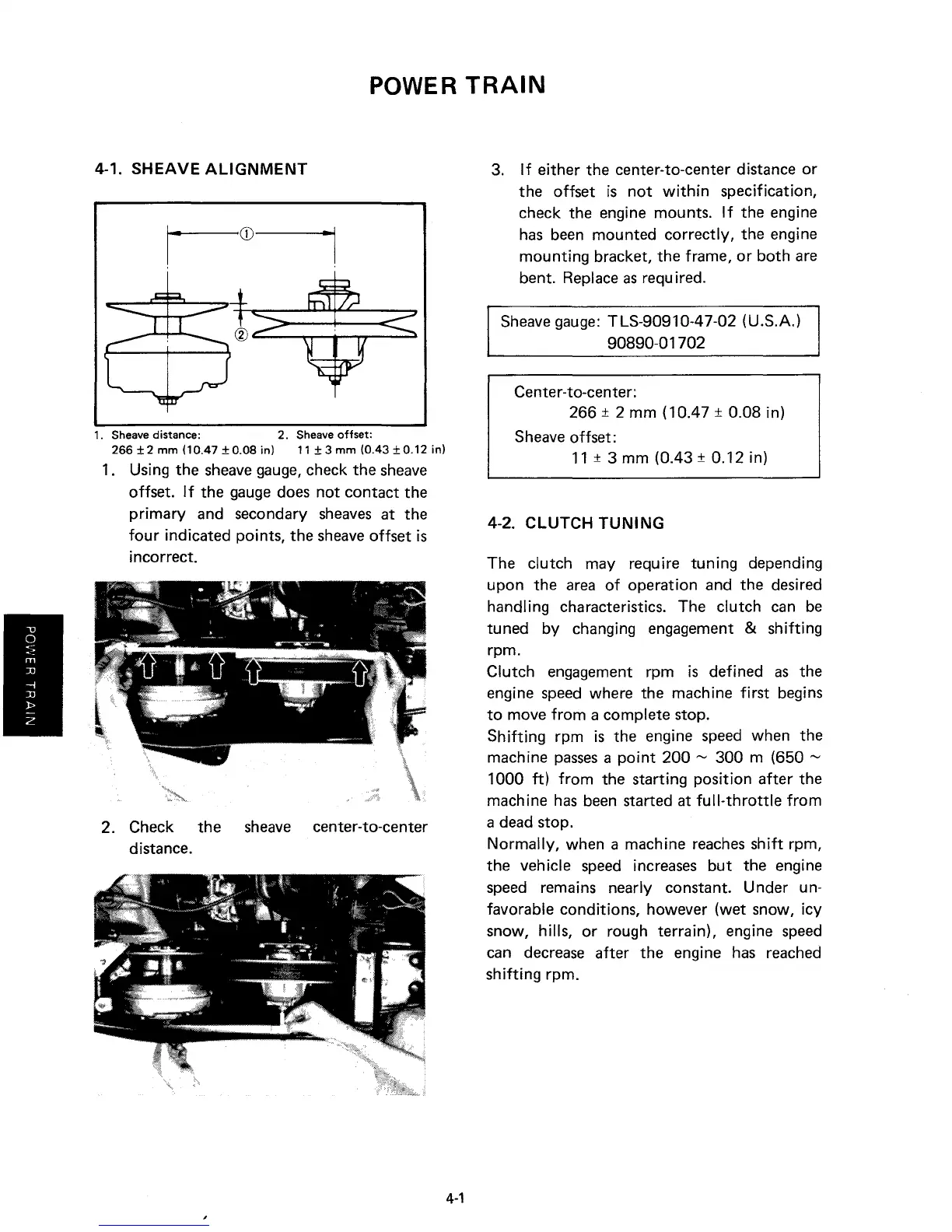
1. Sheave distance: 2. Sheave offset:
266
±2
mm
(10.47 ±O.OS in) 11 ± 3
mm
(0.43 ± 0.12 in)
1. Using
the
sheave gauge, check
the
sheave
offset. If
the
gauge does
not
contact
the
primary and secondary sheaves at
the
four indicated points,
the
sheave offset is
incorrect.
2. Check
the
sheave center-to-center
distance.
4-1
3. If either
the
center-to-center distance or
the
offset is
not
within specification,
check
the
engine mounts. If
the
engine
has been mounted correctly,
the
engine
mounting bracket,
the
frame, or
both
are
bent. Replace as required.
Sheave gauge: TLS-9091O-47-02 (U.S.A.)
90890-01702
Center-to-center:
266
± 2 mm (10.47 ± 0.08 in)
Sheave offset:
11
± 3 mm (0.43 ± 0.12 in)
4-2. CLUTCH
TUNING
The clutch may require tuning depending
upon
the
area of operation and
the
desired
handling characteristics. The clutch can be
tuned
by changing engagement & shifting
rpm.
Clutch engagement rpm is defined as
the
engine speed where
the
machine first begins
to move from a complete stop.
Shifting rpm is
the
engine speed when
the
machine passes a point
200
~
300
m (650
~
1000
ft)
from
the
starting position
after
the
machine has been started at full-throttle from
a dead stop.
Normally, when a machine reaches shift rpm,
the
vehicle speed increases
but
the
engine
speed remains nearly constant. Under un-
favorable conditions, however (wet snow, icy
snow, hills, or rough terrain), engine speed
can decrease after
the
engine has reached
shifting rpm.




 To Next Page