Axiovert 40
B 46-0031 e 11/03 2Ć19
2.4.6 Incident-light fluorescence
Incident-light fluorescence requires the use of the Axiovert 40 CFL microscope with the following compoĆ
nents:
FL incident-light equipment, HBO 50 illuminator with mbq ac-z transformer, 3-position reflector slider P&C
and reflector module FL P&C (equipped with set of filters for fluorescence excitation).
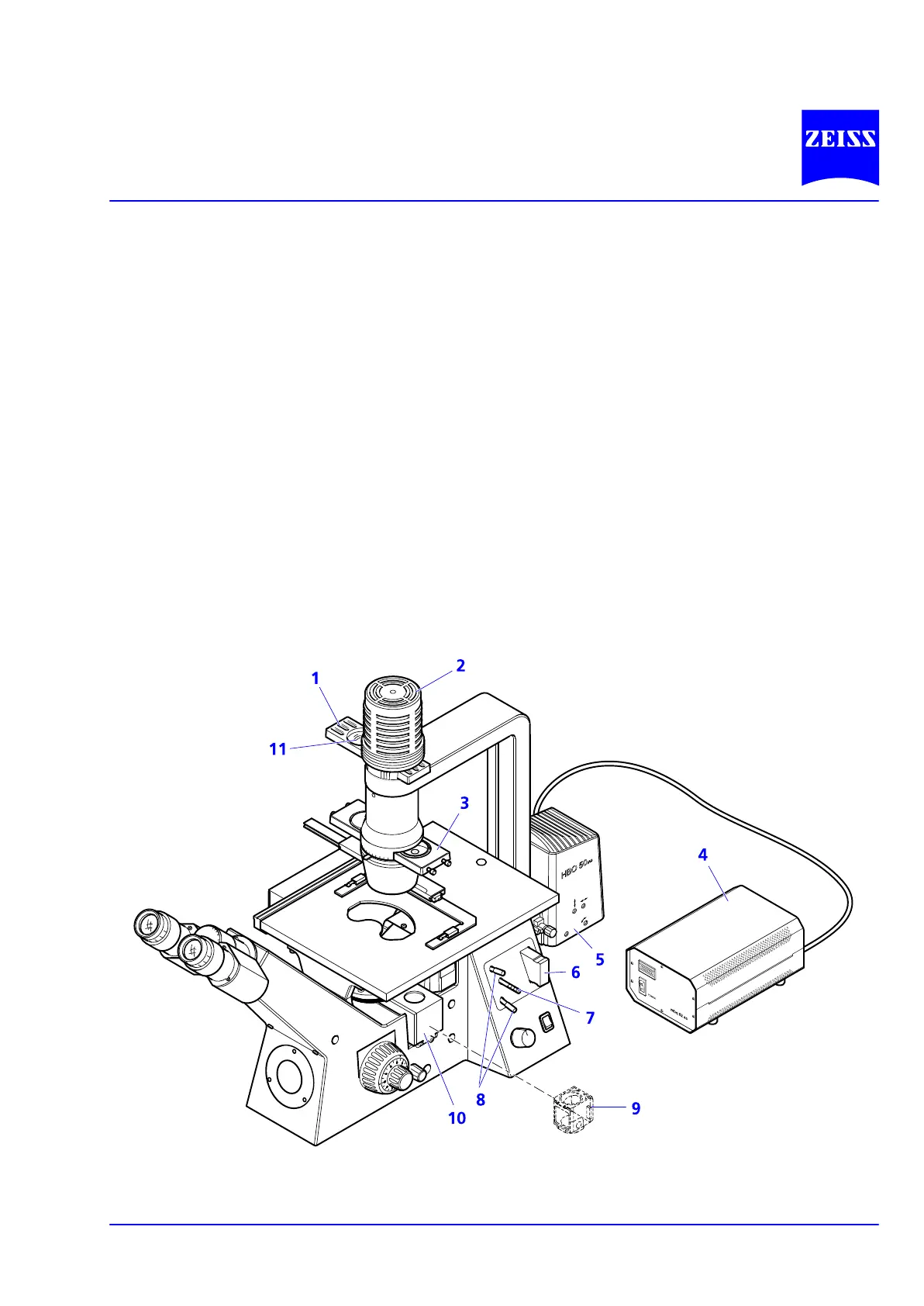
• Select the specimen area to be examined in transmitted light brightfield or phase contrast. To do this, push
reflector slider (2Ć24ā/ā10) to the blank position, switch on halogen bulb (2Ć24ā/ā2) and move diaphragm slider
(2Ć24ā/ā3) to brightfield or phase contrast position.
• Switch on the HBO 50 lamp (2Ć24ā/ā5) at the power supply (2Ć24ā/ā4), but block the light path using the addiĆ
tional filter slider (2Ć24ā/ā6), which in its mid-position does not allow the light to pass.
• After you have selected the specimen area of interest, switch off the halogen bulb.
• With the 3-position reflector slider P&C (2Ć24ā/ā10) move the required filter combination (2Ć24ā/ā9) into the
light path and release the light path by removing the additional filter slider (2Ć24ā/ā6).
• Move the push-pull rod (2Ć24ā/ā7) to close the luminous-field diaphragm until it is visible in the field of view.
Center it by means of centering screws (2Ć24ā/ā8) and open it up to the edge of the field of view.
• In the additional filter slider (2Ć24ā/ā6) of the FL incident-light equipment, you can insert additional 25-mm
excitation filters, which must be held by means of O-rings.
Fig. 2Ć24 Observation in incident-light fluorescence



 To Next Page