- 142 -
000908AG
8 - Maintenance
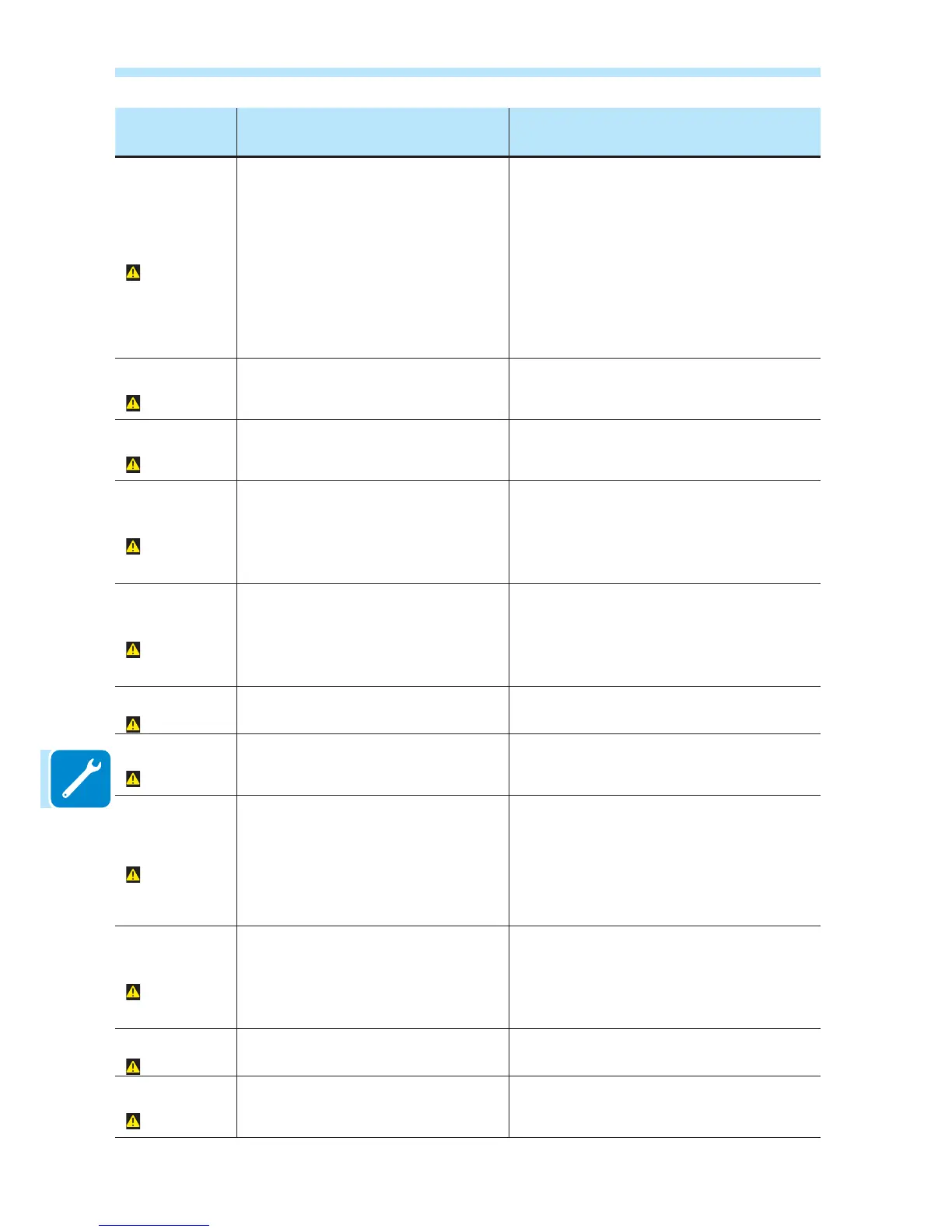
- Error code
- Error message
- Warning
Name of Alarm and Cause Solution
- E004
- Bulk OV
-
(On)
“Bulk” over-voltage (DC-DC circuit):
Error inside the inverter. The alarm is raised when the
voltage at the heads of the bulk capacitors exceeds
the Over Voltage threshold (internal unchangeable
threshold).
The alarm may be triggered by causes external to the
inverter:
- An excessive input voltage can be recorded as a condition
for bulk over voltage. In this case it is advisable to check
the inverter's input voltage and should this value be close
WRWKHLQSXW29WKUHVKROGUHYLHZWKHFRQ¿JXUDWLRQRIWKH
photovoltaic generator.
- Excessive grid voltage could cause the bulk voltage to rise in
uncontrolled fashion with a consequent protection intervention
and hence generation of the alarm. In these cases the alarm is
transitory and the inverter automatically restarts
- The alarm may be triggered by causes inside the inverter
and in this case it is necessary to contact customer
assistance.
- E005
- Comm.Error
-
(On)
Communication error inside the inverter:
The alarm occurs when there are communication
problems between the control devices inside the
inverter.
(UURULQVLGHWKHLQYHUWHUDQGFDQQRWEHFKHFNHGH[WHUQDOO\
- If the problem persists (once the inverter has been switched
off and back on again), contact customer assistance.
- E006
- Output OC
-
(On)
Output overcurrent:
The alarm occurs when the inverter's output current
exceeds the inverter's threshold for maximum output
current.
(UURULQVLGHWKHLQYHUWHUDQGFDQQRWEHFKHFNHGH[WHUQDOO\
- If the problem persists (once the inverter has been switched
off and back on again), contact customer assistance.
- E007
- IGBT Sat
-
(On)
Saturation recorded on the IGBT components:
The alarm appears when one of the active devices of
the inverter is in saturation state.
Once the error appears, the inverter attempts to resume
normal operation.
- Should the error occur sporadically, it may be caused by a
brusque transition of the grid voltage or of the input voltage,
but is not due to a malfunction by the inverter.
- If the error is connected to an internal fault, it will continue to
appear and so it is necessary to contact customer assistance.
- E010
- Bulk Low
-
(On)
Low “Bulk” voltage (DC-DC circuit):
The alarm can be caused by causes external to
the inverter: a reduced input voltage on the inverter
(just above the activation voltage) but which is not
DFFRPSDQLHGE\DVXI¿FLHQWDYDLODELOLW\RISRZHUIURP
the photovoltaic generator (typical condition of the
stages with limited irradiation)
- If the error signal occurs sporadically, it may be due to
causes external to the inverter (limited irradiation and so
limited power availability from the PV generator).
- If the problem occurs systematically even in conditions of
high irradiation and with LQSXWYROWDJHZKLFKLVVLJQL¿FDQWO\
higher than the activation voltage, contact customer
assistance.
- E011
- Ramp Fail
-
(On)
Long wait for “Booster” regime to start:
Error internal to inverter relating to start up time for
DC-DC circuit regime (Booster)
(UURULQVLGHWKHLQYHUWHUDQGFDQQRWEHFKHFNHGH[WHUQDOO\
- If the problem persists (once the inverter has been switched
off and back on again), contact customer assistance.
- E012
- DcDc Fail
-
(On)
Error in the “Booster” circuit (DC-DC side)
recorded by the “Inverter” circuit (DC-AC side):
Error inside the inverter regarding the operation of the
DC-DC circuit part (Booster).
(UURULQVLGHWKHLQYHUWHUDQGFDQQRWEHFKHFNHGH[WHUQDOO\
- If the problem persists (once the inverter has been switched
off and back on again), contact customer assistance.
- E013
- Wrong Mode
-
(On)
,QFRUUHFWFRQ¿JXUDWLRQRILQSXWVVHWLQSDUDOOHO
rather than independent):
The alarm is generated solely when the inverter
LVFRQ¿JXUHGZLWKparallel inputs. In this particular
FRQ¿JXUDWLRQWKHLQYHUWHUFKHFNVWKHinput voltage of
each of the two channels and if the two voltages differ
by more than 20Vdc, the alarm is raised .
&KHFNWKDWWKHVHWWLQJRIWKH,102'(VZLWFKLVVSHFL¿FDOO\
set to "PAR" and that the jumpers between the two input
channels have been included.
,IWKHFRQ¿JXUDWLRQRIWKHLQYHUWHULVFRUUHFWFKHFNWKDWWKH
input strings have the usual number of standard panels of the
usual brand and with the same inclination/orientation.
,IERWKWKHFRQ¿JXUDWLRQRIWKHLQYHUWHUDQGWKHFKDUDFWHULVWLFV
of the 39JHQHUDWRUFRQIRUPZLWKWKHVSHFL¿FDWLRQVFRQWDFW
customer assistance.
- E014
- Over Temp.
-
(On)
Excessive temperature inside the inverter:
External temperature over 60°C. This parameter also
depends on the power which the inverter must supply
since the measurement of temperatures is done
LQWHUQDOO\DQGLVLQÀXHQFHGE\WKHKHDWGLVVLSDWHGE\
the components of the inverter itself
&KHFNWKDWWKHLQYHUWHULVQRWH[SRVHGWRGLUHFWVXQOLJKW:DLW
for the temperatures to which the inverter is exposed to return
to the operating range and for the inverter to cool down.
- If the problem persists (once the ambient temperature has
returned to within the range), contact customer assistance.
You must remember to wait for the time necessary to allow the
inverter to cool down.
- E015
- Bulk Cap Fail
-
(On)
Fault recorded on the “Bulk” capacitor:
Error inside the inverter regarding a problem in the
bulk capacitors.
(UURULQVLGHWKHLQYHUWHUDQGFDQQRWEHFKHFNHGH[WHUQDOO\
- If the problem persists (once the inverter has been switched
off and back on again), contact customer assistance.
- E016
- Inverter Fail
-
(On)
Error in the “Inverter” circuit (DC-AC side)
recorded by the “Booster” circuit (DC-DC side):
The alarm is generated when a problem is detected in
the inverter circuit part (DC/AC).
(UURULQVLGHWKHLQYHUWHUDQGFDQQRWEHFKHFNHGH[WHUQDOO\
- If the problem persists (once the inverter has been switched
off and back on again), contact customer assistance.



 To Next Page