AES 7707 RF Subscriber 17
Part No. 40-7707 Rev. 3a 10/23/2017
Replacing a low-charge battery with a fully charged battery may result in the subscriber not immediately detecting
the charged battery. Due to the test cycle time, up to 60 seconds can pass before the fully charged battery is
recognized.
Low Battery Voltage Cutoff
To prevent deep battery discharge damage, the 7707 subscriber disconnects the battery when voltage is less than
10 V DC.
Discharge/Recharge
The 7707 Subscriber float charges the battery using a 40 VA transformer. The battery voltage level conditions are:
Low Battery (Trouble message): Below 11.2 V DC
Subscriber Battery Disconnect: Below 10 V DC
Battery Reconnect (Restoral message): Above 12 V DC
6. External Antenna
6.1 Antenna Selection
A remotely mounted external antenna may be required for optimal performance on the mesh network, depending on
installation location requirements or conditions. Contact AES Corporation for additional antennas that may be used
with the 7707 Fire Subscriber unit.
6.2 Coaxial Cable and Connector Selection
Use 50-ohm impedance coaxial cable only. RG-8, 9913, LMR-400, and LMR-600 are acceptable coaxial
cables. RG-58 may be used for installations where cable is not more than 25 feet long.
Always use the shortest possible length of coaxial cable. Long lengths of coaxial cable result in greater
transmitted signal loss.
Always use the most direct routing in any coaxial cable installation. Unnecessary and tight bends add to
transmitted signal loss.
Use the proper coaxial connectors and crimp tool for the cable selected. Incorrect or poorly installed
connectors can cause transmitted signal power loss.
6.3 Antenna Location
When selecting an antenna location, keep the following in mind:
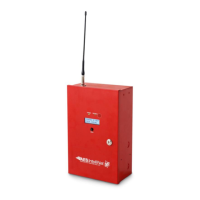
The supplied tamper-resistant and flexible 2.5-dB antenna mounts on top of the enclosure.
Remotely located antennas should be mounted as high as possible, either on top of or inside the building
structure. Rooftops and attic spaces are preferable.
The antenna needs to be high enough to overcome nearby obstructions to the RF signal path.
A remote antenna should be mounted in a location near the transceiver to minimize coaxial cable signal
loss. Do not use cable longer than needed to reach the antenna.
Avoid installing the antenna in close proximity to metal surfaces. Nearby metal may degrade radio
communications through signal reflections or antenna detuning.
Remember that pipes, conduit, wiring, ductwork, and other metal commonly installed within building walls
can affect antenna performance.
─ Take into account foil-backed insulation and wallpaper.
─ Metal objects can also be located in adjacent rooms or above ceilings.
─ Metallic framing and supports are commonly used in buildings. Do not mount the antenna directly
over, or close to, metal studding, beams, or other supports that can interfere with the RF signal.
6.4 Antenna Installation
Warning! Do NOT install Subscriber or antenna during a lightning storm.
The following installation guidelines must be followed when installing the antenna:
The remotely mounted antenna must be properly grounded to help reduce surge damage from lightning.
Grounding must be done in accordance with local building codes and in accordance with other
requirements from the Authority Having Jurisdiction (AHJ).
Mount the remote antenna vertically.
Do not coil or bunch coaxial cable.
Install the remote antenna in accordance with National Electric Code and local electric code.


 To Next Page