Multi-Stream Analysis
141
6.3.2. SLA Statistics
SLA statistics are more similar to BER results than bandwidth statistics or error counts:
Like it happens with BER results, SLA statistics require an special frame / packet
payload. In this case, the payload to be used is the SLA payload (See section 4.1.4,
See section 4.4.6). That means that the tester you are using as a traffic generator must
be configured to use this payload to obtain any valid result.
It is possible to use the same test port for SLA traffic generation and analysis (Port A)
or use Port A for traffic generation and Port B for analysis. Using Port A for generation
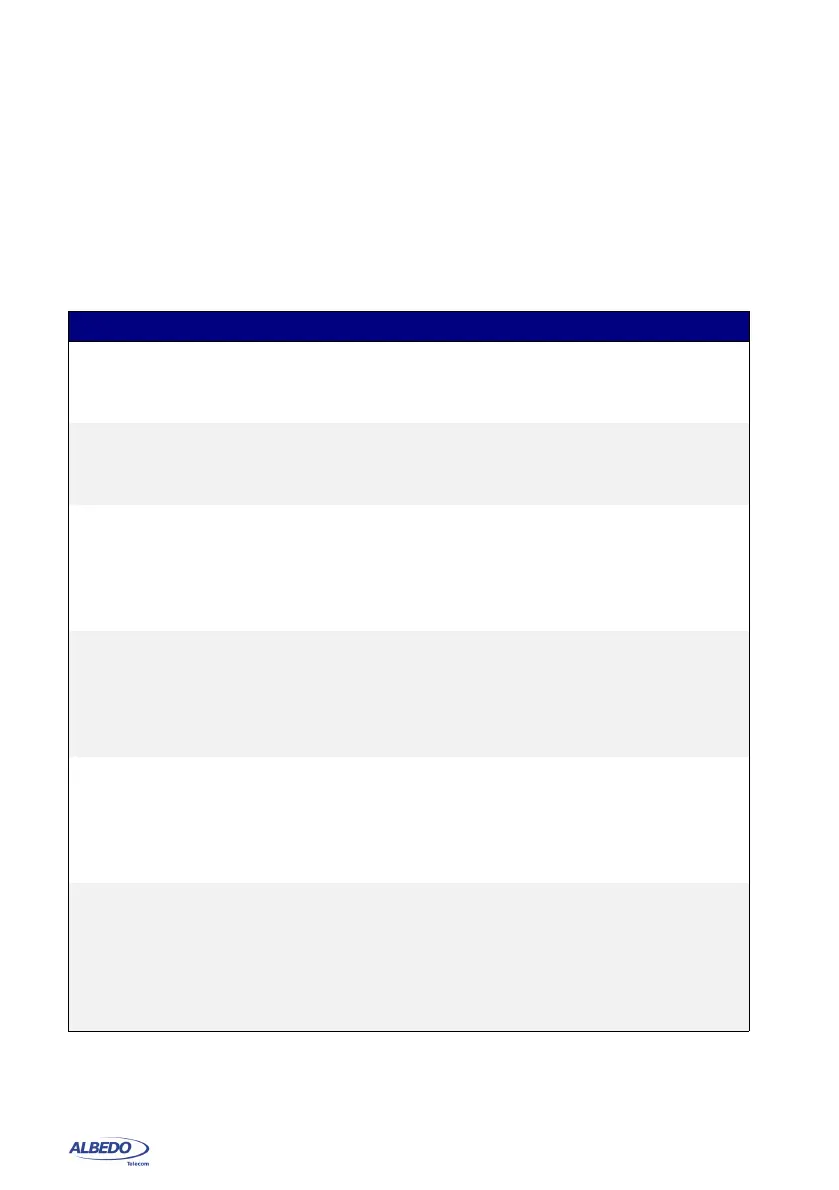
Table 6.9: SLA Availability Statistics
Field Description
Lost frames Total amount of lost frames from the beginning of the test.
One frame is considered to be lost if it is never received or if
it is received with a delay larger than 10 seconds.
FLR Ratio of the total amount of lost frames to the total transmit-
ted frames from the beginning of the test.
Definition of the FLR parameter follows ITU-T Y.1563.
SES This is the amount of Severely Errored Second (SES) out-
comes from the beginning of the test.
The SES is computed as specified in ITU-T Y.1563. The
frame loss threshold used to declare a SES is 50% of the
frames that made up the transmitted block.
PEU (%) Percent Ethernet service Unavailability defined as per ITU-T
Y.1563 and recorded from the beginning of the test.
The PEU constitutes a availability performance figure that
informs about the percentage of time that the DUT / SUT has
been not available for transmit / receive data.
Out-of-sequence
frames
Total amount of packets received with an unexpected
sequence number. Duplicated sequence numbers are not
taken into account for computing the Out-of-sequence frame
statistic.
This metric is based on the definitions given in RFC 5236.
Duplicated frames Total amount of frames received with a duplicated sequence
number. A triplicated frame event is accounted as two dupli-
cated frame events. The same reasoning is applied for
frames repeated more than three times.
The duplicated frames metric is based on the definitions
given in RFC 5236.


 To Next Page