IEEE 1588 Analysis
249
1. From the Home panel, go to RESULTS,
The test port results panel is displayed.
2. Select Port A to enter in the port specific results.
3. Enter in PTP to display results about the PTP protocol.
4. Go to PTP wander test.
5. Choose between MTIE or TDEV.
6. Start the test by pressing Run.
7. Check the Time, TIE, MTIE and Mask results (MTIE results panel) or Time, TDEV
and Mask results (TDEV results panel).
Note: The TIE, MTIE and TDEV values must be understood as pktFilteredTIE, pkt-
FilteredMTIE, and pktFilteredTDEV respectively.
Note: The amount of time to wait before the first results are displayed depends of
the filter settings.
9.3.3. Floor Delay Population Test
PTP slave clocks may increase their accuracy and stability by implementing packet
selection mechanisms. In simple terms, this means that it is an advantage for PTP
slave clocks to just discard packets with a potentially large amount of phase error rather
than trying to use them in any way.
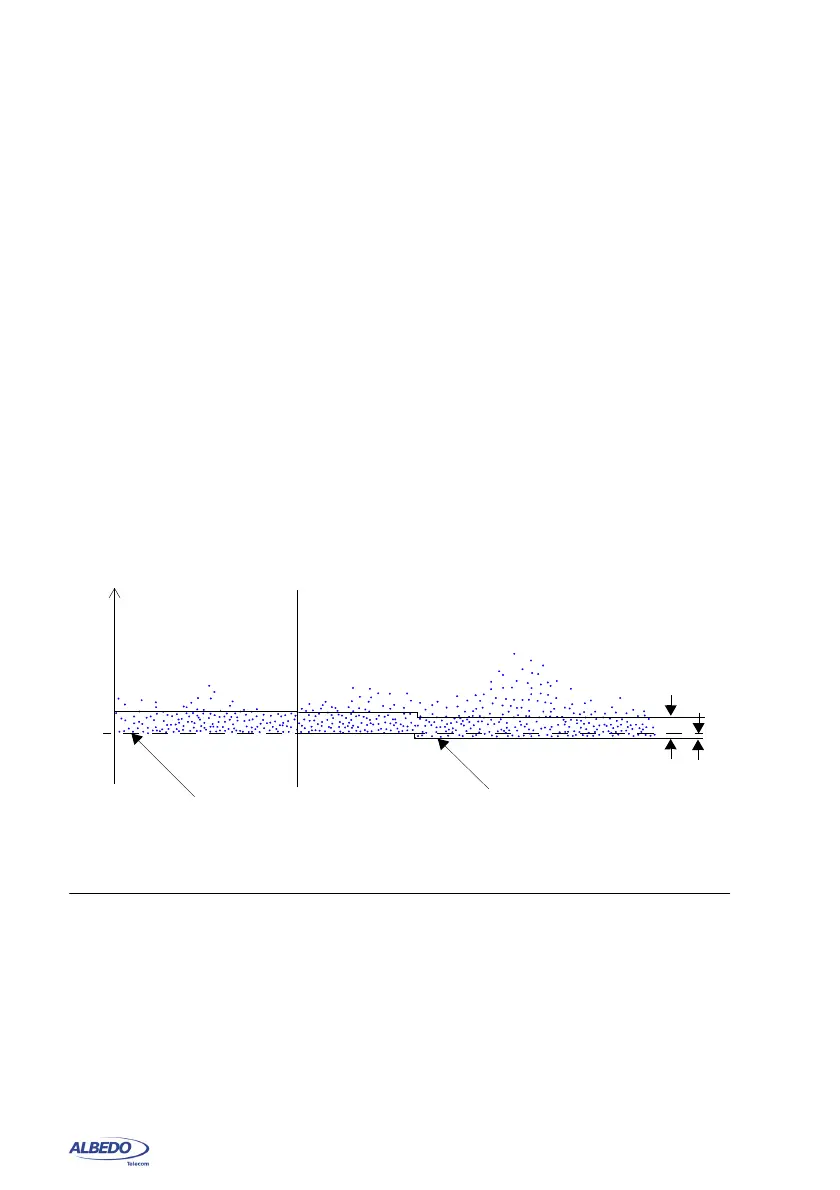
The floor delay population test attempts to implement a mechanism to measure the
number of samples suitable for slave synchronization. With this objective in mind, the
test defines an acceptable end-to-end delay range. The lowest delay is defined to be
the floor delay for the path under test. In other words, the smallest time recorded for a
packet as it is transmitted through the path. The highest delay is obtained by adding a
fixed time to the floor delay. Samples are rated as conforming if they are found between
the minimum and the maximum delay. Not conforming packets exhibit an end-to-end
Figure 9.5: Illustration of the floor delay population test. Samples are classified as
conforming or not conforming depending on the latency they experience from the
grandmaster.
Sync PTD
Settling period
(d)
Testing period
Floor delay
initial estimate
Floor delay
corrected estimation
Estimation excess


 To Next Page