A
L
B
E
D
O
T
e
l
e
c
o
m
-
J
o
a
n
d
’
À
u
s
t
r
i
a
,
1
1
2
-
B
a
r
c
e
l
o
n
a
-
0
8
0
1
8
-
w
w
w
.
a
l
b
e
d
o
t
e
l
e
c
o
m
.
c
o
m
User Guide
82
4.2.2. Configuring MPLS
Multi-Protocol Label Switching (MPLS) is a technology designed to speed up IP packet
switching in routers by separating the functions of route selection and packet
forwarding into two planes:
• Control Plane: This plane manages route learning and selection with the help of
traditional routing protocols such as Open Shortest Path First (OSPF) or Interme-
diate System - Intermediate System (IS-IS).
• Forwarding Plane: This plane switches IP packets, taking as a basis short labels
prepended to them. To do this, the forwarding plane needs to maintain a switching
table that associates each incoming labelled packet with an output port and a new
label.
The traditional IP routers switch packets according to their routing table. This
mechanism involves complex operations that slow down switching. Specifically,
traditional routers must find the longest network address prefix in the routing table that
matches the destination of every IP datagram entering the router.
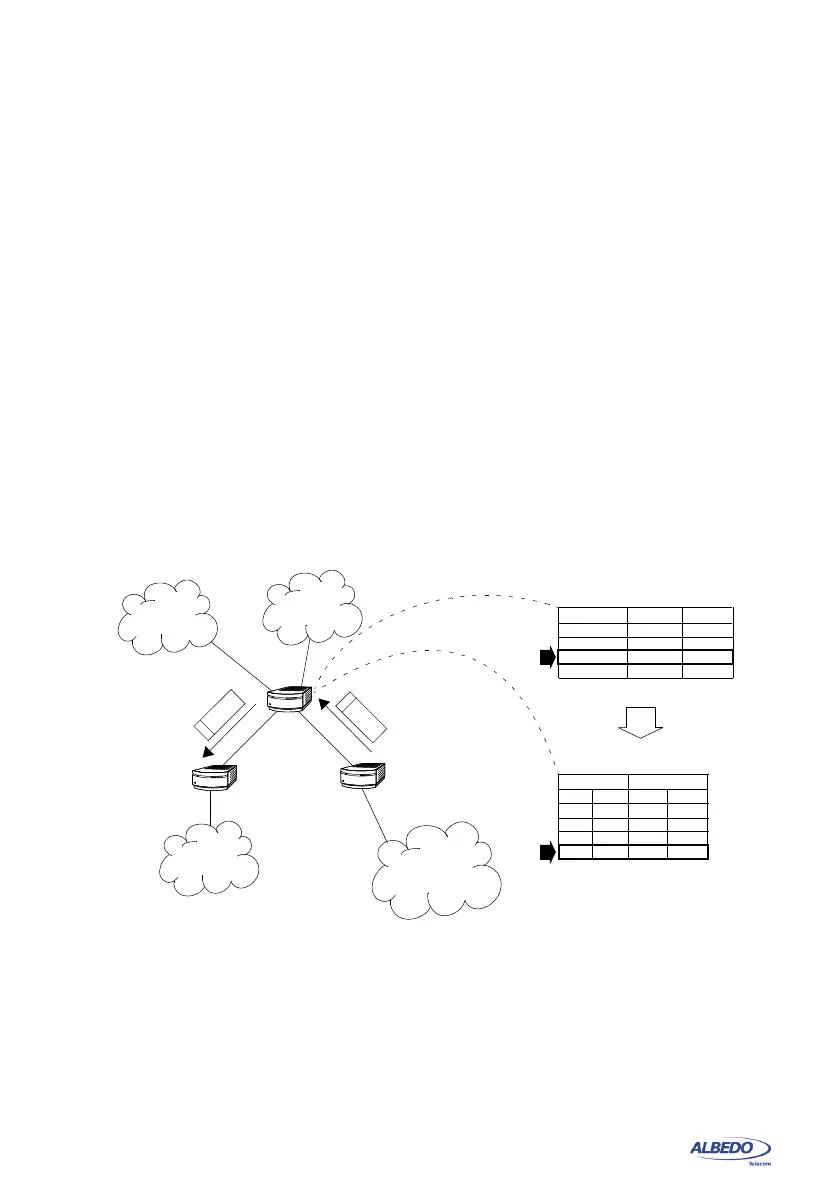
On the other hand, MPLS routers, also known as Label-Switched Routers (LSR), use
simple, fixed-length label forwarding instead of a variable-length IP network prefix for
fast forwarding of packetized data.
MPLS enables the establishment of a special type of virtual circuits called Label-
Switched Paths (LSP) in IP networks. Thanks to this feature, it is possible to implement
resource management mechanisms for providing hard QoS on a per-LSP basis, or to
Network
20.10.10.0/24
Internet
Network
20.0.0.0/8
Network
20.10.0.0/16
Label
Port
Label
226 1 179
Port
1
Input
Output
Switching table (R1)
1
2
3
4
20.0.0.0/8
-
3
Prefix
Gateway
Routing table (R1)
R1
R3
R2
Interface
-
20.10.0.0/16
2
20.10.10.0/24
R2 4
0.0.0.0/0
R3
1
DST 20.10.10.129
Label: 650
291
3336
4881
3151
1181
6501
DST 20.10.10.129
Label: 881
Figure 4.3 Traditional routers have to perform complex operations to resolve the output interface of
incoming packets. LSRs resolve the output interface with the help of a simple switching table.
20.10.10.129
650


 To Next Page