Automatic Performance Tests
163
applications are the DSCP (Layer 3) and the VLAN priority bits (Layer 2). The lat-
ter requires the subscriber frames to be encapsulated in VLAN tagged frames.
7.2.1. Bandwidth Profiles for Ethernet Services
To see how eSAM works it is essential to understand how Ethernet services are
defined. Network operators have at their disposal the tools that enable them to define
their services with great flexibility. The information rate associated with Ethernet
service is not limited to the nominal speed of the access network interface. For
example, certain operator way want to define a 2 Mb/s service over an optical Gigabit
Ethernet interface.
Performance in terms of delay, packet loss and other metrics is applied to traffic flows
defined by their generation statistics or bandwidth profile. The mechanism used by
service providers to make sure the ingress traffic has the correct bandwidth profile is
admission control. Once the Ethernet access has been set up, the service provider
performs admission control over the customer traffic at the user-network interface.
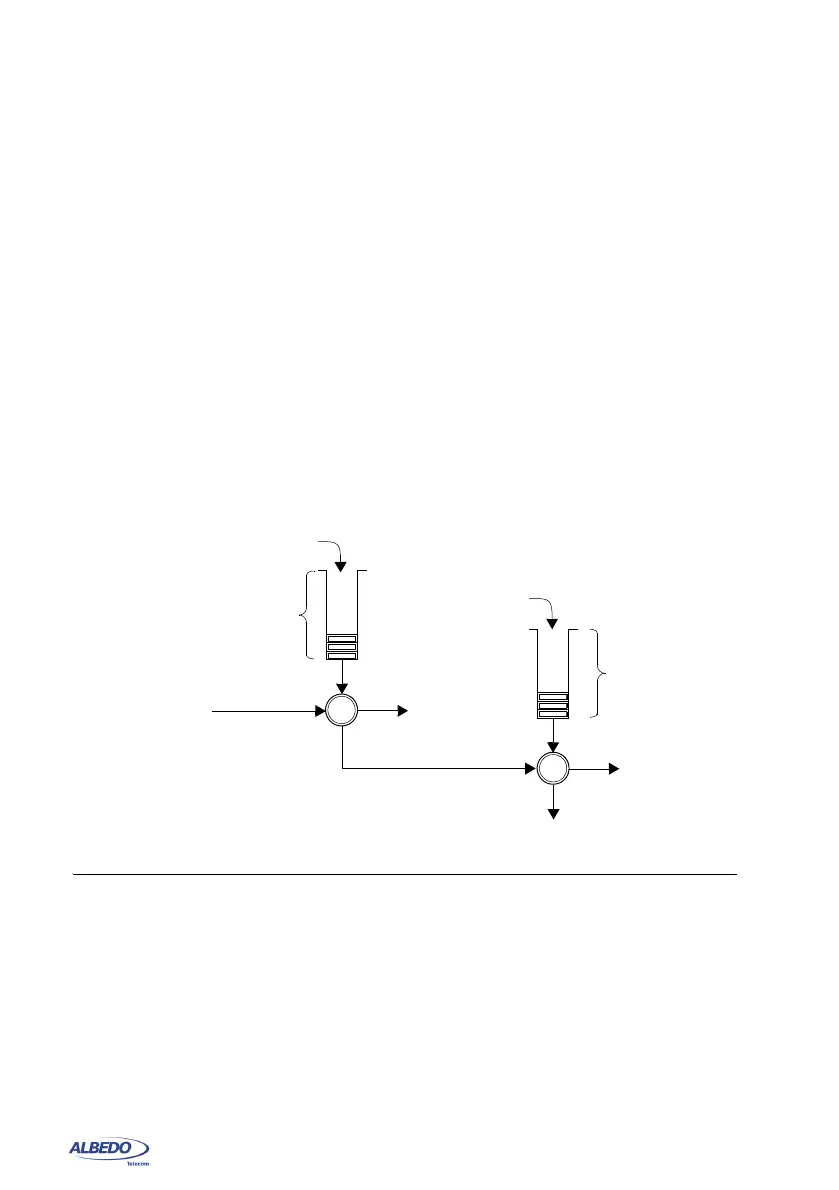
Admission control for Ethernet services uses bandwidth profiles based on four
parameters initially defined by the Metro Ethernet Forum (MEF):
• Committed Information Rate (CIR): Rate up to which service frames are delivered
as per the service performance objectives.
• Committed Burst Size (CBS): Maximum number of bytes up to which service
frames may be sent as per the service performance objectives without considering
the CIR.
• Excess Information Rate (EIR): Rate up to which service frames are still delivered
but they are not subject to any performance objective.
• Excess Burst Size (EBS): The number of bytes up to which service frames are
sent (without performance objectives), even if they are out of the EIR threshold.
CIR
Figure 7.6: Two-rate Three color marker (trTCM). policing algorithm.
Drop
Drop
Send
Send
(green)
(yellow)
(red)
CBS
EBS
EIR
Colorless
Traffic


 To Next Page