A
L
B
E
D
O
T
e
l
e
c
o
m
-
J
o
a
n
d
’
À
u
s
t
r
i
a
,
1
1
2
-
B
a
r
c
e
l
o
n
a
-
0
8
0
1
8
-
w
w
w
.
a
l
b
e
d
o
t
e
l
e
c
o
m
.
c
o
m
User Guide
162
end-to-end network performance and it is therefore an essential parameter to
measure.
3. Compatible with multi-service environments: Modern Ethernet services may be
port based but service multiplexing in the same port by means some service
delimiting tag is also very popular. The eSAM test has been designed to operate in
environments using service multiplexing. In this case, all services are simultane-
ously tested and independent results are given for each of them.
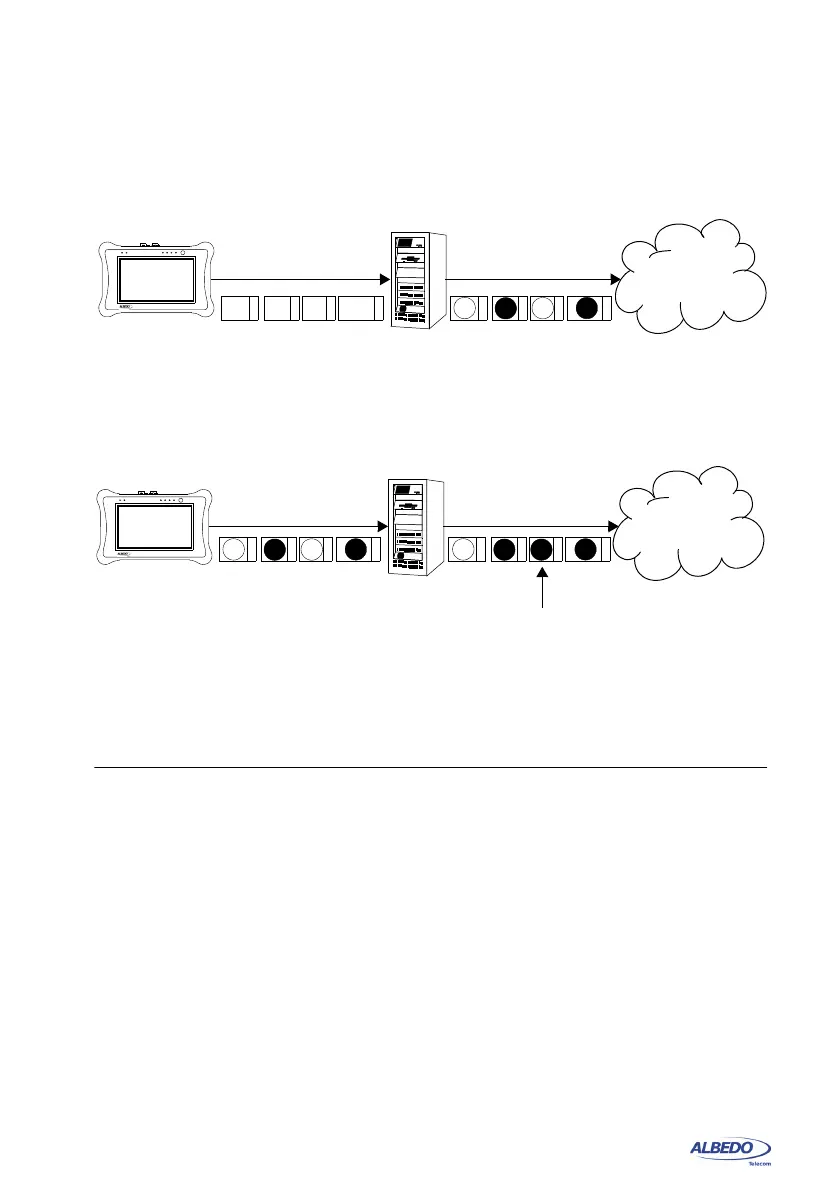
4. Supports color-aware traffic: The eSAM test is compatible with color markers used
by some service providers to enable the different performance levels in their appli-
cations. Color markers classify the network traffic in three sets: green traffic is
transmitted within the delay and frame loss ratio limits guaranteed by the SLA
agreement, yellow traffic is transmitted but the SLA agreement performance limits
do not apply for it, and finally red traffic is discarded and not transmitted (red traffic
is therefore never seen in the network). Common color markers used in practical
Traffic
(a)
Network
acceptance
Traffic
(b)
Network
acceptance
Figure 7.5: (a) Non-color-aware service. It the service provider is wiling to implement
different transmission priorities for this service, marking will have to be carried out by
the access network by means some traffic classification algorithm. (b) In a color-aware
service subscribers mark their own traffic from the beginning. The service provider may
remark some traffic depending on the traffic acceptance algorithm.
G
Y
G
Y
Y
G
Y
G
Y
G
Y Y
Tes ter
Teste r
Re-marking
Traffic is marked
by the subscriber
Subscriber traffic
contains no color marks
Traffic may or may not
be marked by the service
provider
xGenius
xGenius


 To Next Page