IEEE 1588 Analysis
253
whether the problem is caused by the network (congestion, inappropriate switches) or
the device (high sensitivity to PDV, configuration problem).
The passive monitoring operation mode is defined so that it doesn’t affect the network
in any way. No PTP traffic is generated in this mode. Interaction is limited to analysis
of the different types of messages received from other PTP master and slave clocks.
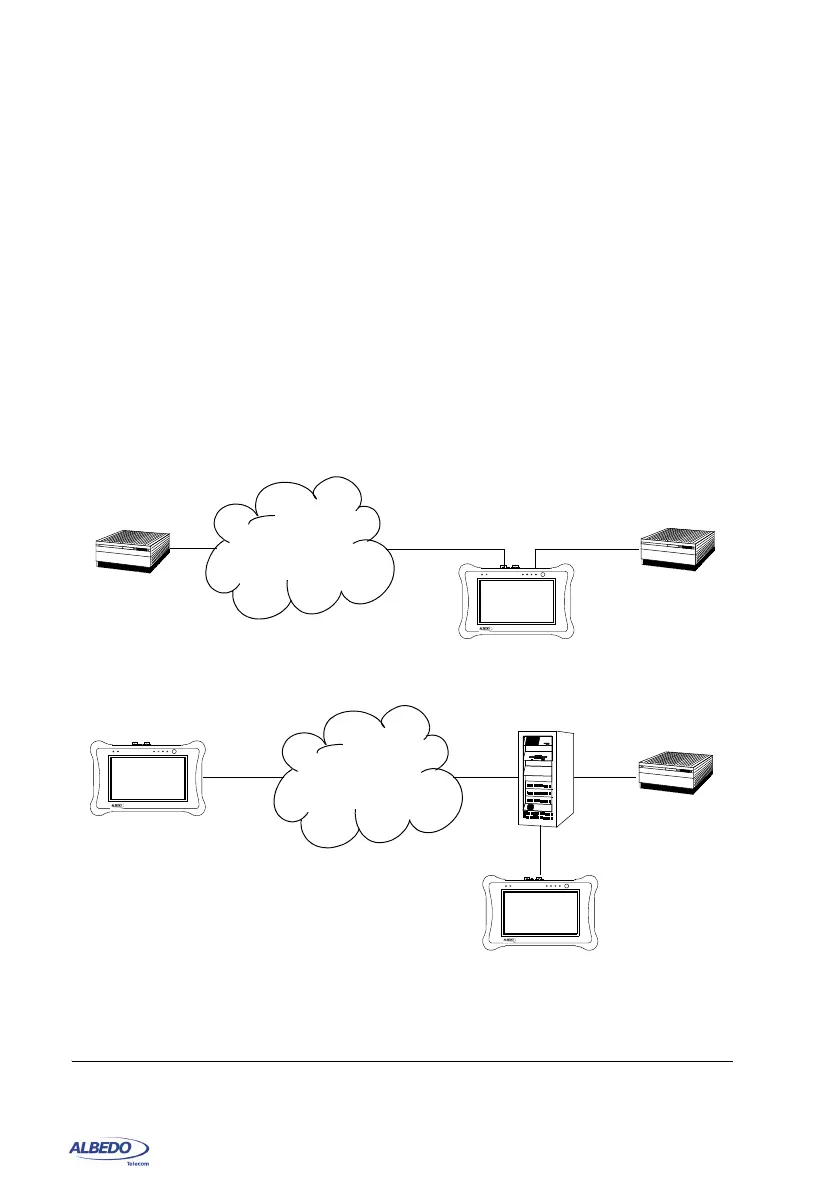
Connection in Ethernet or IP endpoint is allowed when the monitoring mode is
configured but the IP through mode is allowed as well. By connecting the equipment in
pass-through mode at the output of the DUT (usually a PTP slave) it is possible to
analyse the messages the DUT is receiving without any intermediate device that could
be masking the real synchronization performance.
When the test unit is operating in PTP monitor mode it cannot track the phase
generated by the master because it does not estimate the path delay (Delay request-
response mechanism, Peer-delay mechanism) but it can still syntonize the master
frequency. The result is that all metrics related with absolute phase or delay are not
available in PTP Passive monitor mode.
Figure 9.6: Connection of xGenius to the network in PTP Passive monitor mode: (a)
Connection in pass-through mode (IP through operation mode). (b) Connection in
endpoint mode (Ethernet endpoint or IP endpoint operation modes).
Master
device
Passive
Monitor
Ethernet / IP
(a)
Slave
device
Master
emulation
Ethernet / IP
(b)
Slave
device
Passive
Monitor
xGenius
xGenius
xGenius


 To Next Page