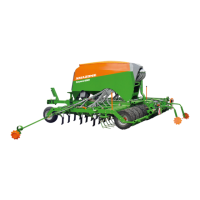
Cayros BAG0172.7
10.7.4 Installation and removal of hydraulic hose lines
Use
• only genuine AMAZONE replacement hoses. These hoses s
up to chemical, mechanical and thermal loads.
• hose clips made from V2A for fitting hoses, as a rule.
When installing and removing hydraulic hose lines, always observe
the following information:
• Ensure cleanliness.
• Always install the hydraulic hose lines to ensure the following in
all operating positions
ο There is no tension, apart from the hose's own weight.
ο There is no possibility of jolting on short lengths.
ο External mechanical influences on the hydraulic hose lines
are avoided.
Use appropriate arrangements and fixing to prevent any
scouring of the hoses on components or on each other. If
necessary, secure hydraulic hose lines using protective
covers. Cover sharp-edged components.
ο The approved bending radii may not be exceeded.
•
When connecting a hydraulic hose line to moving parts, the hose
length must be appropriate so that the smallest approved
bending radius is not undershot over the whole area of
movement and/or the hydraulic hose line is not overtensioned.
• Fix the hydraulic hose lines at the specified fixing points. There,
avoid hose clips, which impair the natural movement and length
changes of the hose.
• The coating of hydraulic hose lines is not permitted.
10.7.5 Installation of hose valve chests with O-ring and union nut
1. First tighten the union nut by hand.
2.
Then tighten the union nut further with a spanner by at least ¼ to
maximum ½ a turn.
You may not tighten the bolted connection with an O-ring as tight as
bolted connections with a cutting ring!
If you tighten the union nut tighter than specified, the tapered bolted
connection can burst (especially on the welded journal of the
hydraulic cylinder).

 To Next Page
 Loading...