General Information 3
General Information
and collects almanac and ephemeris data for each orbiting satellite and stores
this information in battery-backed memory.
• When tracking one satellite, the G12 gets a time reference from that
satellite’s clock.
• When tracking three satellites, the G12 computes and time-tags the
horizontal position (2D) and velocity of its antenna. Input of an initial
position estimate is not required. When it receives an appropriate
command message from controller equipment through one of its serial
communication ports, the G12 sends the results of its computations to the
designated port.
• With four locked satellites, the G12 determines three-dimensional position
and velocity. Stand-alone position accuracy is 3 meters Circular Error
Probable (CEP) when Position Dilution of Precision (PDOP) is less than 4;
velocity accuracy is 0.1 meter per second. Accuracy levels for position and
velocity are subject to the US Government policy of Selective Availability
(SA). When the G12 is operating in differential mode, position accuracy
improves to better than 1.0 m CEP.
The G12 can compute up to 20 independent measurements per cycle (20 Hz),
with no interpolation or extrapolation from previous solutions. Position and
velocity computations are performed simultaneously using all the satellites in
view. The G12 uses instantaneous doppler values from four satellites to compute
dynamic speed, allowing velocity computations to be made independent of the
last position fix. All measurements are referenced to the WGS-84 (World
Geodetic System-1984) ellipsoid model.
The G12 features 12-channel/12-Satellite All-In-View operation; each of up to 12
visible satellites can be assigned to a discrete channel for continuous tracking.
Each satellite broadcasts almanac and ephemeris information every 30 seconds;
this information is recorded in G12 memory automatically.
The G12 is available in two versions. The G12 Sensor contains the G12 receiver
board, a wide range power supply, and a back-up battery for internal memory in a
rugged aluminum enclosure. It can accept input voltage levels from 9 to 36 VDC,
and typical power consumption is approximately 2.2 watts. Power drain on the
back-up battery is typically less than 0.3 mA when external power is applied to the
board, and 1 mA otherwise.
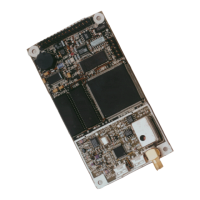
The G12 OEM Board is the G12 GPS receiver board assembly without the
enclosure, back-up battery, or wide range power supply. It requires a regulated
input voltage of 5 VDC (±5%); typical power consumption is approximately 1.8
watts. User-entered parameters can be maintained in the G12 internal memory by
G12RevD.book Page 3 Tuesday, April 2, 2002 4:33 PM


 To Next Page