Router interface concepts
The router in the Branch Gateway includes the following interface categories:
• Physical
• Layer 2 virtual
• Layer 3 routing
Related topics:
Physical router interfaces on page 423
Layer 2 virtual interfaces on page 423
Layer 2 logical interfaces on page 424
Physical router interfaces
The physical interfaces of the Branch Gateway router include:
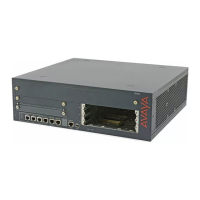
FastEthernet Interface: The 10/3 Fast Ethernet port on the front panel of the Branch Gateway
provides a FastEthernet interface. This interface is an autosensing 10/100 Mbps Fast Ethernet
port. It can be used to connect to a LAN, an external firewall, an external Virtual Private Network
(VPN), or a DeMilitarized Zone (DMZ). This interface can also be used as a WAN interface
when configured for PPPoE. For more information, see Configuring PPPoE on page 252.
Switching Interface: An internal 100 Mbps connection to the Branch Gateway internal switch
provides a switching interface. The switching interface supports VLANs. By default, the
switching interface is associated with the first VLAN (Vlan 1).
When you configure the Branch Gateway without an external VPN or firewall, Vlan 1 is used
to connect the internal Branch Gateway router to the internal Branch Gateway switch. If an
external firewall or VPN is connected to the Fast Ethernet port, it is important to disable Vlan
1 to prevent a direct flow of packets from the WAN to the LAN.
Layer 2 virtual interfaces
Loopback: The Loopback interface is a virtual Layer 2 interface over which loopback IP
addresses are configured. The Loopback interface represents the router by an IP address that
is always available, a feature necessary mainly for network troubleshooting.
Since the Loopback interface is not connected to any physical interface, an entry in the routing
table can not have the Loopback interface’s subnet as its next hop.
GRE tunnel: A GRE tunnel is a virtual point-to-point link using two routers at two ends of an
Internet cloud as its endpoints. GRE tunneling encapsulates packets and sends them over a
GRE tunnel. At the end of the GRE tunnel, the encapsulation is removed and the packet is
sent to its destination in the network at the far end of the GRE tunnel. For more information,
see
GRE tunneling on page 434.
The router
Administering Avaya G430 Branch Gateway October 2013 423



 To Next Page