20 1019572 REV. 03
2.2 Overview of this Model
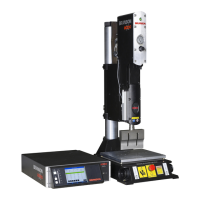
The 2000X aed Actuator is a compact, rigid unit designed for use in manual, semi-
automated, and automated ultrasonic welding systems. The Actuator can be mounted
directly on an I-beam (or similar machine frame), or it can be mounted on a column and
base with start switches and used in a manual or benchtop system. The Actuator is
designed to be operated in an upright position, but is capable of running horizontally or
inverted. If you are mounting your equipment in an inverted position, contact Branson for
further recommendations. (See 1.5.3
Departments to Contact).
The 2000X aed Actuator requires a 2000X distance Power Supply for power and control of
the Actuator’s operation and to provide ultrasonic power to the Converter in the Actuator.
The 2000X aed Actuator is designed with full, built-in pneumatic controls, and mechanical
controls. Operation of the 2000X aed is controlled by inputs to the 2000X distance Power
Supply.
The pneumatics covered in this manual refer to the remote box package sold by Branson.
Some customers may require custom controls.
The Carriage and Slide System
The 2000X aed Actuator’s carriage is driven by a double-acting air cylinder. It is mounted
on a linear ball-bearing slide. The slide system is based on eight sets of preloaded,
permanently lubricated bearings and provides consistent, precise alignment of the
horn, smooth linear motion, and long-term reliability.
The Pneumatic System
The pneumatic system included on the 2000X aed model is contained within the Actuator’s
sheet-metal enclosure and consists of solenoid valves, an air cylinder, and a pressure
regulator with an air pressure gauge. There is a pressure sensor in the actuator to allow
the power supply to read the regulated air pressure. The horn’s rate of descent is adjusted
by the Downspeed control on the front panel of the Actuator. The rate of return is fixed.
For information on setting the Downspeed control, see 2.4
Controls and Indicators.
Dynamic Triggering and Follow-Through
Many welding applications require force to be built up on the part before ultrasonic energy
is activated. To achieve this, the Actuator contains a S-Beam dynamic triggering
mechanism, located between the air cylinder and the converter, which initiates (triggers)
ultrasonics after a preset force is applied to the part. Dynamic follow-through maintains a
consistent force on the part during the weld collapse. This system helps provide uniform
weld quality.
The dynamic triggering and follow-through process operates as follows: upon activation of
the operating cycle, the solenoid valve delivers regulated air to the upper portion of the
cylinder, and exhausts air through the Downspeed control from the bottom of the cylinder,
causing the horn to advance and contact the workpiece. As the pressure increases, the
cylinder compresses springs, forcing a cam to break the optical beam of the trigger
switch. When the trigger switch closes a signal is sent to the Power Supply, which then
starts the weld cycle. At this time, the actuator locks into a cycle, timing begins, and the
palm buttons can be released. As melting of the plastic occurs, spring reaction dynamic
follow through maintains consistent force on the part, ensuring smooth, efficient
transmission of ultrasonic energy into the part.



 To Next Page