11
Humidication and nCPAP
Humidication
Heated humidification is recommended for nCPAP therapy.
The normal functions of the nose and air passages of
the respiratory tract are too warm, moisten and filter
the inhaled gases before they reach the lungs. In normal
respiration, the nasal mucosa and upper airways provide
75% of the heat and moisture supplied to the smaller
airways and alveoli. By the time air reaches the alveoli,
the inspired gas warms to 37 °C at 100% relative humidity
(RH).
13
With nCPAP, the upper airways are not bypassed,
but the high gas flows may be drying to the airways,
especially to a neonate’s underdeveloped lung. Adequate
humidification is essential to maintain airway clearance,
optimize ventilation and improve patient comfort.
The International Organization for Standardization (ISO) and
American Association for Respiratory Care (AARC) clinical
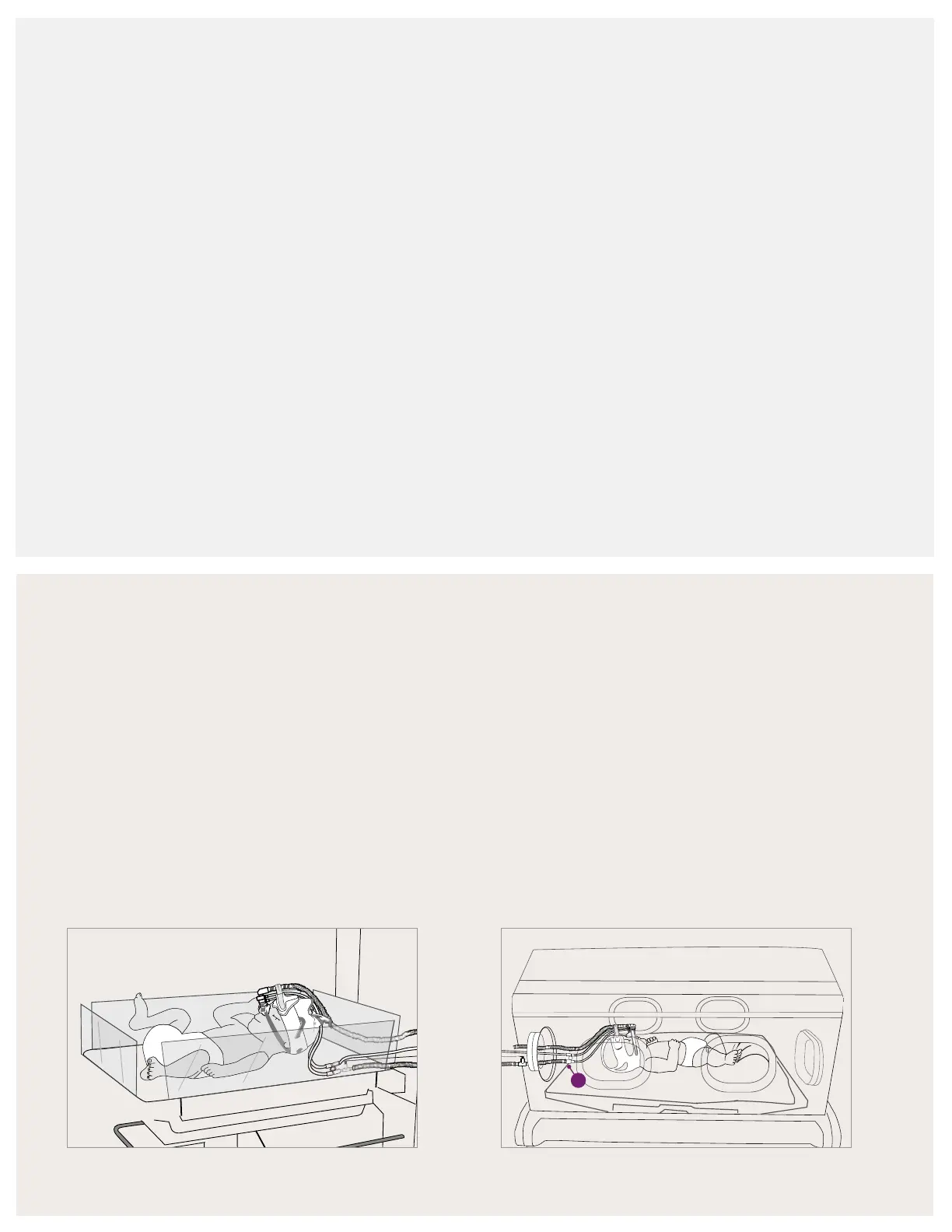
Airway temperature probe placement
Open bed or crib
When the infant is placed on an open bed warmer or
crib, it is recommended to remove the unheated section.
This places the temperature probe next to the
generator assembly.
If the infant is under a radiant warmer or bilirubin light,
the temperature probe should be covered with a light
reflective shield to prevent heating the probe. If the probe
is not covered, it could interfere with the operation of the
humidifier and cause excessive condensation to form.
practice guidelines recommend gas temperature
between 34 and 41 °C to provide a humidity level of
33 to 44 mgH
2
O/L with artificial airways.
14
Be cautious
using higher temperatures, as condensation may reduce
the mucous viscosity and interfere with the mucous
clearance. Extended exposure of gas temperatures over
41 °C may cause cellular damage to the airways.
14
The higher temperature settings may not be required to
deliver adequate humidification, since an artificial airway
is not used with nCPAP. Start with a temperature setting
of 36 °C to 37 °C and adjust the humidifier settings to
maintain adequate humidification; if condensate occurs,
reduce the humidifier temperature setting.
Isolette or incubator
When the infant is in an isolette or incubator, the
non-heated section should be used with the temperature
probe placed outside of the isolette. Make sure that the
rest of the unheated section remains in the isolette.
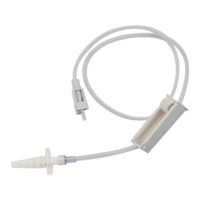
If condensation is observed, remove the non-
heated (A) section and place the temperature probe
inside the isolette.
A



 To Next Page