17
nCPAP mode
nCPAP mode delivers constant, stable positive pressure
to infant airways to help restore the FRC in assisting the
correction of hypoxemia. Adjust the flow rate setting to
deliver CPAP up to 11 cmH
2
O.
CPAP parameters:
• CPAP pressure (set by low pressure flowmeter)
• Oxygen percentage
Initial settings:
• CPAP 4 to 6 cmH
2
O
nCPAP + low breath rate (LBR)/Apnea
The mode allows the delivery of CPAP pressures up to
11 cmH
2
O and breath rate monitoring via respiratory
abdominal sensor and transducer interface. For the SiPAP
Plus system, the LBR setting is determined by LBR time (TLBR)
setting from 10 to 30 seconds. For the SiPAP Comprehensive
system, the Apnea setting is determined by the apnea time
(T-apnea) setting from 10 to 30 seconds. If the apnea alarm
is triggered, the device delivers one breath at the high
pressure setting. The high pressure flowmeter must be set.
BiPhasic mode
This mode cycles between high/low CPAP levels on a timed
basis. Small incremental pressure increases of 2 to 3 cmH
2
O
above CPAP creates a “sigh” breath, and augments FRC
and decreases WOB. The switch to the high CPAP level can
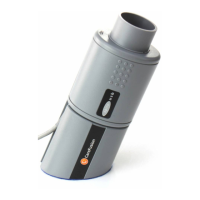
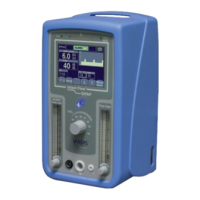
Infant Flow SiPAP nCPAP driver
be set for a duration of 0.1 to 3 seconds to produce
a “sigh.”
Note: This is not the same as pressure support. In
pressure support, the pre-set pressure supports the
inspiratory effort and the patient’s breathing pattern
determines the inspiratory time. In the BiPhasic mode, the
infant can breathe spontaneously at either pressure level.
The time high setting determines the cycle time between
the two levels of CPAP.
BiPhasic parameters:
• Baseline CPAP (set by low pressure flowmeter)
• High CPAP (set by high pressure flowmeter)
• Time high (T-high)
• Rate (cycle rate between pressures)
• Oxygen percentage
Initial settings based on respiratory conditions:
9
• Baseline CPAP 4 to 6 cmH
2
O
• Pressure high (PHigh) 1 to 3 cmH
2
O above CPAP level
• T-high 1.0 sec
• Rate 6 cycles/minute
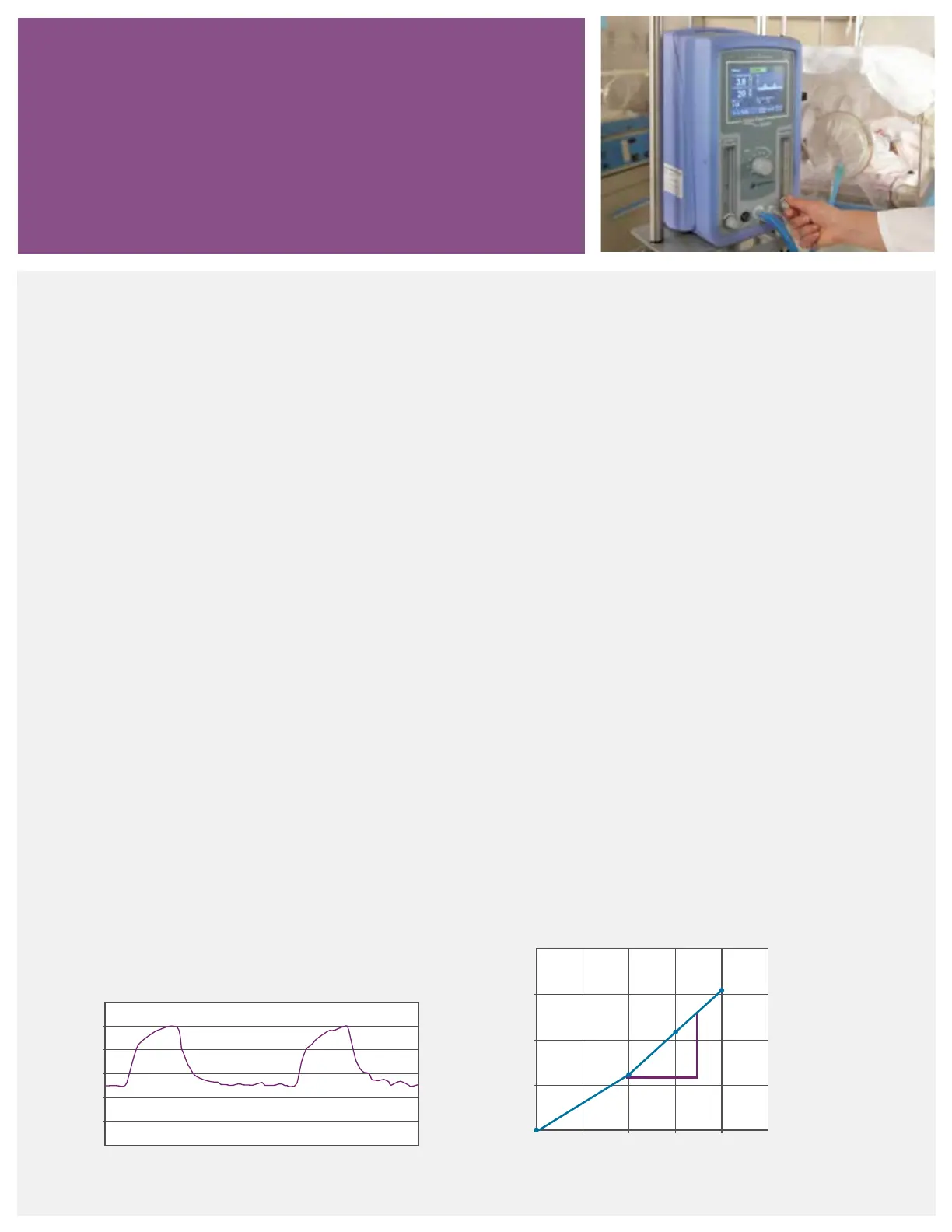
In this study, a
3 cmH
2
O shift in
pressure on an
average increased
FRC by 5.5 mL/kg.
Pandit, P. Pediatric,
2001, 108(3):682–685.
Modes of operation
Seconds
6
5
4
3
2
1
0
cmH
2
O
12
16
8
4
0
0246810
CPAP pressure
Volume change (ml/kg)
5.5 ml/kg
10
Ti = 0.2 s
Time (s)
Seconds
9
8
7
6
5
5
4
4
3
3
2
2
1
0
6
5
4
3
2
1
0
01
Pressure (cmH
2
O)
cmH
2
O
12
16
8
4
0
0246
0
CPAP pressure
5.5 ml/kg



 To Next Page