What is variable ow technology?
10,11
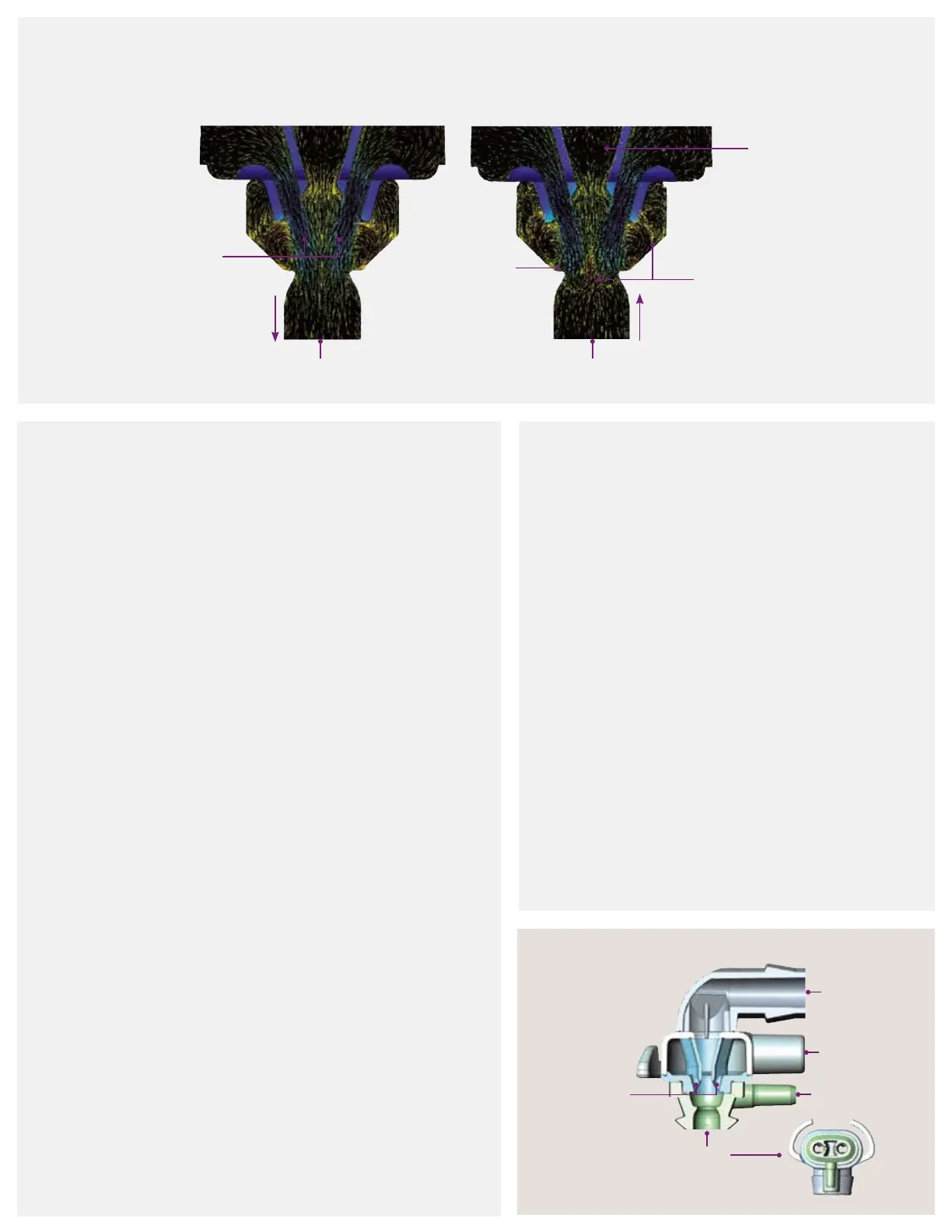
The Infant Flow LP patented dual-jet variable flow
generator utilizes fluidic technology to deliver a
constant CPAP at the airway proximal to the infant’s
nares. Without moving parts or valves, the generator
provides consistent performance. The level of CPAP
created is proportional to the flow provided by the
driver; for example, 9 LPM creates approximately
5 cmH
2
O CPAP. The variable flow generator uses
Bernoulli’s Principle via injector jets directed toward
each nare. If the infant pulls additional flow, the
venturi action of the injector jets entrains additional
flow from either the source gas or exhalation tube
reservoir. During exhalation, the incoming gas flow
redirects away from the infant. This action is referred
to as the “fluidic flip.” By redirecting the gas, variable
flow nCPAP reduces the imposed WOB. The infant
can exhale freely and conserve precious calories for
development. In summary, the direction of gas flow
in variable flow devices depends on the patient’s
respiratory cycle. The flow “flips” away from the
nares when the infant exhales and then, “flips” back
as the exhalation phase ends. The response is almost
instantaneous as it occurs at the patient’s nares.
What is vortices technology?
10,12
The patented Infant Flow LP generator is a new form of
variable ow that uses vortices technology to reduce the
imposed WOB during inhalation. Similar to the single- jet
technology, the ow entrainment reduces the WOB
on inhalation by meeting the patient’s inspiratory ow
demand and during exhalation gas ow ips away from
the patient reducing resistance.
Four low-momentum jets (two per nare) impinge inside
the generator to create a consistent and measurable
positive airway pressure within the generator head.
During inhalation, the dual jets entrain ow to meet
the patient’s inspiratory demand. During exhalation, the
jets easily deect to disrupt the gas ow. This disruption
of ow creates vortice shedding that spirals outwardly,
combining with the exhaled breath to create an
organized, efcient ow path toward the exhaust ports.
5
Variable ow technology
Impinging
jets
Patient
Pressure
line
Drive
line
Exhaust
tube
Inhalation
Dual jets
Exhalation
Patient nare
Fluidic flip
Exhaust tube
Vortice shedding
Patient nare
Flow direction Flow direction



 To Next Page