40
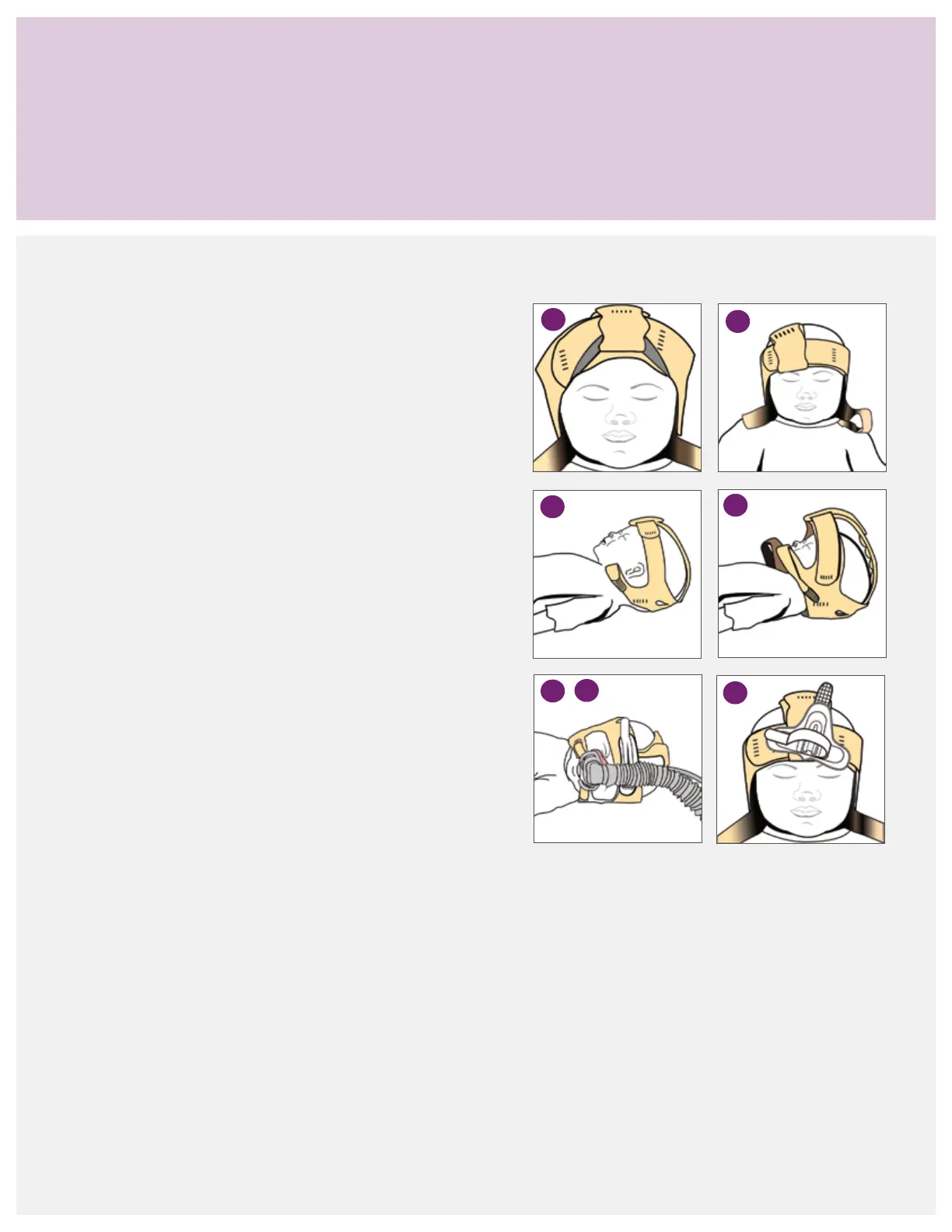
Incorrect headgear position
1. Headgear straps 1 and 3 are too high on the forehead,
and the center strap is pulled too tight.
2. The center strap 2 is not midline to the nasal profile.
Corrective action: Reposition the headgear with forehead
straps 1 and 3 positioned at the brow line, and center
strap 2 over the crown and midline with the nose.
Incorrect headgear size
3. The headgear is too small, not covering the ears and
sitting too high on the back of the head.
4. The headgear is too large, causing folds or gaps in the
back of the headgear. The side straps are too long.
Corrective action: Recheck the head circumference
measurement and resize it as indicated.
Incorrect exhaust tube position
5. The support strap is not wrapped over the exhaust tube.
6. The exhaust tubing pulls forward.
Corrective action: Unhook the support strap and position
the exhaust tube on top of the support cradle. Wrap the
support strap over the exhaust tube, and secure it to the
side of the support cradle. Ensure the slit in the support
strap fits over the corrugate.
Reposition the exhaust tube and circuit to follow the
curvature of the head.
Incorrect support cradle application
7. The support cradle overlaps the edge of the forehead
strap and does not align with midline to the nasal profile.
Corrective action: Remove the support cradle
and reposition it in the middle of the forehead
and center straps.
Properly sizing and placing the fixation device, headgear or
bonnets is essential for the proper alignment and stability
of the generator assembly. Too small and too tight of a
fixation device may cause head molding or skin irritation.
If the fixation device is too large, slippage can occur,
creating additional torque on the generator assembly
or dislodging the interface.
Incorrect application of xation device and generator assembly
5
6
3
4
1
2
7




 To Next Page