50
Frequently asked questions
Q. What does LP stand for?
A. Low pressure. The special patent design of the dual jets
requires a lower driving pressure than other variable
flow generators.
Q. Can I use my bonnets from the original Infant Flow
nCPAP system with the new Infant Flow LP system?
A. No. The Infant Flow LP bonnets have a special pad
that attaches to the support cradle. The support cradle
lifts the generator assembly up and positions it at the
correct angle over the nose. It also provides stability for
the generator. The original Infant Flow bonnets do not
provide the extra height needed to properly position
the generator assembly.
Q. Are the prongs and mask from the original Infant Flow
and AirLife nCPAP systems compatible with the Infant
Flow LP generator?
A. No. The Infant Flow LP generator is keyed specifically
for the Infant Flow LP nasal prongs and masks.
Q. Can the generator assembly and fixation devices be
used on more than one patient?
A. No. The Infant Flow LP system is for single patient
use only.
Q. How can I decrease the noise generated by the system?
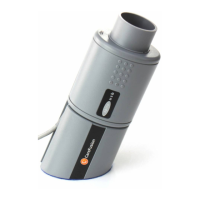
• Use an Infant Flow silencer connected to the
expiratory limb of the circuit to dampen the noise.
• Take care when using the silencer, as it may add
resistance to the system. If the filter becomes wet,
it increases resistance and WOB. Inspect the silencer
frequently, and replace it if wet. The resistance
caused by the filters varies according to the size and
type of filter material. Only use the silencer/filter
approved by CareFusion.
• Attach an extra length of corrugated tubing to the
end of the exhalation tube to direct gas flow away
from the infant and clinicians. These extension tubes
can be ordered separately.
Q. The masks keep collapsing. What should I do?
A. Check the position and placement of the generator
assembly. The generator head should be perpendicular
to the apex of the nose. If the position is too far back
or forward, it changes how pressure is applied to the
bellows and causes the mask to collapse. Check the
tension on the fixation side straps. If they are too tight,
they collapse the bellows and the mask.
Q. What can I do to prevent the headgear fixation
from slipping?
A. Measure the circumference of the head to ensure
the correct headgear size is used. Readjust the straps
until the headgear fits snugly with the forehead straps
resting at the brow line and the scalloped edge at the
nape of the neck. If the headgear is stretched out of
shape, replace with new headgear.
Q. How can I keep the prongs in place?
A. Ensure the correct prong size is used. Check the
alignment of the support cradle and generator
assembly. The generator assembly should be
perpendicular to the nasal profile. Ensure the
headgear or bonnet is properly sized and snug
to prevent the headgear from moving.
Infant Flow LP generator assembly and interface



 To Next Page