20
History fun facts
• 2698-2699 BC: Huang-Ti, emperor, recorded sudden
death from respiratory failure in neonates. He noted
deaths to be more common in premature infants.
• 1543: Andreas Vesalius, father of ventilation, described
tracheostomy, intubation and ventilation to maintain life.
• 1879: Gairal, French obstetrician, created the aerophore
pulmonaire for intermittent positive-pressure ventilation
of infants.
• 1896: Joseph De Lee described warning signs of
fetal distress, recommending to “supply air to lungs
for oxygenation.”
• 1914: A. Von Reuss described using CPAP to
resuscitate newborn infants with an oxygen tank,
mask and water bottle.
• 1963: H. Barrie described a “bubble” pressure apparatus
with tubing inserted to 40 to 50 cmH
2
O.
• 1971: George Gregory delivered CPAP via an
endotracheal tube (ET tube) to treat spontaneously
breathing neonates with RDS.
• 1975: Kattwinkel delivered CPAP using binasal prongs.
CareFusion history
• 1988: Moa and Nilsson introduced the single-jet
variable ow nCPAP using uidics via a generator
and binasal prongs.
• 1991: The rst commercial Infant Flow generator
was released.
• 1993: The rst EME Infant Flow nCPAP driver
was introduced.
• 2000: The Infant Flow Advance with a BiPhasic trigger
mode was launched.
• 2001: The swivel connector was added to the Infant Flow
generator, and the bonnet design was changed.
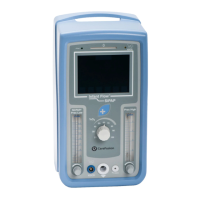
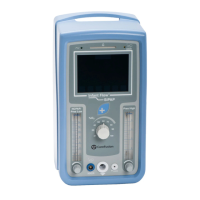
• 2004: The Infant Flow SiPAP driver with Simple Touch
operation and advance patient monitoring were introduced.
• 2006: The AirLife
®
nCPAP dual-jet variable ow generator
with headgear and antomically designed interfaces were
introduced in the U.S.
• 2011: The Infant Flow low pressure generator was
launched globally.
BiPhasic mode strategy (continued)
Strategy for weaning
• Ensure FiO
2
requirements are less than 50%
• Slowly decrease the cycle rate
Example: 20–15; 10–5
• Decrease the high CPAP to baseline CPAP
• Continue to monitor the infant’s respiratory status
and wean the infant from CPAP support as tolerated
Indications of failure to nCPAP therapy
3–6
• FiO
2
≥ 50%
• Respiratory acidosis indicated by a pH < 7.28 and paCO
2
> 50mm Hg
• Development of recurrent apnea requiring stimulation
• Development of a pneumothorax
• Worsening sternal and intercostal recession/
grunt/tachypnea
• Agitation not relieved by simple measures such
as comforting or light sedation
• Development of spontaneous episodes of signicant
desaturation (< 90% for > 20 sec)



 To Next Page