48
Infant assessment and monitoring
• Skin color
• Chest wall stability (e.g., retractions)
• Infant’s behavior (e.g., irritability)
• Skin condition around the prong or mask interface
• Respiratory rate
• Oxygen saturation
• Heart rate and rhythm
• Blood gas values
• Chest x-rays
• Perfusion-BP, peripheral pulses
• Abdominal girth—may need to insert an
orogastric tube
By utilizing this information, members of the
multidisciplinary team can provide an individualized
plan of care.
Humidification
A heated humidier is recommended to warm and
humidify the delivered gases to prevent the mucosal
lining from drying. Routinely check the generator
assembly and interface, and clear them of any mucous
or water droplets. If excessive condensation is present,
check the water level in the chamber, remove the
unheated section of the circuit or lower the humidier
temperature setting.
Nasal care
3,5,17
Prevention is the key to reducing nasal septum
damage. Preterm infants have very thin, fragile skin
due to the immature development of the stratum
corneum, which makes the skin particularly vulnerable
to damage. If subjected to continuous pressure, friction
and/or moisture, the skin will begin to break down.
Skin erosion can occur within a matter of a few hours.
Diligence in monitoring the nasal area from the bridge
to the septum is essential. Avoiding contributing
factors help to maintain an intact septum:
• Use the correct nasal prong size. Prongs that are too
large cause nare blanching. If the prongs are too
small, they may go too far up the nose and press up
against the septum.
• Ensure the side strap tension is not too tight.
• Frequently inspect the skin integrity. If noting signs
of erosion or grazing, remove the pressure, friction
or moisture. Consider alternating the prongs and
mask to change the point of pressure.
• Do not use creams, oil or gels.
• Do not cover an injured septum with hydrocolloid
shields. The increased moisture may further break
down the area.
• Use hydrocolloids and other skin shields with
caution. The skin and shields can trap moisture,
or the shield can slip and block the nasal passage.
Positioning
3,5,6
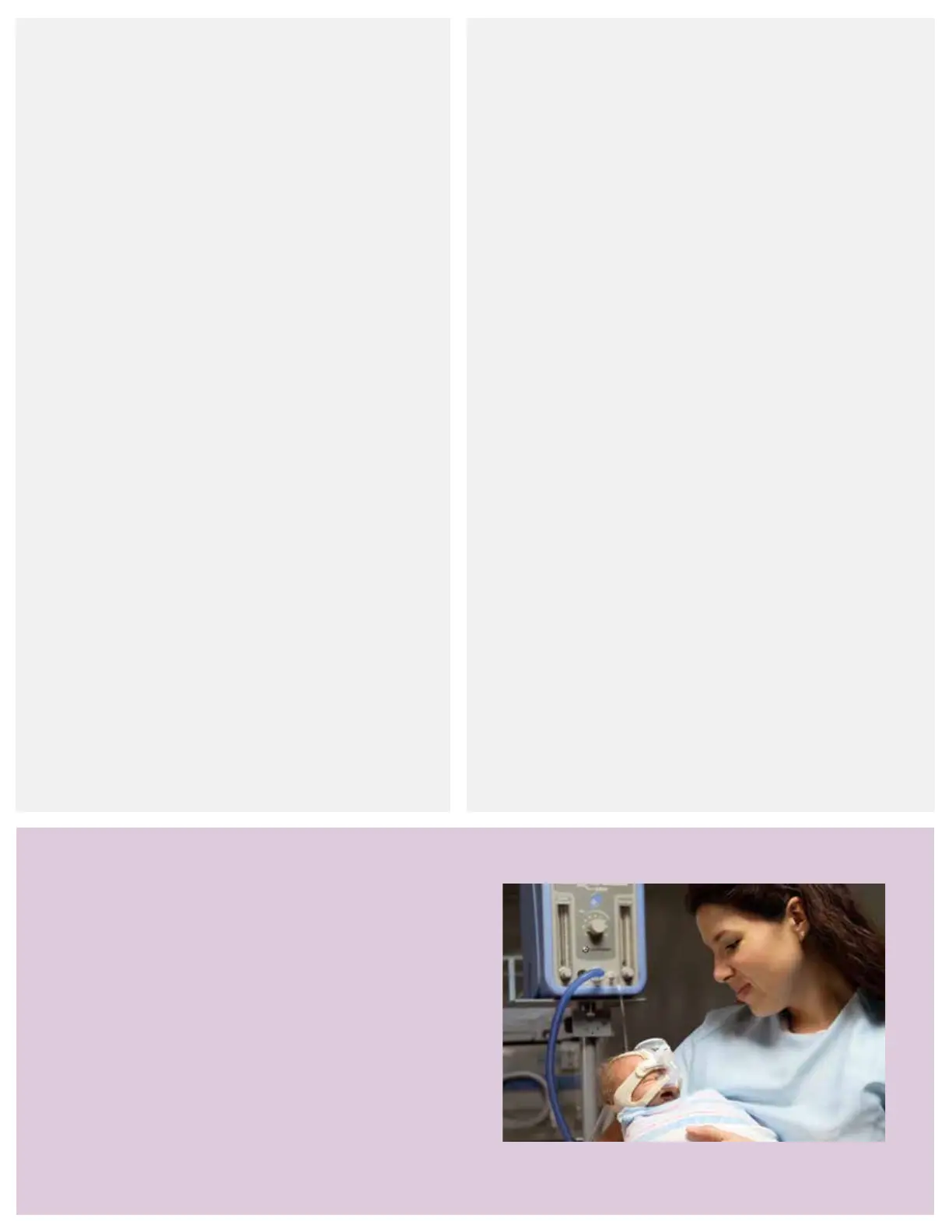
An infant on CPAP can be positioned in any position—the
prone, lateral or supine—as long as it promotes comfort
and optimal airway posturing. Repositioning is essential
to the infant’s neurodevelopmental and respiratory
outcomes. If the exion of the infant’s head and neck is
too pronounced, the airway may be compromised, but
this can be resolved by gentle extension. Positioning aids
may be benecial. Routine positioning allows thorough
assessments by the clinicians. The infant should be
repositioned as per facility standards.




 To Next Page