GE+ ACDC Installation and operation manual v11
63 / 121
5.5.5. Alarms
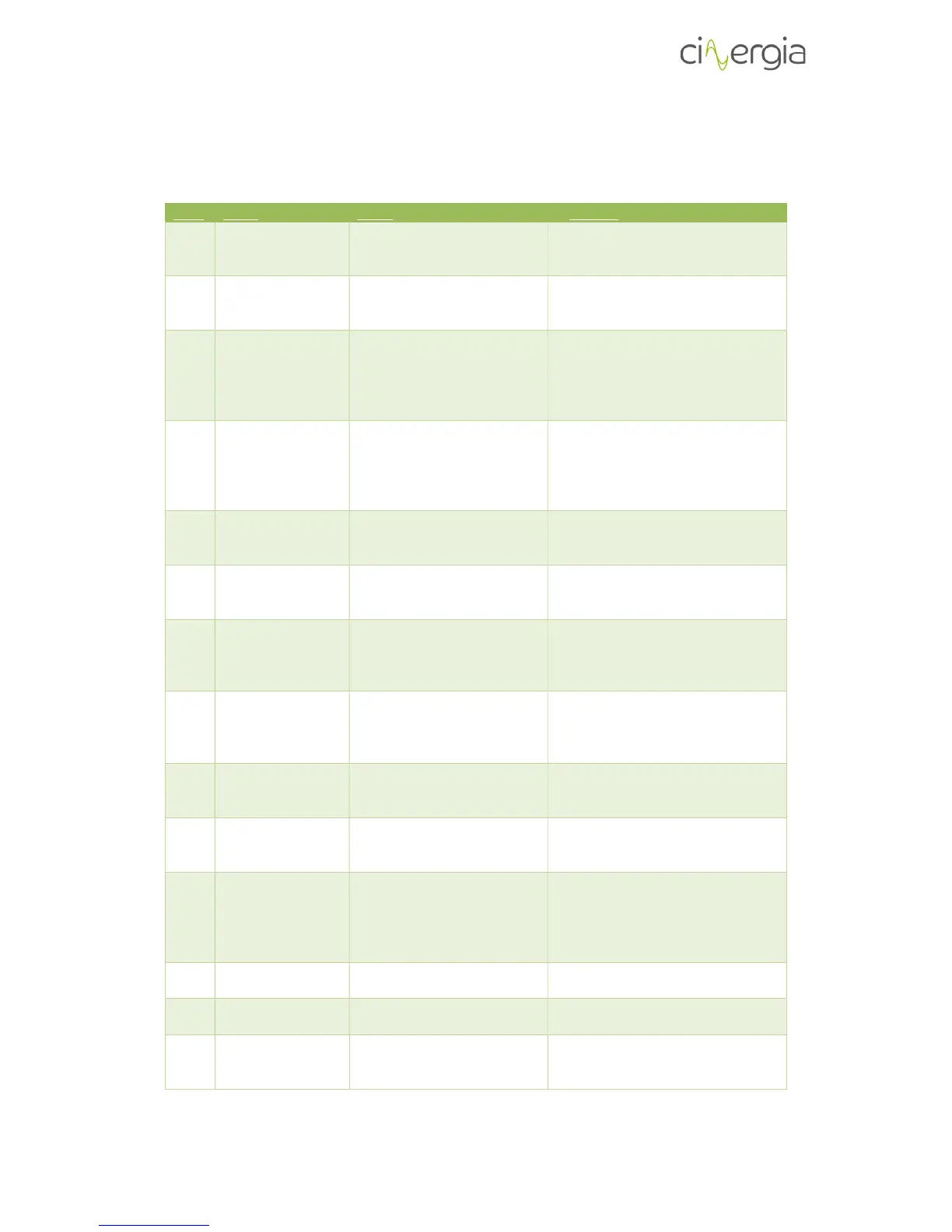
There are different sources of alarm in the power supply. The following table describes them
and offers possible causes and solutions to the user.
Code Name Cause Solution
0 Watchdog Internal microcontroller error. If this alarm persists and is the only
alarm triggered, contact Cinergia’s
technical support.
1 Emergency
sequence
The emergency stop button is
activated or the EPO wire is no
longer connected.
Unpress the emergency stop
button or reconnect the EPO wire.
2 Drivers IGBTs saturation protection
has been activated. This alarm
is triggered when there is a
sudden overcurrent in the
power supply output.
Contact Cinergia for technical
support if this alarm persists. Check
the equipment under test before
restarting the power supply.
3 Alarm precharge Internal alarm caused by a
shortcircuit. It may also be
triggered if there is not enough
time between the EPO release
and the enable signal.
Repeat the Enable action 5 seconds
after the EPO release.
Contact Cinergia for technical
support if this alarm persists.
4 Overvoltage in the
DC link
The DC link voltage has
exceeded its maximum value.
Reduce the output step transition
time. Contact Cinergia for technical
support if this alarm persists.
5 Undervoltage in the
DC link
Undervoltage in the DC link
caused by a fast output
transient.
Reduce the output step transition
time. Contact Cinergia for technical
support if this alarm persists.
6 AC overvoltage The voltage in the emulated
grid is too high. Also in DC
indicates overvoltage.
Check the emulated grid voltage. It
can be triggered due to
connection/disconnection load
transition.
7 AC undervoltage The voltage in the emulated
grid is too low. Also in DC
indicates undervoltage.
Check the emulated grid voltage. It
can be triggered due to
connection/disconnection load
transition.
8 AC overcurrent The output current has
exceeded the configured
limitation.
Check the output load.
9 AC overcurrent
Peak
The output current has
exceeded the configured
limitation (peak value).
Check the output load.
10 Heatsink
temperature ABR or
INV
Overtemperature in the
heatsink of ABR or INV.
Check if there is enough space
between the power supply and the
wall. There is insufficient air flow
inside the power supply. Check if
the fans are working correctly.
11 Room temperature Overtemperature in the room Check that room temperature does
not exceed 50ºC.
12 ABR/INV Alarmed One of the two control boards
has an alarm.
Reset alarms
13 SD Error SD in Control Board is
damaged.
Reset the equipment. Contact
Cinergia for technical support if this
alarm persists.


 To Next Page