12
Cirris 4200 Series User Manual
4. Installing Adapters/Fixturing
4.1 Installing Adapters
The 420 Series uses interchangeable adapters that connect the DUT to the tester. Cirris sells a variety of adapters that mate
to standard connectors. We can also create custom adapters for less common connectors. Visit cirris.com to learn more.
1. Push the slidelocks to the outward positions.
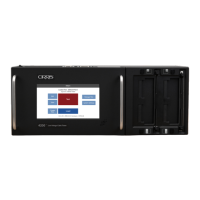
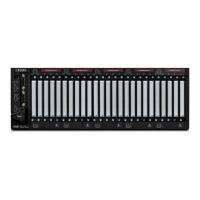
2. Set an adapter in one or more of the J1-J4 slots. With a rm but gentle force, push the adapter forward (toward the
tester’s screen). You may have to use more pressure than expected to move the adapter completely into position. Be
careful not to bend any pins as you slide the adapter into place.
Note: Larger sized adapters can take one, two, or four positions at once. For example, a connector could use both the J-1
and J-2 positions. An adapter in this position will register in the software as a J1 adapter.
3. Once the adapter is rmly connected, move the slidelocks to the inward position to hold the adapter in place.
4.2 Fixturing
Sometimes cables are built with connectors that cannot attach directly to the tester. For this reason, xturing must be built
to provide a way to connect the device-under-test (DUT) to the adapters in the tester.
Fixturing refers to the interface between the DUT and the tester. Fixturing can be a signicant portion of the investment
in a test system. Good xturing is an essential part of ensuring the accuracy of test results and maximizes the test station’s
throughput. This means xturing needs to be at least as good, if not better than the quality of your DUT. Remember, you
want to test the DUT, not the xturing.
Cirris makes generic mating cables with one end that connects to the tester while the other end has unterminated wires.
These cables save time by completing part of the work of creating xturing cables. To learn more, visit cirris.com or contact
your account manager.
4.3 Mating Cycles
The quality of parts you use to build xturing will aect the life of your xturing. Each time a connector is attached and
removed from a xturing adapter is called a mating cycle. A connector can only take so many mating cycles before it no
longer functions like it is supposed to.
Lower quality connectors (typically with tin plating) may be rated for as few as 10 to 50 cycles, while more expensive
connectors (typically with gold plating) are often rated for 500 cycles. These ocial ratings, however, specify how many
mating cycles you can expect to endure while still maintaining the specied contact resistance in the connector datasheet.
In practice, these connectors can endure far more mating cycles and still perform adequately for test measurements.
If you are focused on having very precise resistance measurements in your testing, you will want to carefully consider the
materials you use for xturing, and maintain a maintenance schedule to ensure connectors are replaced before they cause
errors in your resistance measurements.



 To Next Page