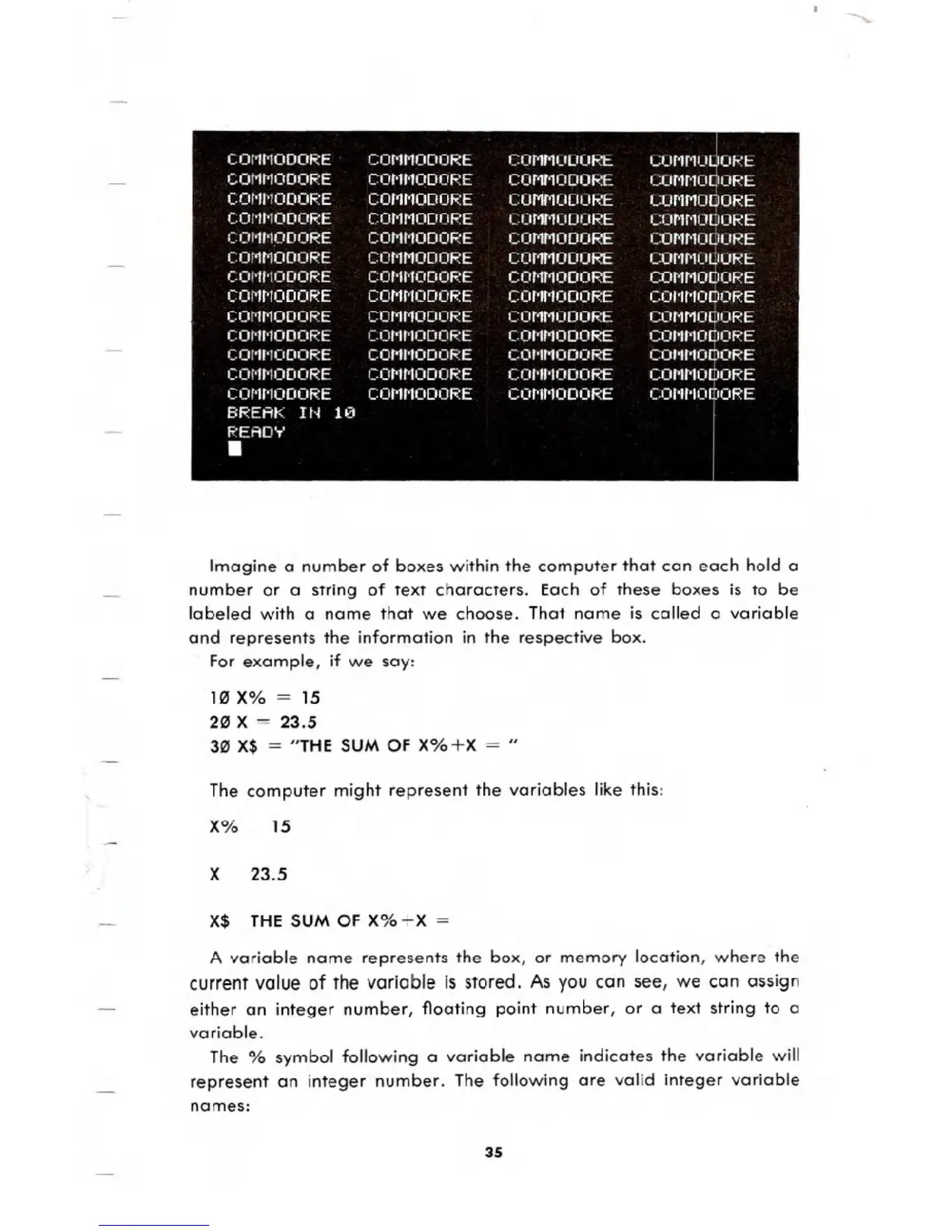
COMMODORE
COMMODORE
COMMODOR
COMMODORE
COMMODORE
COMMODORE
COMMODORE
COMMODORE
COMMODORE
COMMODORE
COMMODORE
COMMODORE
COMMODORE
BREAK IN 10
READY
.
COMMODORE
COMMODORE
COMMODORE
COMMODORE
COMMODORE
COMMODORE
~M~O~E
COMMODORE
COMMODORE
COMMODORE
COMMODORE
COMMODORE
COMMODORE
COMMODORE
COMMODORE
COMMODORE
COMMODORE
COMMODORE
COMMODORE
COMMODORE
COMMODORE
COMMODORE
COMMODORE
COMMODORE
COMMODORE
COMMODORE
I
COMMODORE
COMM06oRE
COMM06oRE
COMM06oRE
COMMODORE
COMMODORE
COMMODORE
COM~J~ORE
COMMODORE
COMMO~ORE
COMMODORE
COMMOBORE
COMMOIDORE
Imagine a number of boxes within the computer that can each hold a
number or a string of text characters. Each of these boxes is to be
labeled with a name that we choose. That name is called a variable
and represents the information in the respective box.
For example, if we say:
113X% = 15
20 X = 23.5
313X$ = "THESUMOF X%+X = "
The computer might represent the variables like this:
X% 15
X 23.5
X$ THE SUM OF X% +X
A variable name represents the box, or memory location, where the
current value of the variable is stored. As you can see, we can assign
either an integer number, floating point number, or a text string to a
variable.
The % symbol following a variable name indicates the variable will
represent an integer number. The following are valid integer variable
names:
35





 To Next Page