D-EIMHP01702-23_00EN- 14/72
37- the accidental discharge of refrigerant in a closed area can cause a lack of oxygen and, therefore, the risk of asphyxiation:
install the machinery in a well-ventilated environment according to EN 378-3 and the local regulations in force.
38- the installation must comply with the requirements of EN 378-3 and the local regulations in force; in the case of
installations indoors, good ventilation must be guaranteed, and refrigerant detectors must be fitted when necessary.
General description
The unit purchased is a Water Chiller and/or a Heat Pump, that is a machine designed to cool/heat the water (or a water-glycol
mixture) within certain limits which will be listed below. The unit operates based on the compression, condensation, and
evaporation of the coolant refrigerant, according to the Carnot cycle, and is composed mainly of the following parts depending on
the Mode of Operation.
Chiller (cooling/heating mode):
• Two scroll compressors that increase the pressure of the refrigerant gas from evaporation to condensation pressure.
• A condenser where the refrigerant gas under high pressure condenses transferring the heat to the water.
• Expansion valve allowing to reduce the pressure of condensed liquid refrigerant from condensation pressure to evaporation
pressure.
• Evaporator, where the low-pressure liquid refrigerant evaporates chilling the water.
Heat Pump:
• Two scroll compressors that increase the pressure of the refrigerant gas from evaporation to condensation pressure.
• A 4-way valve which enables the inversion of the refrigeration cycle.
• A heat exchanger in which the refrigerant condenses heating the water.
• Expansion valve allowing to reduce the pressure of condensed liquid from condensation pressure to evaporation pressure.
• A heat exchanger where the low-pressure refrigerant evaporates removing the heat from the water.
• The operation of the heat exchangers can be inverted using the 4-way valve, with which the use of the heating/cooling unit can
be seasonally inverted.
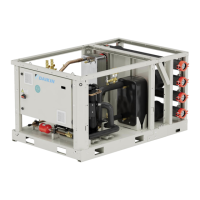
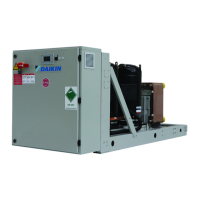
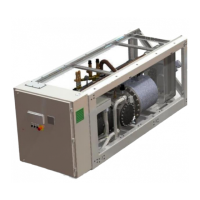
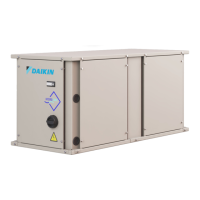
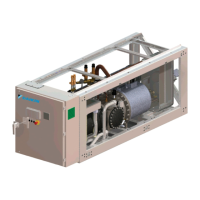
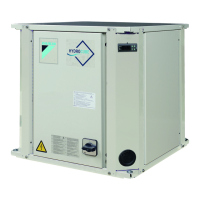
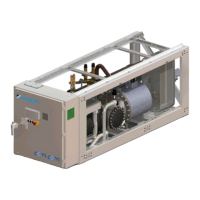
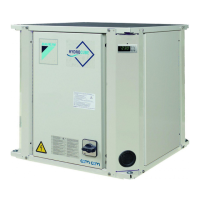
The Daikin EWWT-Q/ EWLT-Q / EWHT-Q modular water-cooled water chillers and heat pump can be used for cooling and heating
applications. XS version is designed for indoor installation while XR version is suitable also for outdoor installation. EWWT-Q and
EWLT-Q units are available in 3 standard sizes and for their nominal cooling capacities see Databook tables. The EWHT-Q is
available in one standard size and for their nominal cooling capacities see Databook tables.
The present installation manual describes the procedures for unpacking, installing, and connecting the EWWT-Q/ EWLT-Q /
EWHT-Q units.
In case of any discrepancy between this manual and the equipment’s documents please refer to on board documents. In case of
any doubt contact the manufacturer representative.
The purpose of this manual is to allow the installer and the qualified operator to ensure proper, commissioning, operation and
maintenance, without any risk to people, animals or things.
Information about the refrigerant used
This product contains R32 refrigerant that has a minimal environmental impact, thanks to its low value of Global Warming Potential
(GWP). According to ISO 817, R32 refrigerant is classified as A2L, which is slightly flammable, since the flame propagation rate is
low, and non-toxic.
R32 refrigerant can burn slowly when all the following conditions are present:
• The concentration is between the lower and upper limit (LFL & UFL).
• T Wind velocity<propagation of flame velocity
• Energy of the ignition source>Minimum ignition energy
But pose no risk under the normal usage conditions for air-conditioning equipment and work environment.
Installation requirements
Before machine installation and commissioning, the people involved in this activity must have acquired the information necessary to
carry out these tasks, applying all the information collected in this book all the procedures reported in the norms and the provided
requirements by the local law.
Do not allow unauthorized and/or unskilled personnel to access the unit.




 To Next Page