D-EIMHP01702-23_00EN- 32/72
5.3.1 To braze the pipe end
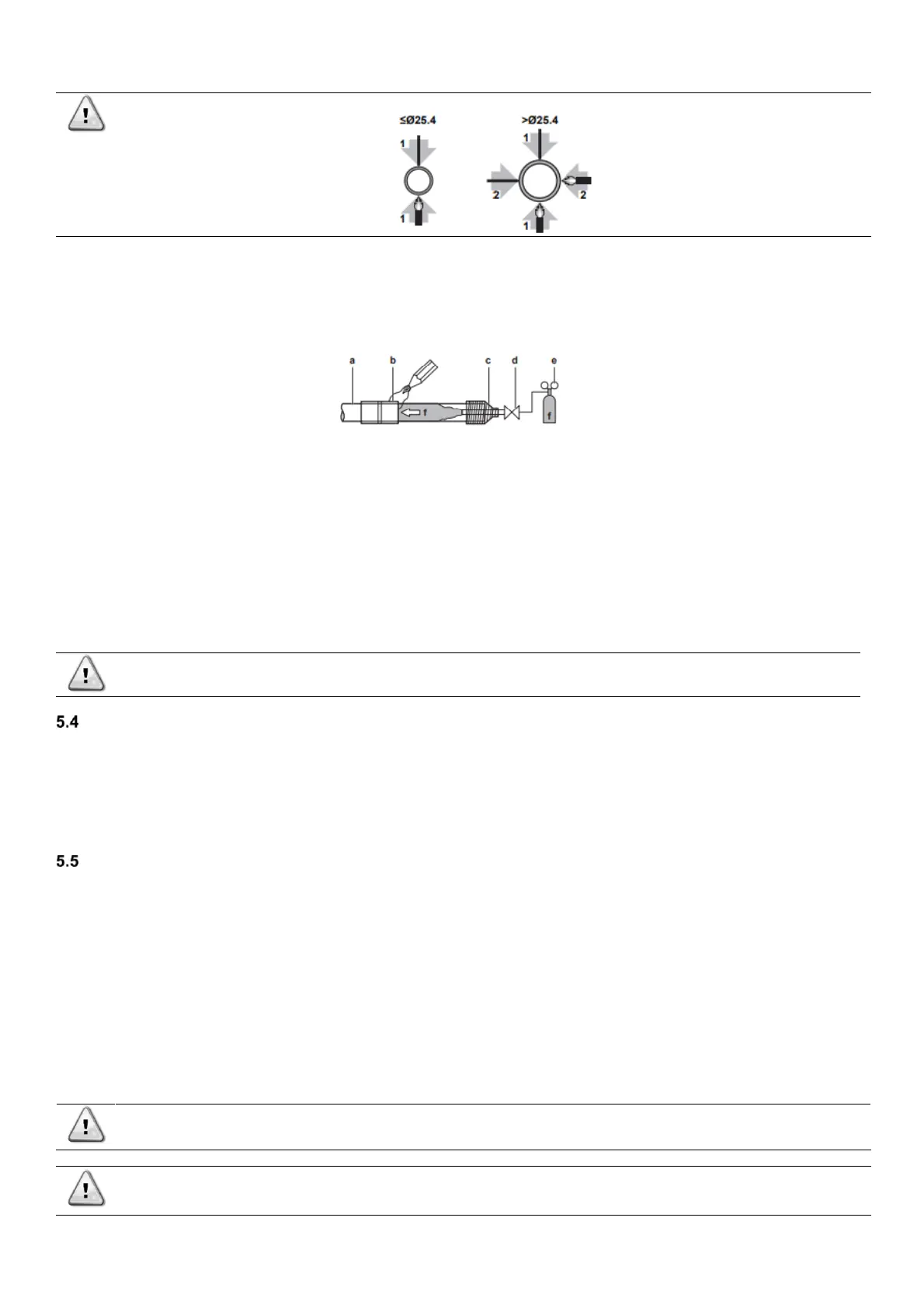
Precautions when connecting field piping. Add brazing material as shown in the figure below:
▪ When brazing, blow through with nitrogen to prevent creation of large quantities of oxidised film on the inside of the piping. This film
adversely affects valves and compressors in the refrigerating system and prevents proper operation.
▪ Set the nitrogen pressure to 20 kPa (0.2 bar) (just enough so it can be felt on the skin) with a pressure-reducing valve.
Fig. 19 – Pipe Brazing
a) Refrigerant piping
b) Part to be brazed
c) Taping
d) Manual value
e) Pressure-reducing valve
f) Nitrogen
Do NOT use antioxidants when brazing pipe joints. Residue can clog pipes and break equipment.
▪ Do NOT use flux when brazing copper-to-copper refrigerant piping. Use phosphor copper brazing filler alloy (BCuP), which does
not require any flux. Flux has an extremely harmful influence on refrigerant piping systems. For instance, if chlorine-based flux is
used, it will cause pipe corrosion or, in particular, if the flux contains fluorine, it will deteriorate the refrigerant oil.
Make sure that the pipes are flushed with nitrogen during the brazing, to protect them from soot.
Leak test and vacuum drying
The condenser-less units have already been checked at the factory guaranteeing that there are no leaks.
Once the pipes have been connected, a leak test must be performed once again.
Before any vacuum procedure begins, it is necessary to make sure that the expansion valve of the unit is FULLY OPEN. Otherwise,
it will not be possible to perform a complete vacuum process. Follow the procedure stated in the operation manual to open the
expansion valve.
The air in the refrigerant circuit must be evacuated at a value of 4 mbar absolute, using the vacuum pumps.
Charging the unit
Carefully perform all required procedures like explained in chapters from which is referred to in chapter “BEFORE STARTING”, but
do not start the unit. It is also necessary to read the operation manual delivered with the unit. This will contribute to understand the
operation of the unit and its electronic controller.
While charging the refrigerating gas, make sure to follow one of the procedures stated below:
• PLATE HEAT EXCHANGER FILLED WITH WATER: Turn on the water pump during the charging process to let the water circulate.
This is to avoid that the expansion that happens while the refrigerating gas fills the heat exchanger leads to an excessive cooling of
the water which may then freeze. The continuous circulation of the water will prevent the water itself from freezing. To manually turn
on the water pump, see further details on the Operating Manual.
• PLATE HEAT EXCHANGER EMPTY (NO WATER INSIDE): It is possible to charge the refrigerant without turning on the water
pump.
Only use R32 as refrigerant. Other substances may cause explosions and accidents.
R32 contains fluorinated greenhouse gases. Its global warming potential (GWP) value is 675. Do not vent these
gases into the atmosphere.
when charging refrigerant, always use protective gloves and safety glasses.




 To Next Page