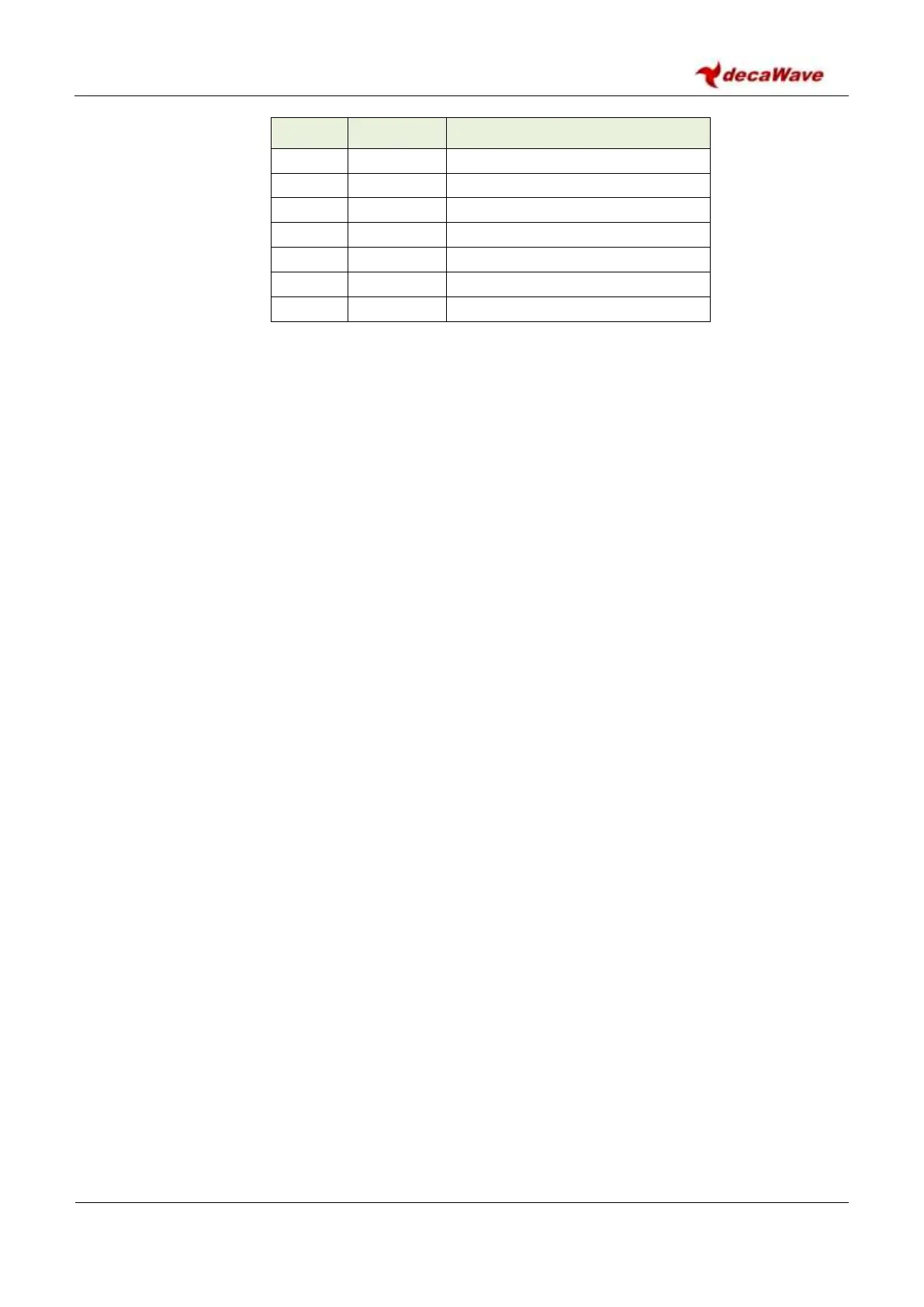
Calibration Separation (m)
The combined transmitter and receiver antenna delay is calibrated by choosing a distance (or receive power)
for calibration and modifying the receiver antenna delay until the range reading given by the device is
correct.
A method to calibrate combined receiver and transmitter antenna delay is as follows:
1. Place the transmitter and receiver at the recommended distance apart as per Table 56 or at a
shorter distance but ensuring that the receiver power level is as per Table 55
2. Using a two way ranging scheme (e.g. “DecaRanging” available from Decawave), perform 1000
ranges.
3. Adjust antenna delay until the average measured range matches the distance chosen in step 1 as
closely as possible.
Record the antenna delay value. This value is then divided by 2 and the new value is stored in the OTP
memory in the locations for both TX Antenna Delay and RX Antenna Delay (see section 6.3.2 – Programming
a value into OTP memory for details of how to program OTP memory and recommended memory locations).
Note: In many systems, where all devices have the same transmitter and receiver antenna delays, it is
unnecessary to calibrate the transmitter antenna delay. The transmitter antenna delay may be set to zero
and a combined receiver and transmitter delay value may be used for the receiver antenna delay without
impairing the ranging performance of the system.
The DW1000 ranging algorithm will calculate the time of reception of a packet in order to estimate the range
to the transmitter. The receiver antenna delay is a constant value representing the propagation time of the
received signal from the antenna to the receiver point of timestamp calculation.
This antenna delay value can then be subtracted from the receive timestamp in order to calculate the time
of flight.
For enhanced ranging accuracy the ranging software can adjust the antenna delay to compensate for
changes in temperature. Typically the reported range will vary by 2.15 mm / °C and by 5.35 cm / V
BATT
.


 To Next Page