not return to sleep but continues to receive preamble and the data frame, and after successful reception can
generate a receive frame interrupt to wake the host microprocessor to process the frame.
A typical example of this would be to use a sleep time of 1 second and a wake-up period of 2 PAC intervals,
where the average current for briefly listening and going back to sleep is very low. To wake up a device
operating in this low-power listening receiver mode, a transmitting device has to send sufficient data to
ensure that it is heard by the listener. Essentially then the transmitter has to send > 1 second of message to
ensure that it intersects with the short listening period of the receiving device. In practice this is done by
sending the same message repeatedly. In doing this, there is a finite chance that the listener listens at a time
when the transmitted preamble is not present. To avoid this, and give a better performing wakeup, the
DW1000 includes the ability to do a two-phase listen. This has a long sleep period followed by a sampling of
the air, followed by a short sleep period and then another sampling of the air. The short sleep time period is
set to ensure that if the first listen hits a message (missing the preamble) then the next listen will see
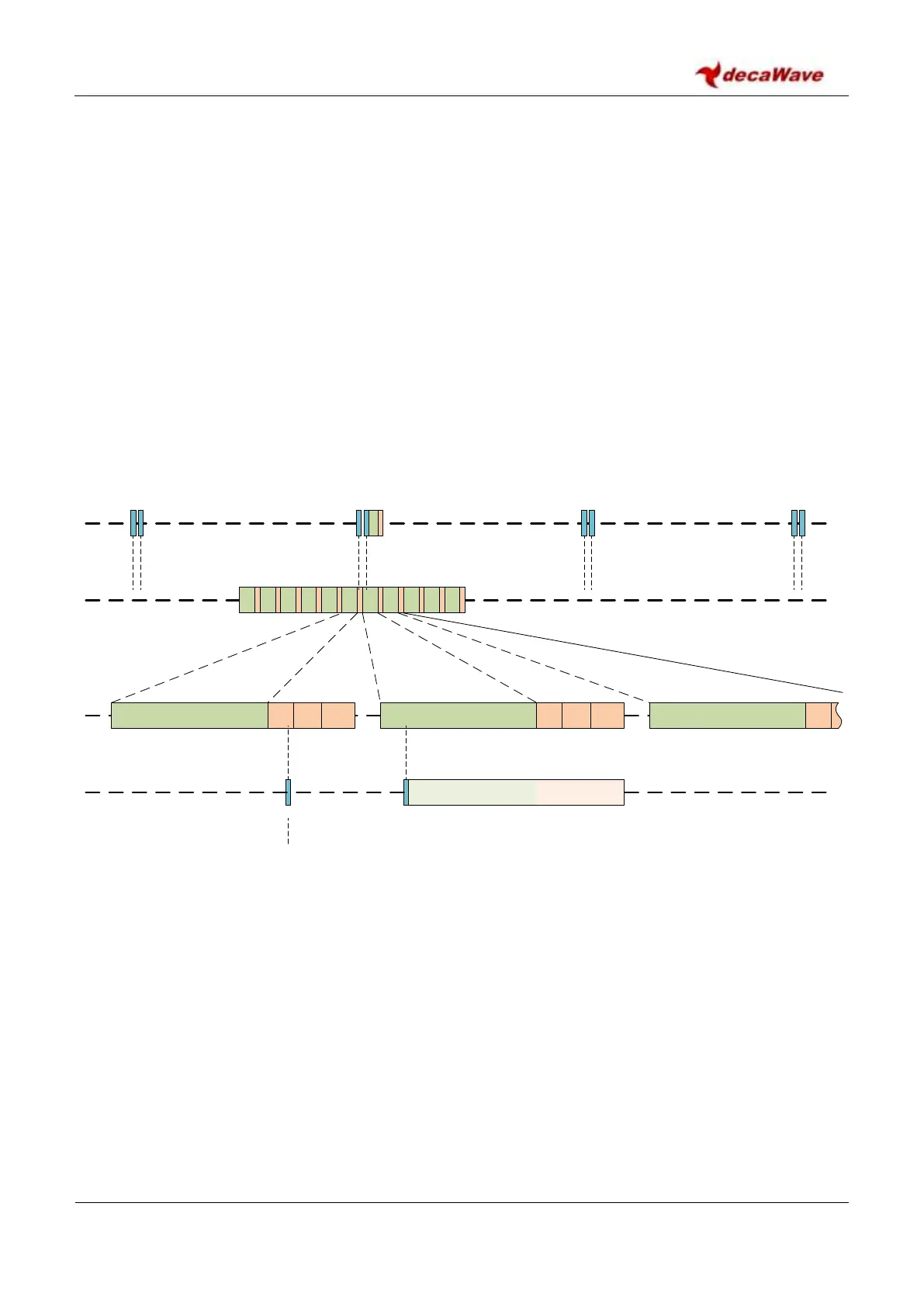
preamble. Figure 16 below shows the periodic listening for preamble and a wakeup sequence where the first
listening period intersects with the PHR or DATA, but where the second listening period allows successful
reception.
Figure 16: Low power listening with two sleep times
NOTE: Low-power listening works best for infrequent wake-ups across a population of listening nodes. The
reason is that every listening node will see preamble and wake-up and consume power receiving the packet
(even if the packet is not addressed to it).
In Figure 16 there is a long period in SLEEP (or DEEPSLEEP) followed by a wakeup to the RX state (on) to sniff
for preamble, followed by (assuming no preamble is detected) a short period in SNOOZE state, followed by
the second RX state (on) to look for preamble, and (again assuming no preamble is detected) a return to
SLEEP (or DEEPSLEEP). Figure 17 shows the power profile associated with Low-Power Listening. If a
preamble is detected in either of the two receive windows, then the frame will be demodulated and an
interrupt set (if configured to do so).
Preamble SFD PHR DATA
IFS
Preamble SFD PHR DATA
IFS
Preamble SFD
Long Sleep (e.g. 1s) Long Sleep (e.g. 1s) Long Sleep (e.g. 1s)
Long Sleep (e.g. 1s) Short Sleep (e.g. 1.3ms)
Wake-up sequence 1s long
Preamble sample
RX Frame
Detect preamble & Receive the frame
1
st
Listen
2
nd
Listen


 To Next Page