4 Message Reception
4.1 Basic Reception
The reception of a frame is enabled by a host request or by an automatic re-enabling of the receiver. The
receiver will search for preamble continually until preamble has been detected or acquired, when a
demodulation will be attempted. A preamble detection timeout may be set to allow the receiver to stop
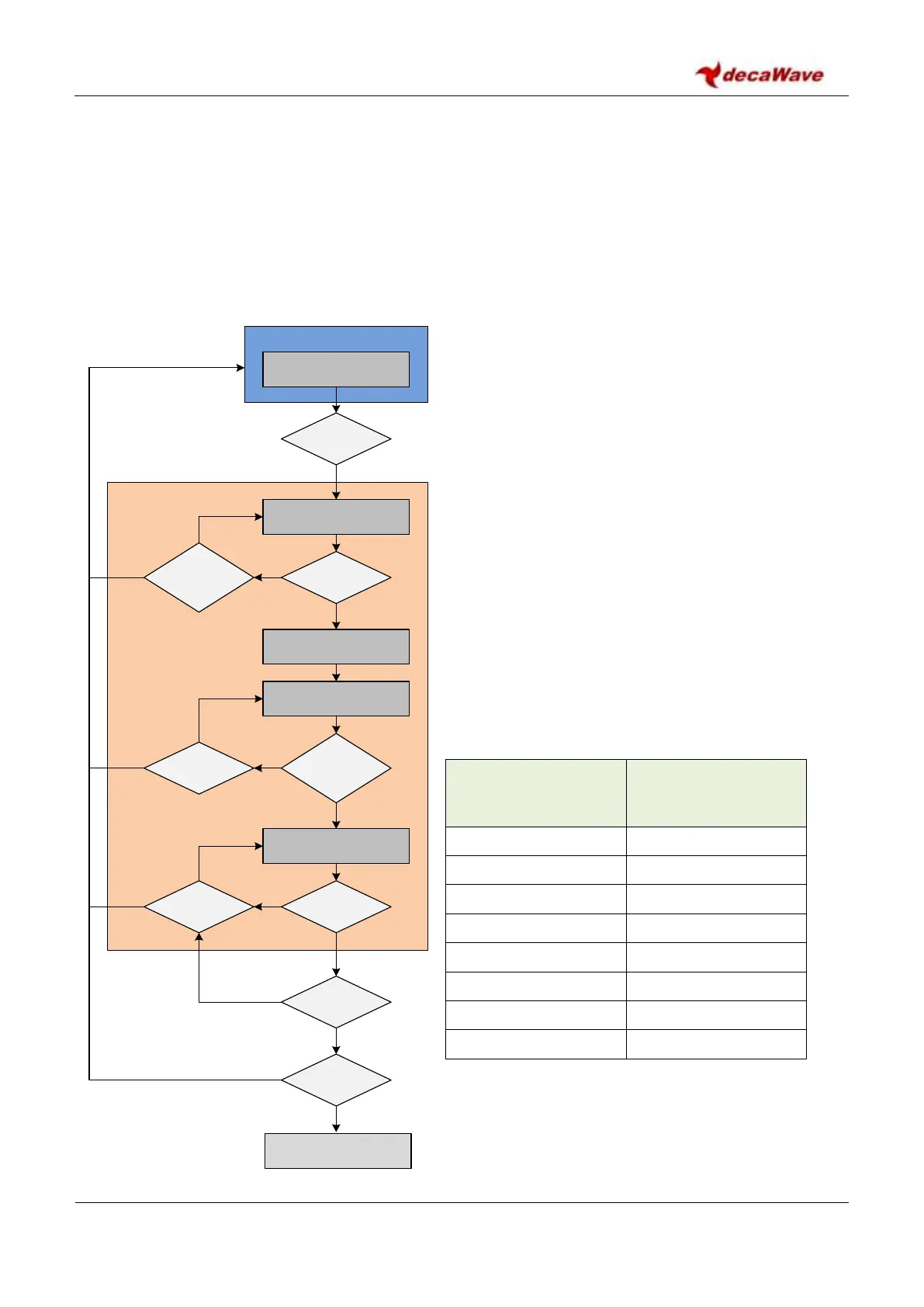
searching for preamble after a desired period. A basic receive sequence is shown in Figure 12.
4.1.1 Preamble Detection
The preamble sequence is detected by cross-correlating
in chunks which are a number of preamble symbols
long. The size of chunk used is selected by the PAC
configuration in Sub-Register 0x27:08 – DRX_TUNE2.
The PAC size should be selected depending on the
expected preamble size. A larger PAC size gives better
performance when the preamble is long enough to allow
it. But if the PAC is too large for the preamble length
then receiver performance will be impaired, or fail to
work at the extremes – (e.g. a PAC of 64 will never
receive frames with just 64 preamble symbols). Table 6
gives the recommended PAC size configuration to use in
the receiver depending on the preamble length being
used in the transmitter.
Table 6: Recommended PAC size
Expected preamble
length of frames being
received
The choice of preamble length is discussed in section 9.3
– Choice of data rate, preamble length and PRF.
It is possible to abort reception if a valid preamble is not
detected within a configured time. This is done by using
NO
RX
complete?
NO
YES
AUTOSLEEP?
Configure Rx parameters
Search for Preamble
RX START?
RECEIVE
YES
IDLE
Preamble
Detected?
Preamble
Detection
Timeout?
YES
NO
NO
YES
Acquire SFD
Preamble
Acquisition
complete?
SFD Timeout?
YES
NO
NO
YES
Acquire data
Frame
Received?
YES
NO
Frame Wait
Timeout?
YES
Acquire Preamble
NO
YES
SLEEP
Figure 13: Basic receive sequence


 To Next Page