UltiMate 3000 RSLCnano – Standard Applications
7
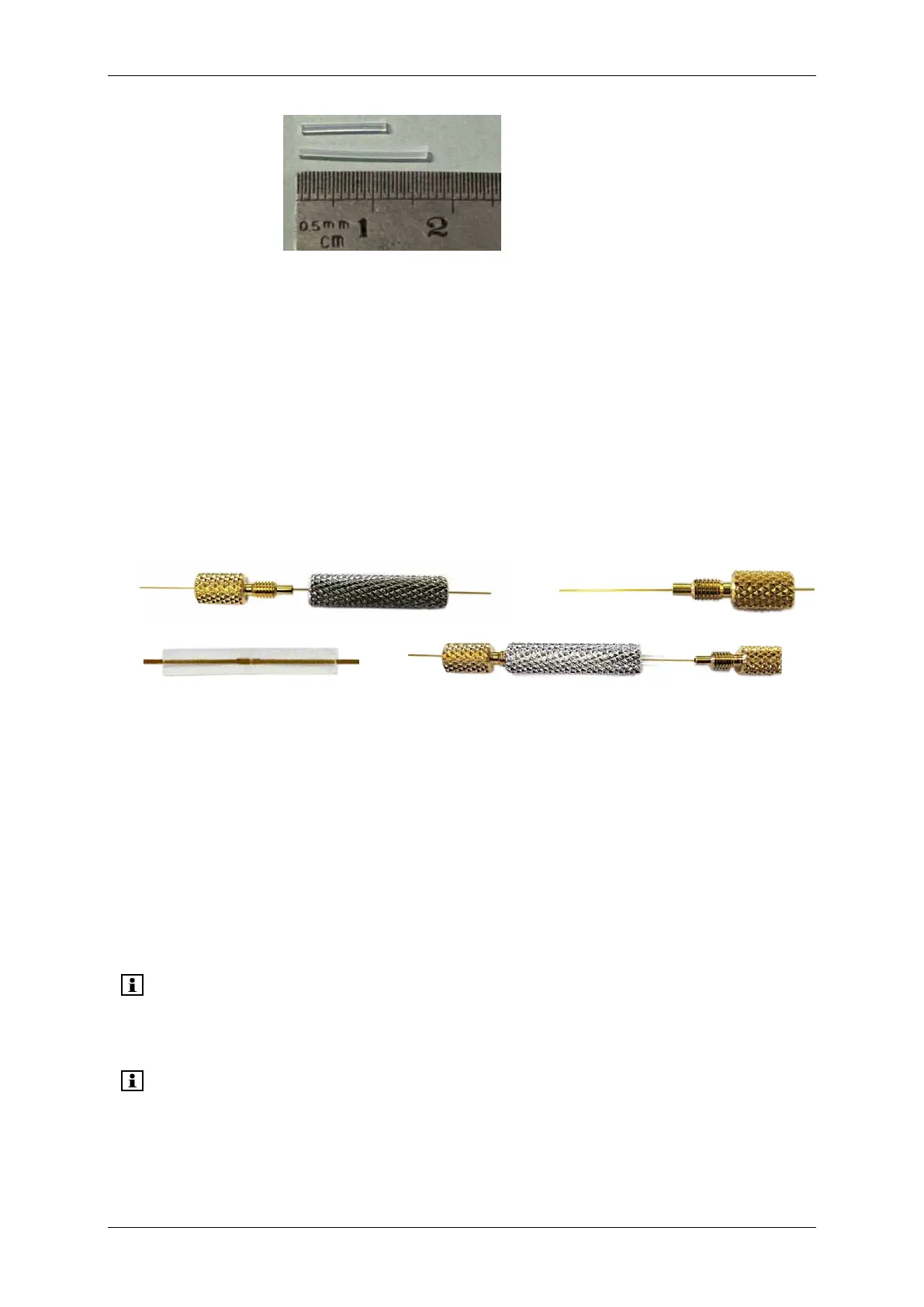
Nano connector sleeve (~1.1 cm)
PTFE (1.8 cm)
Figure 3: nano connector (top) and PTFE (bottom) sleeve comparison
1. Slide the golden nut and silver union onto one of the fused silica outlets; slide the
second golden union on the other fused silica end. (→ Figure 4a and Figure 4b)
2. Slide the nano connector sleeve onto the fused silica, slide the other end of the fused
silica into the nano connector sleeve and make sure the connection is dead volume free.
Figure 4c
3. Tighten the golden nuts equally fingertight to ensure the nano connector sleeve is
centered in the silver union. Figure 4d
4. For traditional fittings, for example, PTFE sleeves see Appendix – Traditional Capillary
Connections (page 54)
a
b
c
d
Figure 4: Using the nano connector
2.1.2 Sample Preparation
• Follow the instructions provided with the test sample and use the solvents as indicated.
• After re-dissolving the sample wait at least 15 min before further diluting it.
o Use water with a minimum of 2 % ACN and appropriate ion-pairing agent to
dissolve.
o Dilution can be done in the same solvent or with water with appropriate ion-pairing
agent.
Tip: To limit the risks of peptides or proteins adsorption on the walls of the vials,
Thermo Fischer Scientific recommends using glass inserts (Polypropylene vials
for WPS with glass insert, 250 µL, set of 25, P/N 6820.0027).
Tip: When using IEX columns, make sure that the sample solvent contains a very
limited amount of salt and is at the right pH level (for example, adjust to pH 3
when using a SCX column to separate peptides).



 To Next Page