30
8.4.3 SETTING THE PRIMARY INPUT TYPE FOR AN AMPLIFIED TRANSMITTER
If using a voltage or current output transducer, the model number of the transducer will designate its
own electrical output. For example, a PT4624-7.5M-6/18 or an S840-000-10M has an amplified
signal output. In plastic melt applications, amplified units have a number where the strain gage units
have a letter (E or A). The PT4624-7.5M-6/18 has a 4-20 mA signal output; the PT4625-7.5M-6/18
has a 0-5 Vdc signal output, while PT4626-7.5M-6/18 has a 0-10 Vdc signal output. In Industrial
applications, amplified units have a middle or end number of 4, 5, or 6. The S840-000-1C has a 4-
20 mA signal output; the PT150-7.5M has a 0-5 Vdc signal output, while PT276-5M has a 0-10 Vdc
signal output.
If you have a strain gauge transducer, load cell, or other mV/V device, see Section 8.4.1.
The Instrument’s default setting is strain gage input. To select another input for a transmitter or to use
another process instrument, such as humidity sensors, position sensors, etc., press the FUNC key until
nonE
and
GROUP
show on the display. Press the ▲ key until
5
shows in the upper display. Press the
FUNC key and the upper display will show
Str
while the lower display shows
PI.TYP
. Press the ▼ or ▲
key until the upper display changes to the correct value (
0-20
for 0-20 mA linear input,
4-20
for 4-20
mA current loop input,
0-5
for 0-5 Vdc linear input, and
0-10
for 0-10 Vdc linear input. Press the FUNC
key to set the value. Press the RESET key to go back to the active display.
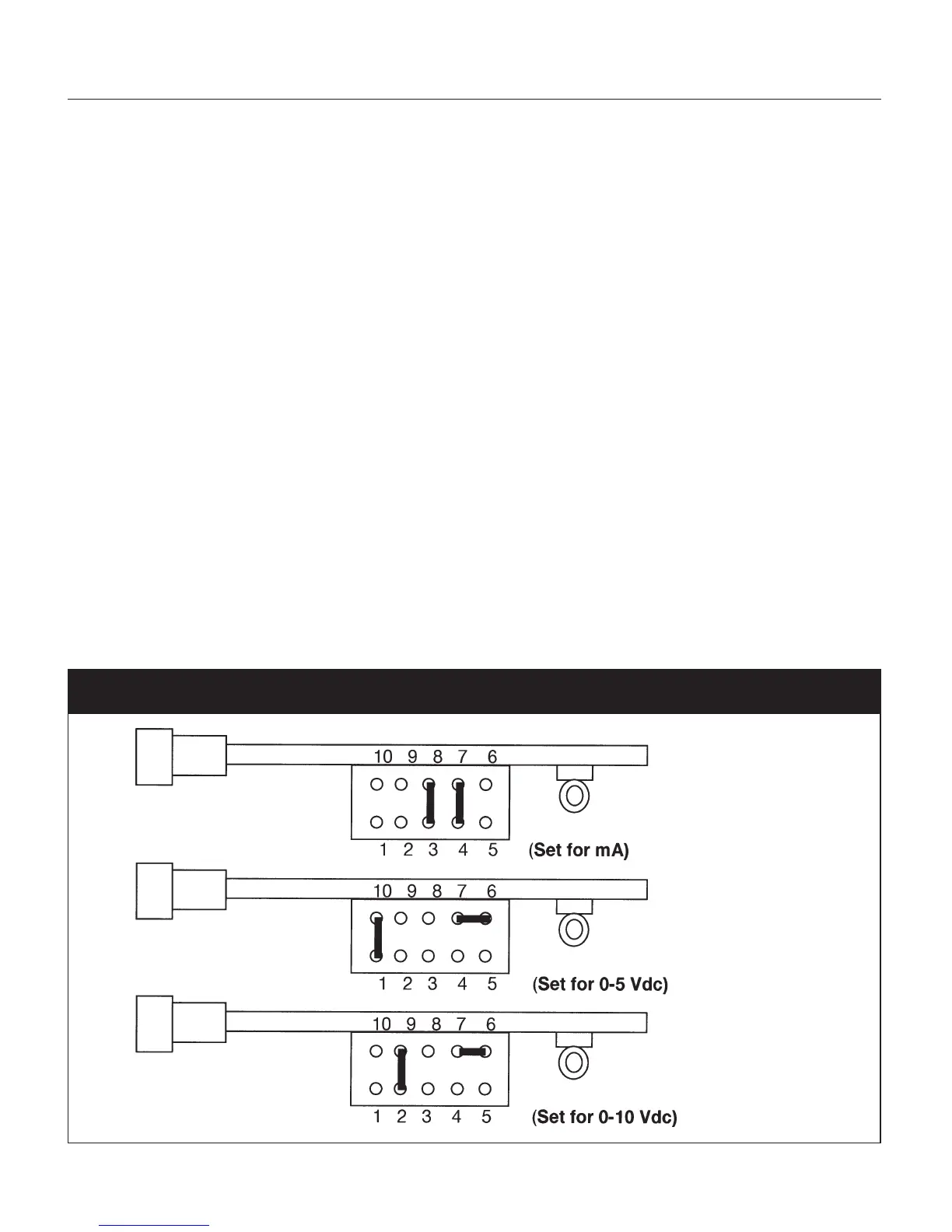
Remember to change the jumper settings to correspond to the proper input as shown in Figure 6 for
board location and Figure 8 for amplified input jumpers.
Fig. 8 Input Selection J84 for Amplified Input


 To Next Page