
 Need help?
Do you have a question about the Eaton STS 2000A and is the answer not in the manual?
The Eaton Static Transfer Switch (STS) 2000A 3-Pole is a sophisticated power distribution device designed to ensure continuous power supply to mission-critical loads by seamlessly switching between two independent three-phase AC input power sources. Unlike electromechanical transfer switches, the STS 2000A utilizes semiconductor technology, specifically silicon controlled rectifiers (SCRs), for faster and more reliable transfers without moving parts.
The primary function of the STS 2000A is to mitigate power anomalies that occur between uninterruptible power supplies (UPSs), utility power sources, or other power sources and the STS load. These anomalies can include loss of an upstream source, out-of-specification power, faulty transformers in power distribution units (PDUs), or nuisance tripping of circuit breakers. The STS 2000A automatically or manually transfers the output load from one power source to the other if the active source fails or goes out of specification, or for testing and maintenance purposes. The device supports two input AC power sources that should be nominally of the same voltage, phase rotation, and frequency, typically from UPSs, utility power, transformer outputs, or PDU outputs. It provides a single AC output to supply redundant power to downstream loads, switching a 3-phase AC load while the neutral wire remains unswitched.
The STS 2000A incorporates advanced transfer algorithms to ensure minimal disruption during switching. The patented Volt Second Synchronizing (VSS) algorithm is a key feature, dramatically reducing current inrush when transferring between sources, especially when downstream transformers are present. This algorithm limits transformer inrush to approximately 1.5 times the transformer’s full load current rating, preventing outages caused by tripping circuit breakers. Automatic transfers using the VSS algorithm are completed in 3/4 of a cycle or less, including sense time, even for 180° out-of-phase sources. For situations without downstream transformers, a faster Power or Gate (POG) algorithm can be used, completing automatic transfers in 1/4 cycle or less. Sense algorithms continuously monitor power sources for out-of-specification conditions, with adjustable parameters for fine-tuning.
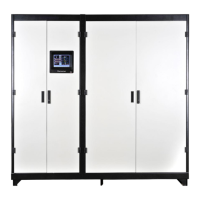
The STS 2000A offers a comprehensive set of operational interfaces and controls. The primary interface is a 10.4-inch diagonal color graphics touchscreen display, which provides a dynamic one-line mimic diagram showing active and inactive power paths, bypass status, and real-time measurements. It also allows access to setup and configuration settings, administrative and operational controls, alarm and event logs, AC waveform captures for transfer events, digital and analog points (Modbus registers), voltage and current measurements, harmonics data, and load trending.
A Voice Unit provides audible announcements for alarms and cleared alarms, as well as operational cautions and step-by-step instructions for procedures like entering Bypass Mode. The Redundant Operator Interface (ROI) serves as a backup, always active, providing manual transfer capabilities and setting the operational mode (Normal or Redundant). Login is not required for the ROI, but key access to the front doors ensures security.
The system supports various communication methods for remote monitoring and control:
Security features include user-specific Personal Identification Numbers (PINs) and passwords, with different access levels (Administrator, Service, Operator) to control actions. Only one user can be logged in at a time, and all logins, logouts, and parameter changes are recorded in the Event Log. Physical security is maintained through key-locked doors for access to internal components.
Optional features enhance flexibility, such as a second MCSW Isolation Switch for redundancy and an Enhanced Contractor Board for additional dry contact and communication options, including a Multi-Switch Link Option for N+1 UPS configurations, coordinating multiple STS units with a single backup UPS.
The STS 2000A is designed for ease of maintenance and high availability. All control and logic components are mounted separately from power components, and MCCBs and MCSWs are draw-out type for easy replacement. Front and rear access (30 inches clearance) is required for installation and maintenance. The unit can be put into a Bypass Mode to isolate electronic components from power sources, allowing safe servicing without interrupting the output load. Kirk Key Interlocks enforce correct coordination between breakers during bypass operations, preventing cross-currents.
The system provides extensive diagnostic information through its touchscreen display and web interface, including:
Eaton offers comprehensive service contracts, including factory-trained technicians for emergency on-site assistance, preventive maintenance visits (inspection, testing, calibration, software updates, cleaning), and time and materials coverage. These services ensure the continued reliability and optimal performance of the STS 2000A.



 To Next Page
 General