10 Eaton Static Transfer Switch 2000A 3-Pole Installation and Operation Manual 164001127—Rev 01
– Each signal bus continuously transmits “bus integrity” signals, when not transmitting true data. If the
“bus integrity” signals are not received by all receivers, then that bus is considered discontinuous and
is alarmed.
– The CAN Bus has circular redundancy so that there are two paths. One path can be severed and
signals will continue to flow via the other path.
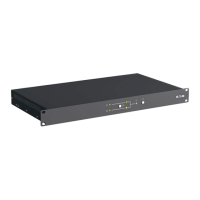
• • The STS has two levels of operator controls and status displays. The Monitor and display is backed
up by the Redundant Operator Interface (ROI).
11..66 OOppeerraattiioonnaall IInnffoorrmmaattiioonn aanndd CCoonnttrroollss
The STS has a color graphics touchscreen, a backup operator interface (the ROI), help screens, and audible
voice assistance that supplements the display in certain situations.
11..66..11 GGrraapphhiiccss TToouucchh--SSccrreeeenn MMoonniittoorr//DDiissppllaayy
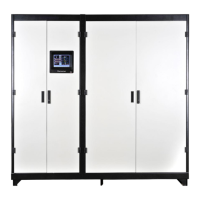
The STS has a front touchscreen display that can display the following information:
• A dynamic one-line mimic display, showing the active source-to-output path, bypass, and measurements
(See Figure 3, Operator Interfaces: Touchscreen Display and Redundant Operator Interface)
• Setup and configuration settings
• Administrative and operational controls
• Alarm Log and Event Log
• AC wave form capture for transfer events or displaying the current wave structure
• Digital and Analog Points (Modbus registers)
• Voltage and current measurements for input sources and output load
• Harmonics for both voltage and current
• Load trending
11..66..22 OOppeerraattiioonnaall AAssssiissttaannccee
• The Voice Unit annunciates alarms (“Static switch, new alarm”) and cleared alarms at the unit and
provides operator cautions (“You are not authorized for this function”).
• The Help function provides both text and voice-over instructions to guide operators through transfer tasks
for going to Bypass Mode and returning from Bypass to Normal Mode. The instructions are context-
specific, providing information for transfers appropriate to the current STS source-to-output connections.
11..77 SSyysstteemm SSeeccuurriittyy
The STS 2000A is designed for mission-critical environments and has security features appropriate to that
environment:
• The administrator assigns each user a unique Personal Identification Number (PIN) associated with an
access level, such as administrator or operator, determining what actions the user can perform.
• A PIN and password are required to login.
• No changes to system parameters or STS operation can be made through the touchscreen Monitor
without a valid user login, and no changes at all can be made remotely via web access.
• Only one user can be logged in at a time. The Event Log records and time-stamps the user’s login,
changes to parameters or actions while the user is logged in, and the user’s logout.
• Doors require a key to be opened, controlling access to the MCCBs/MCSWs, ROI, and components.
• When an STS font door is opened, the unit alarms and the alarm is logged into the Event Log.
System Description




 To Next Page