Appendix B: Transmitter Installation
iConnect Installation Manual
104
home, so they can wake the occupants in time for them to escape. A single smoke alarm will provide some protection if
it is properly installed, but most homes will require two or more to ensure that a reliable early warning is given. For
recommended protection, you should put individual smoke alarms in all the rooms (apart from the kitchen, where heat
alarms should be used) where fire is most likely to break out.
The smoke alarm should be located between the sleeping area and the most likely sources of fire (living room or
kitchen for example). But it should not be more than 10 paces (7.5m) from the door to any room where a fire might start
and block the occupants escape from the house.
Single-Story Dwellings
If the home is on one level (a bungalow or mobile home for example) you should put the smoke alarm in a corridor or
hallway between the sleeping and living areas – see Figure B- 15. Place it as near to the living area as possible, but
make sure you can hear it loudly enough to wake those in the bedroom.
If the premises are very large and the corridor or hallway is more than say 20 paces (15m) long, one smoke alarm will
not be sufficient. This is because no matter where it is located it will be more than 7.5m from potential fires.
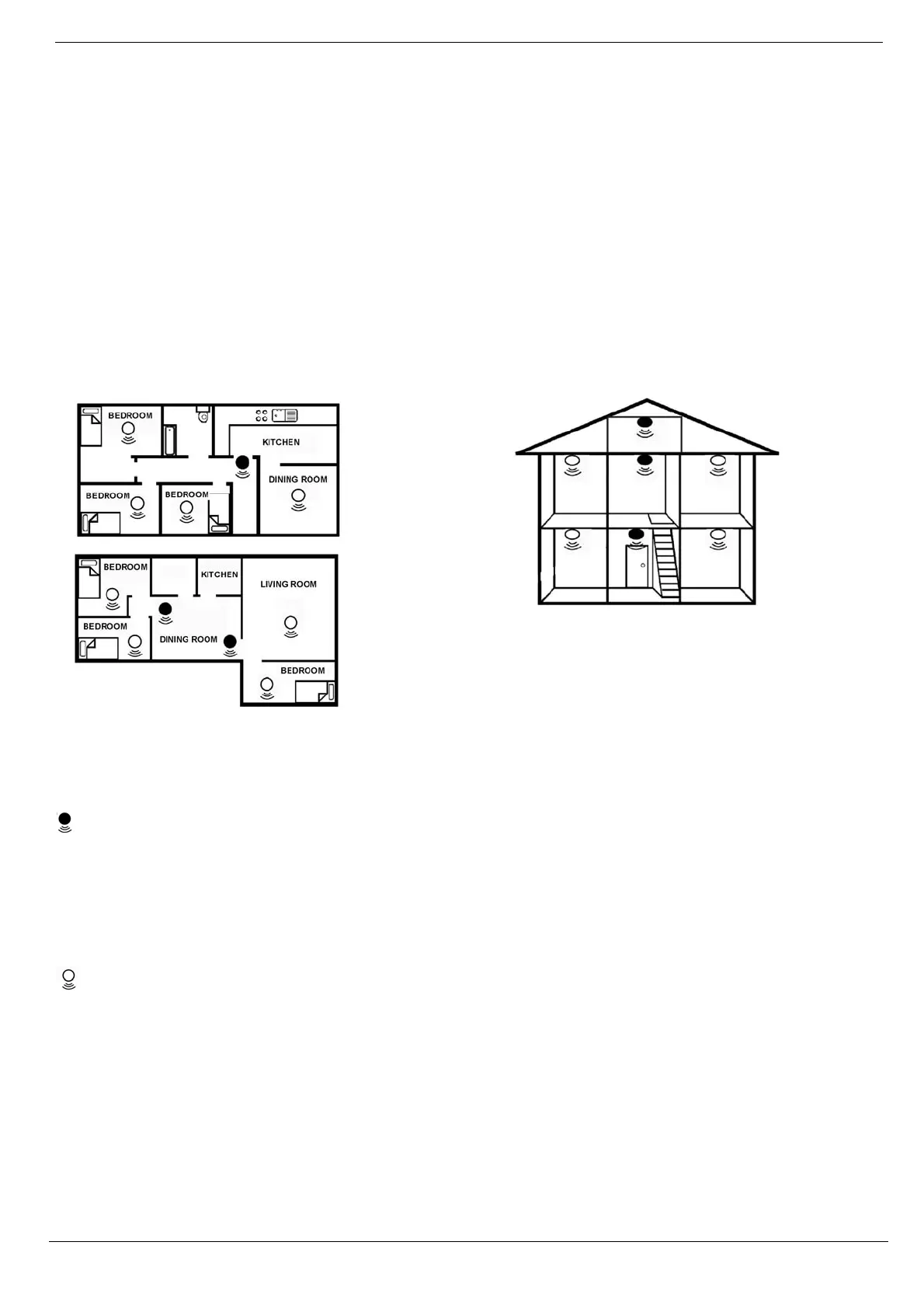
The recommended locations for installation are shown in Figure B- 15 and Figure B- 16.
Figure B- 15: Single Story Dwelling (above) & Single Story
Dwelling with Separate Sleeping Areas (below)
Figure B- 16: Multi-Story Dwelling
For minimum protection:
On each story
In each sleeping area
Every 7.5 meters of hallways & rooms
Within 3 meters of all bedroom doors
All units interconnected
For recommended protection (additional detectors):
In every room (except bathrooms and kitchens)
In houses with more than one sleeping area, Smoke Alarms should be placed between each sleeping area and the living
area – see Figure B- 15.
Multi-Story Dwellings
If the home has more than one floor, at least one alarm should be fitted on each level – see Figure B- 16.
Recommended Protection
Fire authorities recommend you put individual smoke alarms in or near all the rooms where fire is most likely to break
out (apart from the locations to avoid, mentioned below). The living room is the most likely place for a fire to start at
night, followed by the kitchen and then the dining room. You should also consider putting smoke alarms in any


 To Next Page