Appendix B: Transmitter Installation
iConnect Installation Manual
107
Warning Do not test with flame! This can set fire to the alarm and damage the house. It is not recommended
to test with smoke as the results can be misleading unless special apparatus is used.
Test/Hush Button
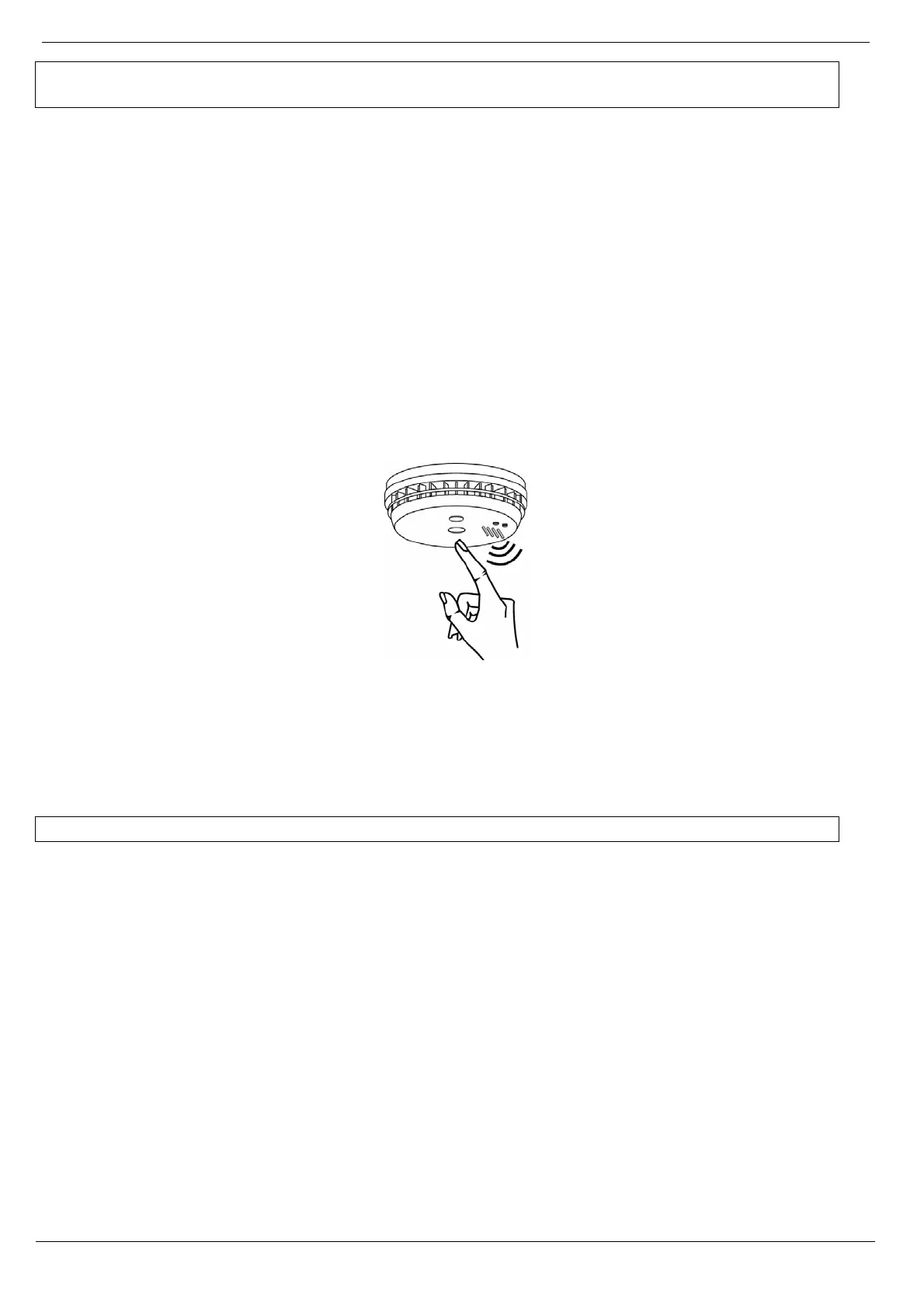
The smoke alarm has a combined test/hush button that allows you to silence the alarm in the event of a false alarm.
If, when the alarm goes off, there is no sign of smoke, heat or noise to indicate that there is a fire, the premises should
be evacuated before investigating the cause of the alarm. The premises should be checked carefully in case there is a
small fire smouldering somewhere. False alarms can be caused by smoke or fumes, for example cooking fumes being
drawn past the smoke alarm by an extractor. . If the cause of the alarm is not clear, it should be assumed that it is due to
an actual fire and the dwelling should be evacuated immediately. If there are frequent false alarms, it may be necessary
to re-locate the unit away from the source of the fumes.
To silence the alarm in the event of a false alarm:
1. Press the test/hush button. The alarm will automatically switch to a reduced sensitivity condition. This
condition allows unwanted alarms to be silenced for a period of approximately 10 minutes. The red
light will flash every 10 seconds (instead of 40 seconds) to let you know the unit has been silenced.
2. The unit will reset to normal sensitivity at the end of the silenced period. If additional silenced time is
required, simply push the test/hush button again.
Figure B- 20: Testing the Smoke Alarm
Cleaning the Smoke Alarm
Clean your Smoke Alarm regularly. Use a soft bristle brush or the brush attachment of your vacuum cleaner to remove
dust and cobwebs from the sides and cover slots where the smoke enters. Keep cover closed while cleaning. Do not
vacuum or brush inside the smoke alarm.
Warning: Do not paint the smoke alarm!
Other than the maintenance and cleaning described in this leaflet, no other customer servicing of this product is
required. Repairs, when needed, must be performed by the manufacturer.
Automatic Self-Test
The smoke chamber automatically tests itself every 40 seconds. If the chamber is degraded it will beep without the red
light flashing at the same time. If this happens clean the unit. If the beeping persists and the beep does not coincide
with a red light flash, replace the unit.
Dust & Insect Contamination
All Smoke Alarms and particularly the optical (photoelectric) type are prone to dust and insect ingress which can cause
false alarms.
The latest design, materials and manufacturing techniques have been used in the construction of our Alarms to
minimize the effects of contamination. However it is impossible to completely eliminate the effect of dust and insect
contamination, and therefore, to prolong the life of the smoke alarm you must ensure that it is kept clean so that excess
dust does not build up. Any insects or cobwebs in the vicinity of the smoke alarm should be promptly removed.
In certain circumstances even with regular cleaning, contamination can build up in the smoke-sensing chamber causing
the alarm to sound. If this happens the alarm must be replaced. Contamination is beyond our control, it is totally
unpredictable and is considered normal wear and tear. For this reason, contamination is not covered by the guarantee.


 To Next Page