6.2 Wired M-Bus slave port
The wired M-Bus slave interface of the product is used to read data received from wireless M-Bus slaves
and also to read/write configuration of the CMeX50 product.
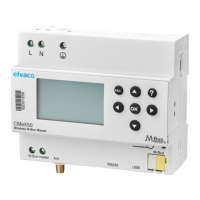
There are four ports available on the CMeX50: IR-interface, RS232, USB and M-Bus slave port. All ports
have the same application layer functionality.
6.2.1 M-Bus product identification
The product can be identified by the following information:
• Manufacturer string = ELV
• Medium = 0x31 (OMS MUC)
• Generation = 01-09
The Generation field between product releases will only change (increase by 1) if the M-Bus protocol
information changes between versions. Use the software version field in the M-Bus telegram to identify
the current software version.
6.2.2 M-Bus addressing
The product can be addressed using primary or secondary addressing. The secondary address of the
product is by default set to the serial number of the product. The secondary address and primary address
can be changed on demand using the display or by issuing standard M-Bus commands.
The connected wireless M-Bus slaves are addressed by primary and secondary address. The primary
address of the connected slave can be changed, but not the secondary address which is taken from the
wireless M-Bus telegram information received from the meter.
Connected wireless M-Bus slaves can also be read using enhanced secondary addressing, which is used
when multiple CMeX50 exist on the same 2-wire M-Bus and the same wireless M-Bus slave resides on
more than one CMeX50. This avoids possible multiple secondary addresses used on the same 2-wire M-
Bus.
6.2.3 M-Bus baud rate
The product can handle 300, 600, 1200, 2400, 4800 and 9600 baud. No auto-baud detection is available.
The baud rate can be changed using M-Bus standard commands. Default baud rate is set to 2400 baud.
6.2.4 M-Bus break
M-Bus master break signals are handled according to the M-Bus standard. Any on-going communication
from M-Bus slave to master will be aborted on break detection from the M-Bus master.
6.2.5 Collision handling
The CMeX50 will generate a break and garbage data and send to the requesting M-Bus master on a
collision between virtualized slaves and/or the CMeX50. In this way the installed M-Bus slaves will behave
like any other normal wired M-Bus installation.
6.2.6 FCB-bit toggling (multi-telegram)
Multi-telegram mode, or FCB-bit toggling, is implemented in the product. By toggling the FCB bit with FCV
bit set, the CMeX50 will reply with the following information:
Telegram 1: Configuration and status of the CMeX50
Telegram 2..n: Information and status of connected wireless M-Bus slaves


 To Next Page