17
Reference Manual
00809-0100-4026, Rev HA
Section 2: Transmitter Overview
November 2014
Transmitter Overview
Table 2-4. Model and Antenna Guide
Model and antenna guide
5402 5401
This table gives guidelines on which
model and antenna to select, depending
on application.
G = Good
AD = Application Dependent (consult
your local Emerson Process
Management representative)
NR = Not Recommended
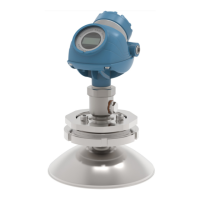
Cone (preferred) Process seal Cone (preferred) Rod
Best choice for a
broad range of
applications, free
propagation and pipe
installations.
Ideal for small tanks
and corrosive
applications. Also good
for heavy antenna
condensation/build-up.
Suitable for some
extreme process
conditions.
Suitable for small
process connections,
and corrosive
environment.
Tank considerations
Installation close to smooth tank wall G G G G
Multiple units on the same tank G G G G
Internal obstructions, directly in path
(1)
NR NR AD AD
Internal obstructions, avoidance
(1)
(1) The obstruction should not be within the radar beam. Preferred choices due to more narrow radar beam: Model 5402, and cone antenna.
G G NR NR
Beam angle 2” 19°
3” 14°
4” 9°
2” 19°
3” 14°
4” 9°
4” 37°
6” 23°
8” 17°
37°
Antenna extends below nozzle G G G G
Antenna recessed in smooth nozzle up to
6 ft (2 m)
GG NR
(2)
(2) If tall nozzle, use extended antenna.
NR
(3)
(3) The active part must protrude beneath the nozzle.
Antenna recessed in nozzle with
irregularities, such as bad welds
AD
(4)
(4) An extended cone antenna must be used.
AD AD
(4)
NR
(3)
Stilling well mounting G 2”- 4” pipe G 2”- 4” pipe G 3”- 8” pipe NR
Valves G G NR NR
Long ranges (>115’ / 35 m) NR NR NR NR
Cleanability of antenna AD G AD G
Process medium characteristics
Vapor (light, medium) G G G G
Vapor (heavy) NR AD G G
Condensing vapor/product build-up
(5)
(5) Build-up can often be avoided or reduced by using heat-tracing or cleaning arrangements.
AD G G AD
Boiling/Turbulent surface (low/medium) G G G G
Boiling/Turbulent surface (heavy) AD AD G
(6)
(6) Use a 6 or 8 in. (150-200 mm) cone antenna.
NR
Boiling/Turbulent surface (still-pipe) G G G NR
Foam
(7)
(7) Foam can either reflect, be invisible, or absorb the radar signal. Pipe mounting is advantageous since it reduces the foaming tendency.
NR NR AD AD
Foam (still-pipe)
(7)
GG GNR
Corrosive products (options available) G
(8)
(8) Other wetted material options include Alloy C-276 and Alloy 400. See the Rosemount 5400 Series Product Data Sheet (Document No. 00813-0100-4026) for details.
G
(8)
G
(8)
G
Materials with very low dielectric G G G AD
Changing density/dielectric/pH/
pressure/temperature
GG GG
Coating/viscous/crystallizing liquids G G G G
Solids, granules, powders G NR NR NR


 To Next Page
 Loading...