IP Server 900 Programming Manual Function 3: Station programming
F.42
Location Key
To facilitate dialing into a remote Esi-Link location, you may assign (700–799) a programmable feature key as
a Location Key. When you press a Location Key, you’ll hear dial tone; you can then dial any extension,
department, mailbox, or outside line group access code
1
in the remote location.
A remote location’s extensions, mailboxes, and departments may also be programmed by entering the
location number (700–799) followed by the number of the extension, mailbox, or department. However, the
system must detect the remote location’s numbering plan before the keys can be assigned. This detection
occurs automatically when the systems are physically connected via Esi-Link.
ESI phone overlays
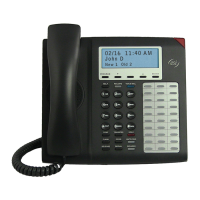
Each ESI desktop phone comes with one overlay for the programmable feature keys. To order additional
overlays, visit the DESI
™
Web site, www.desi.com. While there, you may also want to download the free
Windows-based software, DESI Lite, which allows you to print on the overlays. For assistance with DESI
products, contact DESI (the DESI Web site contains contact information).
Tip: Remember that IP Server 900 Web ESI System Programmer also lets you print on the overlays as well
as perform many other programming tasks.
Feature keys
Feature keys, as listed here, cannot be programmed system-wide but must be programmed for each
individual station. Refer to “Feature key chart” (page F.44) for specific availability by ESI phone model.
Please note that, unlike with previous ESI systems, you must enter a # before each code (except for 599).
• Manual day/night mode (Code #560) — Allows manual setting of the system’s mode — day, night, day2,
night2, holiday or auto (in auto mode, the system follows the day/night mode tables you have programmed).
2
Note: You or the Administrator can also change the mode and/or re-record the holiday greeting remotely to
handle unexpected closings, such as for inclement weather.
• Service observing (Code #561) — Allows authorized users to monitor others’ calls silently (e.g., in order
to aid in quality assurance of call activity).
Note: You or the Administrator must authorize service observing for a station, and you must program the
list of allowed extensions in Function 32 (page F.23).
• ACD agent log-on/off key (Code #5DDD) — Logs an agent on or off the ACD. The DDD represents the
department number (for example, a key programmed with the code # 5 2 9 0 would log an agent on/off
Department 290). Automatically assigned to the lower-left programmable feature key when the station is
listed as an ACD department member (see the “Department list” step on page F.33), it can be moved to
any other available programmable key.
• ACD agent wrap key (Code #562) — Toggles “wrap mode”; i.e., keeps a logged-in ACD agent from
receiving the next assigned call. For use in performing “wrap-up” activities, such as completing
paperwork, following the agent’s most recent call.
• ACD administrator key (Code #563) — Allows a user to view the call activity of an ACD group. Set a
programmable feature key with # 5 6 3 and the ACD department number (for example, # 5 6 3 2 9 0), and
then press the key. It will glow green and the bottom line of an ACD group's display will appear until you
press the key again. Up to eight ACD administrator keys can be programmed per department.
• Headset key (Code #564) — Provides for easy connecting to/disconnecting from calls when the user is
operating in headset mode. The user presses the key to receive dial tone or to answer a ringing call;
he/she then presses the key again (or RELEASE) to disconnect from the call.
• Call forward key (Code #565 or #565XXX) — Toggles call forwarding on and off. If the user always
forwards to the same extension, you (or the user) can program a key with both # 5 6 5 and the extension
number.
1
Depending on the assignment of Function 164.
2
If tenant service (Function 169) is enabled, using this key will set the mode of only the tenant to which the station is assigned.


 To Next Page