IP Server 900 Programming Manual Function 2: CO line programming
E.37
Function 24: Caller ID programming
This function activates the Caller ID capability in an IP Server 900 — if the customer has ordered Caller ID
service from the Telco. The system will display the caller’s name (or “out-of-area,” etc.) for incoming calls or
messages (or show the Caller ID number if the CO only provides a number).
Default: Disabled.
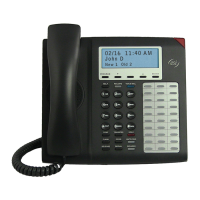
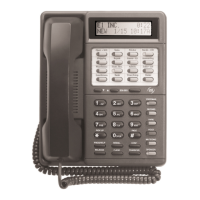
Esi-Dex and auto callback — This is accomplished by pressing FLASH/RDL (or FLASH on certain legacy
phones) or ESI-DEX either during message playback or after an Esi-Dex search. Caller ID numbers received from
the CO are 10 digits long (and include the area codes for local calls). In auto callback, the system assumes all
calls are to be long distance and will automatically add a “1” prefix to the 10 digits to be dialed.
A table of local area codes can be programmed to indicate that calls to those area codes that are to be dialed as
local calls. Select one of the following two types of local dialing for each area code entered:
• Local 7 — Local calls that can be dialed only as seven-digit numbers (the system strips the area code before
dialing and will not add a “1” prefix).
• Local 10 — Local calls that can be dialed only as 10-digit numbers (the system will not add a “1” prefix).
Maximum area code entries: 16.
For an area code that can be called as a long distance number (with a “1” prefix) and as a local number (10 digits
without a prefix), decide which case is the more prevalent and then add to or exclude from the area codes
exception list accordingly. Thus, some of these calls must be made manually.
Notes: Since the Caller ID information is transmitted from the CO during the silence between the first and second
rings, enabling this feature will delay the answer of inbound calls until the second ring.
ESI Caller ID works with only the standard ring cycle — two seconds on, four seconds off.
Analog stations cannot use the auto-callback feature.


 To Next Page