IP Server 900 Programming Manual System programming: An introduction
C.2
Entering alphanumeric characters
You enter names for extensions, departments, branch IDs, CO lines, guest mailboxes and DIDs by
pressing the dial pad key that corresponds to the character to be entered. The key’s possible entries will change
each time the key is pressed, and the display will show this. When the desired character appears on the display,
press # to confirm; the cursor will move to the next character position. You may move the cursor left (to correct
an entry) by pressing the left scroll key () or move right (to add a space) by pressing the right scroll key ( ).
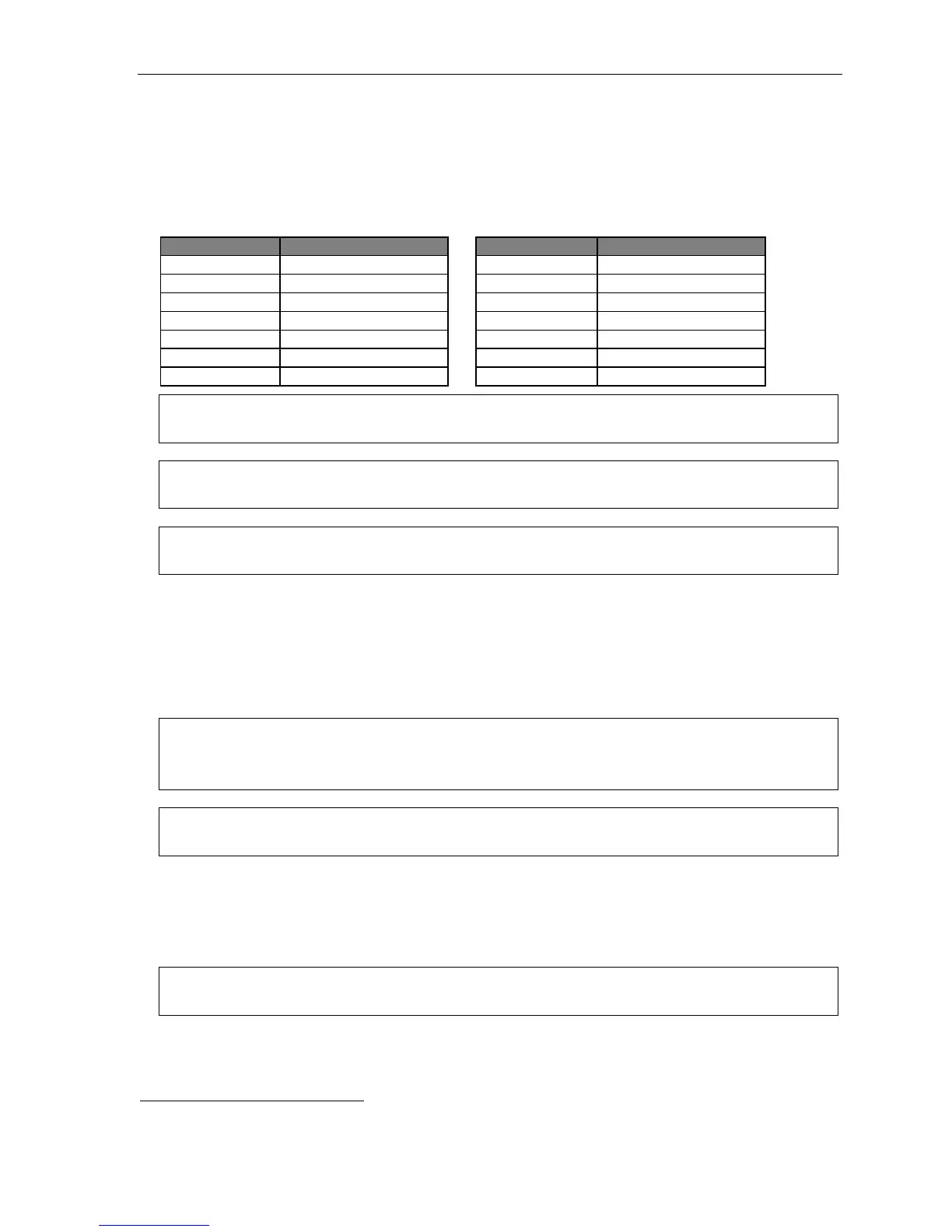
Key Options Key Options
0 0, - (hyphen), _ (underline) 7 P, R, S, p, r, s, 7
1 Q, Z, q, z, 1, “_” (space) 8 T, U, V, t, u, v, 8
2 A, B, C, a, b, c, 2 9 W, X, Y, w, x, y, 9
3 D, E, F, d, e, f, 3 (left scroll key) Backs up and erases
4 G, H, I, g, h, i, 4 (right scroll key) Adds a space
5 J, K, L, j, k, l, 5 # [Enter]
6 M, N, O, m, n, o, 6 # # Ends the name
Important: Lower-case letters are available only for programming the settings for Function 2142 (p. E.18) and
Function 823 (page L.7).
Example: To enter a B, press 2 twice (the possible options to scroll through are A, B, C, a, b, c, and 2). When B appears,
press # to confirm; the cursor will move to the next character to be entered. To complete the name, press # #.
Note: On an incoming call, the name you assigned to the call’s CO line or DID — rather than the Caller ID data —
will appear until the call is answered.
Selectable numbering plan
The IP Server 900’s selectable numbering plan offers up to nine pre-configured ranges — three three-digit plans
and six four-digit plans. When an extension range is selected, department numbers and guest mailbox numbers
are also changed. However, regardless of which extension range is selected, feature key codes, and CO line
group access numbers will stay the same. The dial plan range is selected through Installer programming
Function 169 (see page D.11 for more information).
Notes: The ESI Presence Management RFID Reader
1
uses one digital or IP extension, regardless of dial plan.
An ESI desktop IP phone, the IP Cordless Handset (Local or Remote), VIP 7 Softphone, and a SIP phone
each uses one IP port, regardless of dial plan.
Important: Full capacity on the IP Server 900 can be achieved only by using a four-digit plan. (See “System
capacities,” page B.1.)
Line groups
The numbers 9, 8, and 71–76 are designated as line groups. A line group is, as the name implies, a specific
group of lines in a key system that are used for making outgoing calls. In an IP Server 900, line groups give
phones access to outside lines without taking up any programmable keys on each phone.
Note: Line groups 71–76 may conflict with Esi-Link locations 710–769 (if they’re needed); refer to Function 164
(see page D.7).
1
For more information, see the ESI Presence Management Installation Manual (ESI # 0450-0792).


 To Next Page