
 Need help?
Do you have a question about the Fusion3 F410 and is the answer not in the manual?
Safety warning against operating the 3D printer without supervision to prevent damage or fire.
Identifies components that reach high temperatures and can cause burns during operation.
Alerts users to the risk of electric shock from internal components if service doors are removed while powered on.
Instructions to keep all packaging materials for potential future shipping or returns.
Guidance on safe lifting and handling of the 3D printer, emphasizing it's a two-person lift.
Requirements for a stable and sturdy surface to place the F410 printer on, considering weight and vibration.
Specifies the recommended ambient temperature and environment for optimal printer operation.
Details about the printer's power consumption, voltage requirements, and electrical safety precautions.
Information on connecting the printer to a local network via Ethernet for remote monitoring and control.
Directs users to separate guides for setting up the Simplify3D software with the printer.
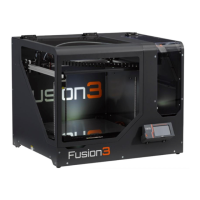
Diagram and labels identifying components visible from the front of the F410 printer.
Diagram and labels identifying components visible from the right side of the F410 printer.
Diagram and labels identifying components visible from the back of the F410 printer.
Detailed view and labels of the filament bay area, including spool holder and tracks.
Close-up view and labels of the extruder's cold end, showing filament path components.
Illustrates the printer's build volume and the axes (X, Y, Z) used for printing.
Detailed view and labels of the print head assembly, including cooling and filament feed.
Overview of the F410's touchscreen interface, its main areas, and navigation.
Instructions on how to access the printer's web interface using a browser and its default address.
Description of the web interface's layout, tabs, and general functionality.
Guide on modifying website name, login password, and network settings via the config.g file.
Lists compatible web browsers for accessing the printer's web interface.
Provides links to external resources like video libraries and tutorials for Simplify3D software.
Offers recommended links for learning the basic interface and operations of Simplify3D.
Explains how Simplify3D uses processes and profiles for material and nozzle size settings.
Guides users on importing, selecting, and managing Simplify3D profiles for optimal printing.
Discusses how Simplify3D provides estimates for print time and material usage, with a note on accuracy.
Details how to generate and manage breakaway support structures within Simplify3D for complex prints.
Explains the use of .factory files to save and reopen print configurations, models, and support structures.
Addresses common issues like printing small or large parts and STL file problems.
Emphasizes matching the correct Simplify3D profile to the installed print head size for accurate printing.
Instructions for safely opening and closing the printer's main and filament doors.
Covers the two workflows for running a print: physical setup and software preparation.
Guidance on how to safely remove completed prints from the print bed for various materials.
Explains the printer's bed leveling systems (manual and auto) and how to achieve optimal results.
Step-by-step instructions for loading filament into the printer, accommodating various spool sizes.
Procedure for safely unloading filament from the print head and extruder.
Instructions for changing filament before or during a print job.
Guidance on cleaning the print bed using only tap water to ensure proper adhesion.
Steps for applying glue stick to the print bed for optimal print adhesion, with material-specific notes.
Instructions on safely manually moving the printer's axes when the printer is powered on.
Details how to pause, resume, and cancel active print jobs from the control panel.
Importance and methods for proper filament storage to maintain quality and prevent issues.
Guidelines for storing filament in sealed bags with desiccant or in actively dried chambers.
Discusses the impact of moisture on different filament types and sensitivity levels.
Explains how dust affects filament and print quality, and the printer's built-in wiper.
How to clean the exterior, windows, and bottom debris of the F410 printer.
Procedure for cleaning the underside of the print head to remove debris and molten plastic.
Ensures the print head's hot section is firmly threaded into the cold section for proper function.
Instructions for tightening the print head hot section to prevent filament oozing.
Checks for debris, gear lash, and correct spring preload in the extruder mechanism.
Guidance on inspecting and adjusting the preload of linear motion assemblies for smooth operation.
Ensuring proper tension and squareness of the XY drive cables for accurate movement.
How to modify printer parameters by editing the config.g file on the SD card.
Detailed steps for removing and installing the glass print bed and its components.
Procedure for safely removing and reinstalling the F410's print head assembly.
Instructions for replacing the conductive foil tape on the print bed corners.
Details on which parts require lubrication and the type of lubricant to use (white lithium grease).
Steps for removing and reinstalling the extruder assembly, including electrical connections.
Safety precautions and steps for accessing the printer's electronics bay.
Guides on identifying and correcting first layer height issues for successful prints.
Troubleshooting steps for common network and connectivity problems with the F410 printer.
Procedures for diagnosing and clearing filament jams in the print head.
 General
| Print Speed | up to 250 mm/s |
|---|---|
| Filament Diameter | 1.75 mm |
| Nozzle Temperature | up to 300°C |
| Bed Temperature | up to 140°C |
| Nozzle Diameter | 0.4 mm |
| Connectivity | USB, Ethernet, Wi-Fi |
| Supported Materials | PLA, ABS, PETG, Nylon, ASA |
| Power Requirements | 110V or 220V |
| Build Volume | 355 x 355 x 315 mm (14 x 14 x 12.4 in) |
| Frame | Aluminum |

 To Next Page

