To Next Page


M
michelle18Aug 31, 2025
How to fix dim characters on Getac Laptop screen?
- DDr. Benjamin Smith DVMAug 31, 2025
If the characters on the screen are dim, adjust the brightness and/or contrast.

How to fix dim characters on Getac Laptop screen?
If the characters on the screen are dim, adjust the brightness and/or contrast.
What to do if Getac X500 Laptop numeric keypad is disabled?
If the numeric keypad is disabled, make sure that the Num Lock is switched on. (Check if the Num Lock Indicator glows or not.)
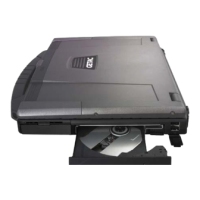
What to do if Getac X500 DVD drive cannot read a disc?
If the DVD drive cannot read a disc, make sure that the disc is correctly seated in the tray with the label facing up, that the disc is not dirty (clean it with a disc cleaning kit), and that the computer supports the disc or the files contained.
How to fix Getac X500 Bluetooth wireless technology connection?
To connect to another device with Bluetooth wireless technology, make sure that the Bluetooth wireless card is correctly installed and that both devices have activated Bluetooth feature. Also, ensure that the distance between the two devices are not over 10 meters or that there are no walls or other obstructions between the devices, that the other device is not in 'Hidden' mode, and that both devices are compatible.
What to do if no sound is produced by Getac Laptop?
If no sound is produced, make sure that the volume control is not set too low and that the computer is not in Sleep mode. If using an external speaker, make sure that the speaker is properly connected.
How to speed up slow hard disk drive operations on Getac X500 Laptop?
If the hard disk drive operations on your Getac Laptop seem slow, use a tool such as Window’s Disk Defragmenter to defragment the files.
What to do if Getac X500 stops after POST?
If your Getac Laptop stops after POST when you turn it on, reset your computer.
What to do if my Getac X500 does not respond when turned on?
If you turn on your Getac Laptop and it does not seem to respond, make sure that either the AC adapter is connected or the battery has power. For models with the 'HDD preheat' feature, the computer will heat up the hard disk in extremely low temperatures. If external AC power is unavailable and the remaining battery power is too low, the computer may not start up. Turn off the computer and leave it at room temperature for about an hour before trying again.
What to do if nothing appears on the screen of my Getac Laptop?
If nothing appears on the screen of your Getac Laptop, the screen may have automatically turned off due to power management. Try pressing any key to see if the screen comes back. Also, the brightness level might be too low, so increase the brightness. Finally, the display output might be set to an external device; press the Fn+F9 hot key or change the display through the Display Settings Properties to switch it back to the LCD.
How to fix a Getac Laptop that is not charging?
If your Getac Laptop battery is not charging and the battery charge indicator does not light amber, ensure the AC adapter is properly connected. Also, the battery might be too hot or cold; allow it time to return to room temperature. If the battery doesn't charge after being stored in very low temperatures, try disconnecting and reconnecting the AC adapter. Ensure the battery pack is correctly installed and that the battery terminals are clean.
Guide to initial setup and getting the computer operational.
Instructions for powering the computer using the AC adapter.
Procedures for powering the computer on, off, and using sleep/hibernate modes.
Identification of the computer's front-facing components and their functions.
Identification of the computer's rear-facing components and their functions.
Identification of the computer's right-side components and their functions.
Identification of the computer's left-side components and their functions.
Identification of the computer's top-open components (screen area) and their functions.
Details on keyboard layout, keys, and special functions for input.
Guide to operating the touchpad for cursor control and selection.
Instructions for using the touchscreen and multi-touch gestures for navigation.
Connecting the computer to a network using the wired LAN port.
Steps for connecting the computer to available wireless networks.
Installing SIM card and setting up 3G for mobile internet access.
Using the AC adapter for power and managing battery charging.
Configuring system power management for energy saving and performance.
Guide to accessing and navigating BIOS menus for system configuration.
Steps to restore the system to factory default settings using the recovery tool.
Overview of G-Manager for system, battery, ECO modes, and sensor configuration.
Initial steps and checks to perform before diagnosing computer problems.
Guidance for resolving typical issues with battery, Bluetooth, display, and sound.
Diagnosing problems with DVD drive, ExpressCard, hardware devices, and LAN.
Troubleshooting power management, software, startup, and WLAN problems.
Procedures for rebooting or resetting the computer when it freezes.
 General
| Form factor | Clamshell |
|---|---|
| Product type | Laptop |
| Product color | Black |
| Housing material | Magnesium |
| Panel type | TFT |
| Touchscreen | - |
| LED backlight | Yes |
| Display diagonal | 15.6 \ |
| Native aspect ratio | 16:9 |
| Internal memory type | DDR4-SDRAM |
| Maximum internal memory | 64 GB |
| SSD capacity | The Solid State Drive's storage capacity in Gigabytes. |
| Storage media | HDD+SSD |
| Optical drive type | DVD Super Multi |
| Total HDDs capacity | 500 GB |
| Total SSDs capacity | 1000 GB |
| Total storage capacity | 1500 GB |
| Number of HDDs installed | 1 |
| On-board graphics card ID | 0x591B |
| On-board graphics card model | Intel® HD Graphics 630 |
| On-board graphics card family | Intel® HD Graphics |
| On-board graphics card OpenGL version | 4.4 |
| On-board graphics card base frequency | 350 MHz |
| On-board graphics card DirectX version | 12.0 |
| On-board graphics card dynamic frequency (max) | 1100 MHz |
| Battery voltage | 10.8 V |
| Battery capacity | 8700 mAh |
| AC adapter power | 150 W |
| AC adapter frequency | 50 - 60 Hz |
| AC adapter input voltage | 100 - 240 V |
| Cable lock slot type | Kensington |
| Antenna type | 2x2 |
| Wi-Fi standards | 802.11a, 802.11b, 802.11g, Wi-Fi 4 (802.11n), Wi-Fi 5 (802.11ac) |
| Top Wi-Fi standard | Wi-Fi 5 (802.11ac) |
| Ethernet LAN data rates | 10, 100, 1000 Mbit/s |
| Storage temperature (T-T) | -40 - 71 °C |
| Operating temperature (T-T) | -20 - 55 °C |
| Operating relative humidity (H-H) | 0 - 95 % |
| Certification | MIL-STD-810G, MIL-STD-461G |
| Charging port type | DC-in jack |
| USB 2.0 ports quantity | 0 |
| Ethernet LAN (RJ-45) ports | 2 |
| USB 3.2 Gen 1 (3.1 Gen 1) Type-A ports quantity | 4 |
| Keyboard layout | QWERTY |
| Pointing device | Touchpad |
| Operating system architecture | 64-bit |
| Bus type | DMI3 |
| Tjunction | 100 °C |
| Processor cache | 8 MB |
| Processor model | i7-7820HQ |
| System bus rate | - GT/s |
| Processor family | Intel® Core™ i7 |
| Processor series | Intel Core i7-7800 Mobile Series |
| Processor threads | 8 |
| Processor codename | Kaby Lake |
| Processor frequency | 2.9 GHz |
| Processor cache type | Smart Cache |
| Configurable TDP-down | 35 W |
| Processor lithography | 14 nm |
| Processor manufacturer | Intel |
| PCI Express slots version | 3.0 |
| Processor boost frequency | 3.9 GHz |
| PCI Express configurations | 1x16, 1x8, 2x4, 2x8 |
| Thermal Design Power (TDP) | 45 W |
| Maximum number of PCI Express lanes | 16 |
| Processor ARK ID | 97496 |
| Processor package size | 42 x 28 mm |
| Supported instruction sets | AVX 2.0, SSE4.1, SSE4.2 |
| Intel Identity Protection Technology version | 1.00 |
 Weight and Dimensions
| Depth | 320 mm |
|---|---|
| Width | 410 mm |
| Height | 65 mm |
| Weight | 5200 g |